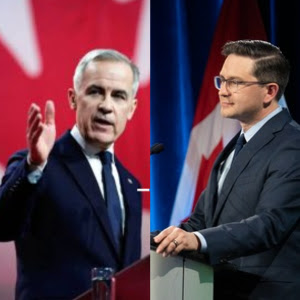
The new budget comes November 4 and the final vote on it comes a few weeks after. It is a confidence vote. If all the parties vote against it and there are no abstentions or people absent from the House, it is an automatic election before Christmas. An election is not an idle thing to dismiss. In 1979, the Progressive Conservative government of Joe Clark was defeated six months after being elected in a confidence vote. Pierre Trudeau and the Liberals one again became the government.
Wednesday, November 5, 2025
Election 2025?
The new budget comes November 4 and the final vote on it comes a few weeks after. It is a confidence vote. If all the parties vote against it and there are no abstentions or people absent from the House, it is an automatic election before Christmas. An election is not an idle thing to dismiss. In 1979, the Progressive Conservative government of Joe Clark was defeated six months after being elected in a confidence vote. Pierre Trudeau and the Liberals one again became the government.
Tuesday, May 13, 2025
The Future of Canada
To be fair, twinning of Trans-Canada to Ontario is going through the planning stages now and we'll need those east-west corridors even more. However, it shows what our priorities have been. It has been those north/south road, rail routes, pipelines and airport connections all focused on the States. There have been a few projects to enhance other economic routes such as Trans-Mountain Pipeline, the railway to Churchill, Trans-Canada Highway improvements and LNG projects.
Alberta has been focused on pipeline projects headed south but that always results in discounted oil prices. Neither Trump or Biden got pipeline projects approved. Harper didn't either. Trudeau actually got an expensive one built but probably got no benefit from it in Alberta. For that province though, it is the best paying oil pipeline the industry has. Funny, how that goes. The Trans-Mountain Pipeline has been selling higher priced oil than anything shipped through southern pipelines. Given the costs of the line, even if western pipelines were approved, it is possible companies would be hesitant due to the enormous costs. Most are shying away even though most think tanks keep saying give the private companies the freedom. Most won't commit even if all restrictions are gone. The costs of infrastructure, labour and supplies are high.
Manitoba has decided not to re-new a hydro energy deal with U.S. company Northern States Power. Part of this is to ensure the province has capacity but also for exports to western provinces and the north. With federal help, hydro can be extended all the way to Nunavut. To that end, the premiers of Manitoba and Nunavut have signed an agreement to get this work done. This is a project of national importance and sovereignty. It is a $1.6 billion project to connect five communities in the north to Manitoba Hydro. Some infrastructure would be built in Manitoba and quite a lot in Nunavut. It is no doubt one of the biggest nation building projects west of Ontario.
Most oil industry people now believe pipelines going east are now too costly. This is why the premier of Manitoba Wab Kinew has proposed a second port on the Hudson Bay to the European delegation at Port Nelson. A second port site runs more along solid ground than Churchill does and avoid beluga areas. There is more silt to dredge than at the deepwater port at Churchill. This isn't as out of the question as it sounds. Dredging is regularly done at ports around the world such as San Francisco Bay.Sunday, April 27, 2025
The Healing Election Speech for Canada
What a night. It is with great humility that I take on the task of this great enterprise we can call Canada. I couldn't have done this alone and I thank my family and my party that helped and guided me from coast to coast to coast. We have elected MPs in every part of the country, my friends, in places where we haven't had representatives in some time. It is a huge honour and a responsibility we take seriously. And we will not let the Canadian people down!
To all the candidates from all the parties, I thank you for committing to the great democratic process of Canada. I have spoken to my opponent in the election and wish him and his family well. His public service over the years deserves recognition and while we disagreed over policy, I wish him the best. Likewise, I extend my gratitude to the other opposition leaders tonight for their service.
(repeated in French)
The mandate we have received this evening from Canadians is a strong one. It is an expression of national unity that comes along at certain times in our history and it is one that Canadians have consistently answered. It is fair to say that external factors made us take a hard look at ourselves and we have risen to the occasion. Tonight's election results are proof of that!
The strong and cross country mandate means we go back to our nation's capital with both determination borne of national unity. We are not an artificial country as described by one individual. We are not a 51st state as said by another individual. We are a country bounded together by language, culture, business and 13 provinces and territories with common cause. One country, united and strong!
(repeated in French)
I know that when we return to Ottawa, we will have the support needed to respond to the challenges to our sovereignty. Our goals remain the same as what we campaigned on. We wish to unite the people and to thwart those that would try to annex us or break us a part in separation. To that end, I say to those that didn't vote for us: We have heard you and we won't let you down.
In the past, it was too easy for us to think we could tie ourselves to peace, security and prosperity with our southern partner. At home we have faced extraordinary challenges and continue to navigate through them. This has resulted in inflation, supply chain issues, tariffs and employment instability. What has been unexpected has been that our longtime friend and ally has targeted Canada in ways that they have not even done to long time rivals! We have defended ourselves in the past and we will do so in the present and in the future!
(repeated in French)
Canada's energy needs at home and exports abroad need to move through Canada. Eastern Canada relies on pipelines that go through the U.S. which makes the country vulnerable. Future pipelines south have not had much success through three administrations. The TMX pipeline built by the Liberal government has been the one that has helped the west along with the approved LNG plants on the coast. Oil will continue to be important to Canada until we improve renewables through infrastructure and technology.
To that end, we will be supporting east-west energy grids as well as ones extending north. We will be reaching out to our provincial and indigenous partners to make Canada independent for our own needs and to whom we sell to. And we will looking to do more carbon capture, accelerating tree planting (the ultimate things to remove carbon) as well as move to cleaner renewables through investment an technology. We can not let people suffer from loss of employment, living in poverty and depravation because of moves to cleaner energy. Nor can we let communities be consumed by fire, flood and loss of life due to inaction on climate. It will require balanced and caring approach and that is what you will see from this government!
(Repeated in French)
We have heard Canadians and will make housing, healthcare and affordability priorities. We have heard our allies and will commit to defense spending as well as purchasing it more at home and using our steel and aluminum. We are committed to our indigenous communities, the north and provinces from west to east. We will fulfill our obligation for a just and peaceful society based on law and convention. People need to know they are safe to live their lives and not fear crime will rob them of their right to live without fear.
We have a renewed sense of pride and purpose in Canada and we will make this journey together. All of us. Together!
(Repeated in French)
Lastly, while talk was of elbows up in the country, we always remember when it is at the end and all is said and done, we shake hands because that is the country we live in. (In French) Canada will be united and joyful about what who we are. (In French) Thank you, merci and good night. Thank you, merci, Canada!
Sunday, April 6, 2025
Poilievre vs Carney and Threat of Western Separation
Tuesday, March 11, 2025
Trump Speech to Congress
The 47th President addressed the 119th Congress at Capitol Hill in the longest speech in modern history. It was a combination of script and improvisation and very much a victory lap. The Democrats looked very much defeated and quite frankly, shabby. They wore shirts with messages, carried paddles with messages they kept flashing to the camera. At one point a Democrat had to be escorted off the floor as he was shouting at Trump.
Throughout the long speech, Democrats heckled and booed. At one time this was just not done. Now it is normalized. This is a reflection of the leaderless aspect of the Democratic party. Biden and Harris are out of sight. The minority leaders in the Senate and House of Representatives have been unable to show real leadership. The Democrats are rudderless with only brief example examples of policy and direction since their federal defeat.
Even in Canada in can be hard to be in opposition even though we have a formalized role for in our democracy. If the government has the majority, it can mean little coverage of opposition parties. Media often doesn't cover anyone except premiers and prime ministers. It isn't great for democracy as a leader-centric system means people are too scared to say anything even when it is clear that it will hurt the them.
This could be as true for Trudeau and it is for Trump. It is not even 100 day into the presidency but Trump changes positions sometimes a few times in a day. Trudeau is finished and a new prime minster will be in place. And that new leader will have the same powers as the old one. It is how our system has been set in place. Power used to be more diffuse.
Trump is very good at TV for the most part but his speeches can go on for quite a bit. He crafts himself as entertainment. His jabs at his opponents have been and always will be merciless. Republicans have largely gone silent or just let things happen. Some have tried to mimic his approach but it isn't something that other people have been able to translate into success.
Democrats sitting in the audience did a terrible job of sitting in opposition. Their dress, their paddles with slogans and constant shouting made them look like they were not ready to run a hotdog stand. Consider the professional appearance and demeanor the NDP in Manitoba had just prior to becoming government. They dressed and acted like a government in waiting. The policies were considered better than what the other side was proposing.
Being in opposition isn't easy. It requires ways to look relevant and oppose in meaningful ways. Some get attention with bluster and histrionics. It can help pull down your opponent but hurt your own likeability. It is unclear how Democrats will become relevant but when in doubt, focus on the economy. It is what worked for Clinton. And at the moment, the economy looks roughs and Trump is at the helm.
Saturday, November 9, 2024
U.S. Election Results and Canada
U.S. elections always seem surprising affairs. If Canadians voted in U.S. elections, we'd probably be like California: Largely Democratic with a few Republican enclaves. Most polls show Manitobans if the could vote in the U.S. would vote for Democrats. We don't get to vote though and it is why both government and oppositions usually keep fairly quiet because it is possible that either side might be who Canada has to deal with in the aftermath.
There is usually an assessment by both parties of what they did well and what did badly at in victory and defeat. They are often. Bill Clinton's adviser James Carville was right when he said: It's the economy, stupid. With Americans still feeling it with inflation, it just wasn't going to be some Harris could run on. And no matter what the economy was doing, it has been decades of fears about the border and immigration.
Trudeau was credited with managing good relations with Trump for quite some time when he was in his first term. With Trump you only have to stumble once though. A tweet from Trudeau on border issues was enough to raise the ire of the man who was once president and is now again. In the case of the U.S., it is often best not to be on the front pages. However, you also don't want to be forgotten or taken advantage of. Trump has said he will arrest Trudeau if President if he comes to the U.S.. It might be best to confirm that before travelling when Trump is 47th President. He did accept Trudeau's congratulations.
Generally, how Canada manages its relationship with the U.S. is largely the same whatever the party in power in Ottawa. Stephen Harper didn't try to lean into conservative politics south of the border as he does elsewhere in the world. Trudeau didn't lean into liberal politics with Trump most of the time. The focus was trade, defence and areas of mutual interest. The reason is that the relationship is too important to play games. Even the very least comment or media reference can sour the relationship. The best relationship is a professional one.
Canada has tried to have a diverse relationship covering state and federal elected officials. Civil servants, including appointed diplomats, political staff and family members, are also important. Trudeau's government was very good to reaching out to Trump's family. That might not be an option this time with Trump. It was Ivanka and Jared Kushner that Canadian officials worked with and they are not there this time. The same applies for Trudeau as well as he is separated and the leaders often bring their partners in travel.
It is unclear what diplomatic connections Poilievre has to Trump or Republican and Democrats both federally or in the states. He won't be able to handle it the way he handles domestic policies. Sloganeering, lack of forthright dealing with issues or being vague will not save a possible from Conservative government from retribution if they don't come up with a plan to get to 2% GDP on defence or end milk protection. On the bright side for Poilievre, he can possible end all federal work on carbon pricing. It is doubtful that he can do that on electric cars as the U.S. itself is pushing on that. Just ask Elon Musk.
Results in U.S. elections can take a long time. But the Senate was always going to be tough to keep for Democrats so that has swung Republican. The House of Representatives is a mystery till the end but probably a Republican win as well. A Trump win and Republican agenda will have a two year free reign till the mid-terms. No worries on a conservative dominated court either. There are plenty of Democrat run states.
Ukrainian military support probably ends and the U.S. could let Russia take over the country. The 40 million people in Ukraine might be on the run if they are cut off. In terms of Canadian policy, it will be interesting if our military support ends as well. A change in government might do that. It is unknown whether Poilievre will pull funding. What will less likely be tolerated by Liberal and Conservative voters in Canada is not helping Ukrainians who could be refugees. Expect a lot more if they are left few options.
The tariffs Trump proposed starting at 10% across the world could start a trade war not seen since the 1930s. There could be an element of bullying here for concessions but is likely going to see some businesses scrambling. China will take it on the chin but might think there is nothing to lose in taking Taiwan. Unless the U.S. is willing to use military might, Taiwan could end up along with Ukraine being taken over.
Russia itself could see sanctions drop. The U.S. might pull out of NATO or just have a president who doesn't care. It is possible he pulls support from Poland, Estonia, Lithuania and Latvia and other countries in Europe. No one knows for sure. However, Putin is likely to look at grabbing more territory and not face consequences. Russia probably sees a resumption of relations with the U.S.
For immigration, the push will be to deport those deemed illegal. That could be up to 11 million immigrants. However, we could see a real cooling of actual legitimate immigration into the U.S. as well. This could represent an opportunity for Canada for skilled people who are in the U.S. but no prospect for American citizenship in a timely way. It could mean Canada sees people fleeing the U.S. and coming across the border wherever they can in Canada.
If there is not a robust response in Canada to illegal immigration, it could mean hundreds of thousands crossing. The lack of planning on this could literally crush whoever is is in government in Canada. The Conservatives may wish they weren't in power if it happens on their watch. What would they do? Put Ukrainians in internment camps?
On health (including abortion), education and justice Canada should stay right out of the conversation. If Trump is president, they do what they want on those areas and we say nothing. Our system is completely different and so long as it doesn't affect us, it isn't our business. Our issues are mutual defence, border security (including migration) and trade above all other concerns. Defence will play a role too although we may have to rely on Britain, France, Japan, Korea and Germany a lot more.
We have increased our military pending quite a bit. It won't reach 2% till 2032 and that is probably not going to be good enough for the U.S. or our other allies. The Liberal caucus and cabinet are meeting and pushing to counter U.S. policy changes that Trump might bring. An acceleration of military spending may not be enough to avoid some sort of punishment. Likewise, there will be some in the new Trump administration looking to see if the Conservatives have a plan for a fast build up. Presently, they don't.
The first 100 days in 2025 of the Trump administration might have massive changes including to taxes. The Republican led Congress and Trump might looks to madly get things done. The Canadian Parliament will have to monitor carefully to see how it affects Canada directly and plan for what might happen in January. The tariff changes could be huge. Already in the U.S., some companies are cancelling their Christmas bonus as companies that buy foreign products for their business are adding the costs to how they run things.
Canada has tried to diversify it's markets many times. Our saw mills are built for the U.S. market and we only need about 30% of the wood products we harvest. The problem is that every time we try to expand to Asia, there are possible supply chain, logistics or political problems that crop up. Trade is up in China but the Chinese continue to have Canada at a lower tier of trade priority. India faces challenges as well. Canada depends on a rules based world. When rules are broken, we suffer.
Over the next months and years, the government of Canada whatever political party that is in power will have to come up with quick responses for policy changes. One of the very early ones could be the digital tax Canada has. Elon Mush and other tech billionaires are likely going to ask for punishing measures takes on Canada to allow unfettered access for Facebook and X and the end of tax and antitrust rules. The Conservatives have said they will get ride of these laws as well as the CBC. It begs the question of whether there will be any media or news in four years. All news outlets might not have sufficient supports to keep running.
It is possible new international agreements are in place on a digital tax but big companies are looking for a complete cease of tax or regulation. Trump might just do anything Elon Musk says. However, keep in mind that Musk believes in climate change and Trump doesn't. This could hurt Tesla. In fact, there are are some ferocious fights to get into the administration. The feeling is that this is where Republicans can change things for the next decades.
Could this change taxation in Canada? It is possible but the income and corporate lower taxes are often lower Canada so perhaps the U.S. just gets to Canadian standards. In any event, it will take a while for any of these changes to work their way through the legislative process as Trump will need Congress to get things passed.
It is clear that the U.S. election results means that Canada has to speed things up when it comes to inflation, cost of living and irritants that they'll want responded to. With Trump, it is unlikely we delay without punishment. The glacial pace of change could mean that pain last years.
Monday, July 8, 2024
How is it Britain Can Transition Government in One Day?
Monday, April 1, 2019
Canada Poll of Members of Parliament
In a poll of Canada's 338 members of Parliament, a varied list of questions was given to Canada's Members of Parliament on a wide range of topics and issues during the last week of March, 2019. A complete document of the responses is available on our website but the highlights of what was found are as follows:
Question: Do you believe Australia is a real country? 42 MPs believed that it wasn't real. 4 MPs believed it was in Europe and Adolph Hitler was born there.
Question: Do you believe Canada's economy is improving? 106 MPs believed their own personal finances had improved since they were elected. 2 MPs and formal cabinet ministers believed their own personal finances declined.
Question: Do you believe Canada's military is in a good state of readiness? 203 MPs believed that as long as other countries had aging equipment to buy, Canada would always be ready. 11 MPs wondered if the former submarines at West Edmonton Mall were still available.
Question: Do you personally ensure you and your family are vaccinated? 338 MPs said they did because they didn't want to get autism from the general public.
Question: Is a life in Ottawa hard on your relationships? 144 MPs said what their partners didn't know, wouldn't hurt them. 1 former MP and present premier said: what did he know...he lives in his mom's basement.
Question: What is Canada's national sport? 334 MPs replied Timmies. 2 MPs said Lacrosse. 2 MPs said Cricket.
Question: Has Canada leaned anything from Truth and Reconciliation? 338 MPs all agreed that there is no reconciliation in truth and no truth in reconciliation.
Question: Does 24 Sussex, the Prime Minister's residence, need to be fixed or replaced? 337 MPs said that only the resident needed to be replaced.
Question: How should Canadians prepare for retirement? 300 MPs said vote themselves a pension. 38 MPs said get appointed to the Senate.
Question: What is the major issue in your riding? 338 MPs agreed it was voter ignorance of the MP's achievements.
Question: Do you believe in prosecutor independence? 338 MPs didn't think if they personally faced charges.
Question: Do you read the Bible? 4 MPs said they had read it in the original Klingon. 1 MP said that they wrote it. 80 MPs said they watched it on TV.
Sunday, October 18, 2015
Election 2015
It was a pretty glorious fall day to start off and I wanted to get it done so on election night, I could watch and not have to be running around too much.
I have voted in every election where since I turned 18 save for when I was living in Japan. I haven't regretted voting ever even though I've supported losing candidates more than winning candidates on the whole.
My involvement in elections varies. Once I was a candidate, many times I have been in the trenches, other years just a donor or putting up a sign, many years a political party member, some years not. Always a voter though.
This year and for the last few years I have been a member of the Liberal party and donate a bit each month. I didn't get involved in nominations or campaigning much this year. Work schedule can always be a bit of an issue. I usually donate a chunk of money at the end of the year when I know what I can afford to give.
Election 2015 has been a very long election campaign. That was by design. Stephen Harper and the Conservatives called it earlier than they had to and their reasoning probably felt sound. They had the most money to spend and it was a good way to shut down third party ads from organizations as they would be forbidden from being shown during the election. The only bad thing was no government advertising either. On the balance it seemed a small price to pay.
Despite the fact that the NDP were in the lead at the start of the campaign in August, the Conservatives must have felt their chances were excellent. The addition of seats in the House of Commons in Ontario, Alberta and B.C. were in areas that Tories felt paved the way to majority.
Negative ads month after month had worked at pushing Justin Trudeau down to third place in the polls after an extended honeymoon after he became leader. At some point Stephen Harper must have figured the time was never going to be better. And so we plunged into this very long campaign during the hot months of summer.
Most political organizers will tell you that as a soon as an election is called, it is difficult to gauge day to day issues that rise above carefully scripted days. Limiting the amount of questions and media exposure is a tactic to control the message. Even though the Tories knew that the court hearing on Mike Duffy would be on with an early election call, they figured they could manage it. The PM would only answer 5 questions a day.
It made Tories very angry that all five questions for days and days were about Mike Duffy!
Conservatives at rallies began heckling the media for asking questions based on the latest from the Duffy trial. Not a good situation and one that lent itself to stories about Tory anger
I, like a lot of Canadians, watched the Duffy case with interest. It is hard not to be disgusted or disappointed in the failures of the Senate. Any thoughts I had when I was younger about reforming it are now grounded in the reality that it requires constitutional change. Both Mulcair and Harper have proposed policies this election on the Senate which won't stand a Supreme Court challenge. At some point, if either the NDP or Tories got elected, they will have to appoint senators. The law says so.
But that debate is for another day.
Despite the trial, Conservative poll numbers didn't take a beating. However, the Liberal ones rose up at the expense of the NDP. For the longest times this campaign, the polling numbers in aggregate have been stuck at 30%. No one close to a majority and for once the Tories not making big noise about a coalition. Why? It is because there appears to be enough people out there that want Harper gone who may wish the other parties to agree to govern. Unlike last time, it could happen.
In a 338 seat Parliament, a majority comes at 170 seats. No party seems close to that number. Talk of a minority government became inevitable.
The debate in English and French came early and not without controversy. Still, it didn't seem to move the polls until the issue of the niqab came up. But I don't think anyone really saw how things would turn out. Stephen Harper and his party saw an area that could create a wedge. Banning face covering for citizenship and possibly civil service looked to have majority support across Canada. Justin Trudeau, Elizabeth May and Tom Mulcair were on the side of the courts and said the issue seemed moot since only a very few had asked for such a thing. Gilles Duceppe with his finger on the pulse of Quebec went all in and supported the ban.
So what was the result? NDP support began to dip. The niqab might not be the only reason for the slide. In truth, there will some soul searching among the NDP as their campaign plan was mostly sound. However, the party has had trouble expanding their support and had all parties chipping away at their strongest base in Quebec. The main beneficiary has been Trudeau.
In the last week before the election, NDP and Conservative support appears to be waning. Is it Trudeaumanina? That seems a bit of reach. Support in polls has been incremental, notching up only a bit at a time. Is it a media swoon? That might be giving the media a bit too much credit given that it isn't only about the leaders.
Perhaps I don't listen to or watch the right media. Private radio has been traditionally conservative and appears to remain so. CBC takes it on the chin a lot but their popular political news and panel shows on TV and radio have members of all parties debating every day.
How about newspapers? Every major newspaper in Canada endorsed the Conservatives last election except one. The Toronto Star endorsed the NDP.
Of course, I'm sure some will have a different view of all this and say for sure that Trudeau has been the recipient of a love-in. There are probably quite a few NDP and Conservatives who might say so.
I have never been a fan of Stephen Harper. I believed his politics were narrow and mimicked the worst aspects of the Liberals he so wished to defeat. I often hear even from some Conservatives nowadays that they still are Conservative but not always comfortable with the leader. I think this has been the case of Liberals and NDP from time to time as well. It happens.
The longer a leader is in place in Canada, the more power the Prime Minister's Office has to act in the stead of cabinet and caucus. In recent years, we have seen orders given out to MPs and Senators from the PMO that thwart how the Parliamentary system operates. The contrast to Britain and Australia has become more pronounced over the decades as MPs and Senators in Canada become like potted plants standing behind their leaders.
The threat a MP faces is to be kicked out of caucus or not have their nomination papers signed by the leader. The threats to Senators are also being kicked out of caucus or other sanctions. We have seen during the election campaign how candidates are tossed under the bus at the first sign of trouble. This isn't limited to one party. It happens to all of them.
In the case of Stephen Harper, he has taken control to new levels and tried to stifle independent offices of Parliament such as Elections Canada, Parliamentary Budget Officer and civil servants in general. The one thing he has not been able to control is the Supreme Court which has sent a great deal of legislation down to defeat. This despite the fact that Harper has appointed 8 of the 9 Justices!
This election won't change this awful power dynamic of the PMO. However, a new PM could certainly change the contemptuous nature of the leadership. Parliament in and of itself is important and should operate not at the behest of an unelected chief of staff appointee. While we need a good prime minister, he has to share the heavy lifting and quite honestly, Harper has had fewer of those not more.
Many have said this election is about the economy and I don't disagree it is a driving factor. But it isn't a one man show as it seems to be now. We will need 338 members of Parliament who are prepared to work hard, research the issues, listen to the public, form plans and initiate legislation on health, defence, immigration, finance, aboriginal affairs, foreign affairs and trade.
There are three things when considering voting: 1: Local candidate 2. Political party and policies and 3. Leader.
It should always be remembered that a voter elects a member of Parliament. I look at my local candidates always. It would be very hard for me to vote for my candidate if they were totally wrong for the riding.
Next, political party and policies are important. If the candidate I like wants to separate my province from Canada, I obviously have to move along. In other words, I look at the platform and determine if the party as a whole is compatible with my world view. I know not everything will be perfect but it has to be more or less something I can support.
Lastly, the leader is final thing to consider. We are simply too leader-centic. A captain on a hockey team doesn't win games by themselves. They do set the tone, do a lot of heavy lifting and keep the team going. This is what I look for. I am not looking for a genius in every category. I do want a leader who find the people to be the skilled and dedicated person in their area of expertise. I believe weak leadership is not being able to delegate.
So there you have it. I looked the last fours years of record. I looked at candidates, policies and leaders. I rejected my Tory candidate Steven Fletcher despite the fact that he is a better MP now than when he started. Getting demoted from cabinet has actually allowed to be freer on speaking on issues his party doesn't want to deal with such as "right to die" legislation. Still, he has been more polarizing and divisive figure rather than a visionary one.
I have already looked at the Conservative policy platform and leadership and find both wanting. I can't say that I am too impressed with their economic record. A lot of the credit goes to the previous Liberal government who left the cupboards full. Never have I been too comfortable with the tax credits aimed at different groups. Taxes should be easier not more complicated. It's a mess. In other policy areas, I find myself often disagreeing with their strategy.
I have left the NDP till the end. My local candidate for the NDP was tossed at the last moment. I found his removal to have been hasty to say the least. They have replaced him with the previous candidate who has been barely visible. Can't say it was an impressive more from Tom Mulcair and the NDP. They crippled their campaign in this riding.
I like Elizabeth May from the Greens and Parliament is better with her in it the Green local candidate won't be able to take down Steven Fletcher. Also, I can honestly say that the platform of the Greens still leaves me doubtful on their ability to run the country.
Foe me that leaves the Liberals. I have a solid Liberal candidate with Doug Eyolfson, an ER doctor in the city. He is a longtime resident and his resume looks strong. I like the Liberal platform this election and I like Justin Trudeau as leader. There are a few policy areas I disagree with but I am satisfied about intentions of the vision of the candidate, the leader and the party.
Endorsements don't mean a thing and it is okay to be very private about political votes. But too quiet sometimes means afraid, complacent or ignorant. In short, some should speak when others won't. I am more unhappy with people not voting than by who they are voting for. A disengaged public can be led to ruin and they will not even have had a say in the matter because they excused themselves from doing so. I will be voting for Dough Eyolfson in Winnipeg Charleswood for the Liberals and win or lose, I will be happy with that decision.
Be happy with your decision as well. But do decide to vote.
Tuesday, January 28, 2014
Joyce Bateman in Israel
Joyce Bateman was among the over 200 people who went to Israel on the Harper government visit these past days. Nine Conservative MPs and six cabinet ministers were on the junket. There were also 21 rabbis and evangelical ministers.
No Canadian delegation has ever been so big as this one in history.
No Canadian delegation has ever picked up the tab for non-government officials prior to this. There were 29 people who had a full ride paid trip to Israel. And how much was that? Well, the Sun Media group said the government required media to pay $8000 per person.
Some might criticize past Liberal and Progressive Conservative government for Team Canada trips to countries. However, Mulroney, Chretien and Martin also included premiers, academics from the universities and a host of business leaders who were not necessarily party members or contributors to the party in time and money.
Stephen Harper's visit to Israel had a more partisan slant to it, more Conservatives, supporters and donors than anything Canadians have seen to date.
The objective according to many is to secure the 10 seats in Canada where there is a significant Jewish vote.
The riding boundaries change quite a bit almost everywhere but the Conservative hope is that they can capture more of the Jewish vote in Canada by having the most pro-Israel policy.
The Jewish population in Canada is around 350,000 people, about 1% of the population. There are several communities in Canada where Jewish votes are more concentrated.
The riding of Winnipeg South Centre is one such riding and Joyce Bateman won it in a close race with Liberal Anita Neville.
Prior to the 2011, Bateman had been a longtime Liberal but said she joined the Tories because she thought the party fiscal policy was "reckless."
It is wrong to think the Jewish vote as monolithic but even Neville said that some people in the Winnipeg riding changed their vote based on a more pro-Israel stand by the Tories.
It is safe to say that the Harper Conservatives now have the most pro-Israel government in Canadian history. However, while the trip was front page news in Canada, it was inside the cover in Israel.
To be honest, Canada really doesn't matter in the grand scheme of things to Israel. As with all things, it is the United States that matters most. That is now, in the future, forever.
What might have helped Israel would have been Canada on the Security Council of the United Nations. But Canada was rejected in part because of the Harper's government pro-Israel policy.
Some Tories will say that doesn't matter, that a principled stand full of conviction is what is more important. Maybe. The word being used lately is that Canada no longer has "nuance."
A principled stand can and should have nuance. And by that the thinking is that Canada has to take the broad view lest it be taken for granted, ignored or simply lumped in as not really having a unique view on things.
This lack of nuance may help the Conservatives with one group and hurt them with another.
The population of Canadian Muslims has reached 1 million and now comprises 3.2% of the population. It is possible that Harper's policy in Israel might run into resistance with some of the ethnic and religious Muslims in Canada.
Tory "incrementalism" targets ethnic communities with things they favour strongly. The problem is that at some point, there will be a conflict that can't be easily smoothed over.
At the moment, Stephen Harper is "all in" when it comes to Israel policy and they are likely to play that up to the max with a very large ad campaign. In the past, they have accused a Liberal MP Irwin Cotler, a Jew, of being anti-Semitic. It is possible we will see this type of nastiness again with suggestions that anyone other than a Conservative is anti-Jewish and anti-Israel.
It is remarkable that it has come to this when you think of how Brian Mulroney and Jean Chretien were able to show support for the Northern Ireland peace process from 1985 on without electioneering. And make no mistake, Canada became deeply involved there with Canadian General John de Chastelain overseeing decommissioning of the instruments of war throughout the 1990s and 2000s.
In Winnipeg, it is expected that Joyce Bateman will campaign hard and strong mention will be made of her pro-Israel stand. The Liberals have several high profile people even now testing the waters for the Winnipeg South Centre nomination.
If there is a difference this coming election is that the Liberals seem to be emerging from a deep funk from years in office. The unpopular leaders, inability to fundraise and the stand pat attitude that marked elections across Canada during the recession are in the past. The Liberals are clawing out from oblivion.
An election is some time a way but the campaigning is already beginning. One wonders if Joyce Bateman going to Israel and being pro-Israel will be enough to win when the election does happen.
Justin Trudeau as Liberal leader is already creating concern among Tories who just barely won last election. The question is how much they ramp things up. Best guess: It is going to be a full throated election campaign.
Monday, November 25, 2013
If the Liberals Win Brandon-Souris today...
I am not going to make hay of people leaving office before their terms are over. We have seen it periodically done by politicians over the years. The provincial NDP have criticized past Conservative leaders resigning from office while ignoring how their own leader Gary Doer left half way through his term.
Suffice to say that elected officials leave office due to health, family and work related reasons just like any other job.
By-elections by tradition are generally more about what is happening locally than getting into sweeping national issues. Most fly under the radar which suits the government in power fine. It is they who set the timing of the vote inside of a year.
Prime Minister Harper called the by-elections when it appeared it would do the least damage to him or his government. In short, he wanted any Senate scandal wrapped up and to come off a Conservative convention with good momentum. Best case scenario would be Tories retain their seats with good margins, steal a seat possibly from Liberals and watch Opposition attack each other. In the aftermath, point out the failures of the other political leaders in not doing better.
The worst case scenario is if the Liberals win their seats and gain one and get better numbers across the board.
For the NDP, any win today would be a victory. That would be the best case scenario. The worst case is if their vote share went down.
The situation in Ottawa has been brutal in the last months. The Harper government's handling of The Senate has not been their finest hour. They might try to deflect and say it isn't important but when the RCMP starts poking around and talking fraud and possible arrests, the situation looks to unwind quickly.
Stephen Harper certainly looks to own the results of Brandon-Souris entirely. He has campaigned there directly through a letter to constituents and has test driven the main argument against the Liberals. To whit, he believes Brandon will make marijuana an issue in not voting Liberal.
If Manitoba voters want to send a message to Ottawa today, they ought to vote for the Liberal in Brandon-Souris as well as Provencher. It would send a loud and clear message to Stephen Harper that he has to do better than he has been doing.
If the polls are to be believed, the Liberals do have a chance of taking Brandon. And wouldn't that be something if they did.
Thursday, November 21, 2013
Rob Ford
The only mention I have in this blog about Toronto's mayor Rob Ford goes back to where he was taken into court regarding conflict of interest. A lower court found him guilty and a higher court dismissed the charges.
My note on him in these pages was in reference to Sam Katz's conflict charges. I indicated it was possible to avoid this if there was a more definitive separation between city business and personal business. In the case of Winnipeg's mayor, he reneged on the promise to put his business in a blind trust because he indicated there was no law stating that he had to. This has resulted in a few runs ins where questions have been raised about decisions that may conflict for the mayor and city business.
In the case of Rob Ford, the issue of his personal business and city business has not generally been about business operations but on personal behaviour. A lot of it has been dismissed by his supporters as a latte sipping liberal elite sniping at a mayor who represents real people. The mayor and his brother have accused some of the media of being on a personal vendetta against him and stalking him even in his own home.
For many conservatives, it was easy to believe that the bad behaviour was more on the side of the media and liberal elites. This has been part of a carefully created narrative of the urban and suburban wars where never the twain shall meet.
There is some truth in the schism. The previous mayor of Toronto David Miller used to make some suburbanites weep over his spending plans. The receptiveness to Rob Ford was paved by the previous administration's actions.
Since his election, Rob Ford has been seen as a hero on the right by those who thought the city was being mismanaged financially. He was booed on the left by his boorish behaviour and for his disdain for things like the Pride Parade in the city.
There were incidents of reckless activities such as reading and driving and hints of possible over drinking. Once again to his supporters it seemed like personal attacks from the left who had nothing but vitriol for the mayor.
And then came the picture and rumour of a video showing the mayor smoking crack cocaine. The floodgates then opened about how the Ford family and drugs were no stranger from other media sources aside from the Toronto Star.
The Ford brothers came out swinging and despite and international effort to produce the video, none was produced. Staff in the mayor's office quit, others were fired, statements made that the mayor should get help were issued. Still, the city of Toronto and Rob Ford lumbered along.
A massive police sweep some time ago after claims of a video were first made added fuel to the fire of speculation that there might be something to the story after all.
And then came the Toronto police chief's news briefing that they found a video and had several more as part of a drug sting operation that showed the mayor both smoking and possibly receiving drugs. The pubic still waits to see the mountain of evidence.
The furor resulting from the police news conference and caused world-wide media attention. Rob Ford finally broke down and admitted he smoked crack probably in a "drunken stupor."
You can't really go anywhere now without someone commenting or making a joke about Rob Ford the last months. I've made a few myself to people I meet and on social media.
I don't live in Toronto so am not affected directly from any of what happens there. It seems a bit of a reach that it has much negative impact beyond making it difficult to govern Toronto. However, perhaps it is unwise to say there is no fall out at all. The widespread cynicism towards public official is pretty awful.
There is no denying that every day seems to be marked with new stories about the mayor and how his city council tries to deal with him. He won't step down. The power to remove him appears very limited. All the council has done is stripped him of resources. But it doesn't seem to stop him.
The Harper Conservatives are trying to link this to Justin Trudeau admitting he smoked pot. However, they have been loath to even mention Rob Ford who is seen as an ally of the federal Conservatives. Only one cabinet minister has stepped out and said he believes Rob Ford should resign.
The by-elections this coming Monday have included attacks authorized and signed by Stephen Harper about Justin Trudeau's use of pot. The pictures and video of Harper and Ford and the Conservatives largely being silent on the issue of admitted cocaine use are now in sharp contrast. There is a very real danger that despite a hugely negative campaign by the Conservative and now the NDP, the Liberals could capture three out of four seats in the vote. This would include the long held Conservative seat in Brandon.
It is hard to know how much longer this drama will continue. It may only end in next year's city election in Toronto. But then again...maybe not. What is Ford gets elected again?
And if he does, would that mean the federal Conservatives warm up to him again...all the while claiming how bad it is that Justin Trudeau smoked pot?
Sunday, February 26, 2012
Rigged Elections

It is rather astonishing the revelations about the robo-calls that took place in the federal election last fall that misdirected voters away from where they were supposed to go or tried to confuse or anger voters. The Conservative party has been implicated in this using technical gadgetry and voter lists that are in their possession.
The Conservative response has been two-fold. One is to accuse the opposition of doing the same and two, to say that it is the work of one individual. One Tory staffer has resigned.
Rigged elections are nothing new in Canada. We have seen both the NDP and PCs in Manitoba use fraud, voter suppression, illegal advertising or spending or plain stealing or questionable ballots or theft of voter boxes. The Filmon Progressive Conservatives faced the wrath of the electorate over tactics used to split the NDP vote.
The NDP learned from this and ensured no investigation was ever done on the 1999 election campaign where they used union workers resulting in $76,000 that had to be returned to Elections Manitoba. Bit of a sweetheart deal and no further inquiry was made. Ancient history for some but we have seen continued suppression by the NDP of their part in illegal activity. And in the most recent election, we saw some gaming of the system when reporters were invited to the birthing centre in contravention of the law.
But Manitoba provincial politics is not what we're talking about here. It is the federal Conservatives under Stephen Harper who may have really stepped in it. The machinery of the Conservative party has been used to disrupt election intentions.
Lists of people who identified as Liberal were used to make calls to turn the tides in an election. This is considered breaking the law.
The RCMP should be contacted and a complete investigation done by Elections Canada.
There are probably many Tories laughing at all this. Some might be saying: So what? Other might accuse the Liberals or NDP of doing worse over the years.
The truth is they should be concerned. If someone was able to access their lists, their vote call machinery and a budget to make those calls, they should be sweating. It bespeaks of a lack of control at the top.
If it turns out a lot of people were involved, it might prove bad as well if charges are laid.
The Conservatives might think: Oh, we'll win this in court. Like we always do. Or in the court of public opinion, we'll win.
However, think of Gary Filmon and his shock when people actually did remember the fraud from the previous election.
Monday, May 2, 2011
Election Prediction

I think vote splitting will be the rule of the day.
Here is my prediction:
Conservative: 176 seats
NDP: 85 seats
Liberal: 32 seats
Bloc: 13 seats
Green: 1 seat
Independent: 1 seat
Of course, the polling has been somewhat mystifying in its range. It really is hard to hard to sense how Quebec will go but the Bloc is under lots of pressure as are the Liberals.
Both parties might not survive.
Sunday, April 3, 2011
Winnipeg South Centre - The Problems of Joyce Bateman

The Conservatives have coveted Winnipeg South Centre for a long time. It is therefore surprising that they manage to screw up in the process of finding a candidate for the area time and time again.
It seems that in the lead up to this present election that the Tories had set up a nomination process, had a fair election and chosen a candidate to run in Raymond Hall. By all appearances, the candidate had set up offices and advertising and was ready to go.
Not so fast though. Many local Conservatives sniped from the sidelines. Obviously not happy with the choice that resulted from an election, some members grumbled and complained and in the end undermined their candidate to the point that he resigned with the election writ only days away.
Many local Tories were rubbing their hands with glee thinking it was too late for a regular nomination and election process for the riding. Several names were tossed out as possible direct appointees of Harper for the candidacy. When an election did in fact happen, Winnipeg South Centre Conservatives jostled unseemly to be appointed.
Now, I'll be the first to say that parties can choose any process they want to select their candidates. However, I think it is important to remind political parties that local members of the party might feel anger in regards to interference from the central office in their ability to select their own person. We have seen that across many political parties over the years.
In the end, the Conservatives have chosen Winnipeg No. 1 School Trustee Joyce Bateman as their appointed candidate to face against Liberal MP Anita Neville.
Until very recently, Bateman was a Liberal party member and strongly associated with the federal and provincial party. She says she was disaffected by Liberal financial spending ideas. It is certainly her right to quit a party, join another and run under that banner. However, the reasons for decision and when she made that decision to part from the Liberals remains a little unclear. Also unclear is when she joined the federal Conservative party. Was it more than 21 days ago? If it wasn't, she wouldn't have even been eligible to vote in a nomination fight let alone run according to what I know of the Tory rules.
Indeed, it is all very puzzling why Bateman was chosen. Are local Tory members and supporters happy about it? Will local Liberal members and supporters be happy with about what happened?
Is this all about strategy? The way the Tories think they can win by selecting someone long associated with the Liberal party?
I don't believe that Bateman will be able to run without answering some key questions about why she is a federal Tory candidate. I can't be the only one confused by her candidacy. However, it is possible that the Tories will keep her well away from the media or unscripted moments just as they did for their candidate in Winnipeg North's byelecton. Whether this works is anyone's idea although it certainly didn't work a few months ago in the city.
I suppose as voters it will be for Winnipeg South Centre to decide whether the federal Tories have done right by the riding by choosing Joyce Bateman.
Saturday, January 1, 2011
The Quietest Day of the Year

I find it to be one of the quietest days of the year. It seems even the kids don't get up before a certain hour. Most things are closed and people are not rushing off to family events associated with other holidays. Look at any the traffic cams around the city and you don't see much going on.
It is a time for introspection, relaxation and for a few... college football games in the U.S along with the Tournament of Roses Parade and the Rose Bowl that follows. I think it must always be sunny and warm in Pasadena on New Year's Day.
I am looking forward to the new year and hope for great things for my family and for the place I live and work.
2011 will be an important year in that both provincial and federal elections are scheduled to happen due to term limits. I think it is safe to say that many people are looking for some vision.
The Economist recently said that the older people get, the happier they get.
But there was more:
Four main factors, it seems: gender, personality, external circumstances and age. Women, by and large, are slightly happier than men. But they are also more susceptible to depression: A fifth to a quarter of women experience depression at some point in their lives, compared with around a tenth of men. Which suggests either that women are more likely to experience more extreme emotions, or that a few women are more miserable than men, while most are more cheerful.
Two personality traits shine through the complexity of economists' regression analyses: neuroticism and extroversion. Neurotic people -- those who are prone to guilt, anger and anxiety -- tend to be unhappy. This is more than a tautological observation about people's mood when asked about their feelings by pollsters or economists. Studies following people over many years have shown that neuroticism is a stable personality trait and a good predictor of levels of happiness. Neurotic people are not just prone to negative feelings: They also tend to have low emotional intelligence, which makes them bad at forming or managing relationships, and that in turn makes them unhappy.
Whereas neuroticism tends to make for gloomy types, extroversion does the opposite. Those who like working in teams and who relish parties tend to be happier than those who shut their office doors in the daytime and hole up at home in the evenings. This personality trait may help explain some cross-cultural differences: A study comparing similar groups of British, Chinese and Japanese people found that the British were, on average, both more extroverted and happier than the Chinese and Japanese.
Does this sound like any particular political leaders you might know?
In fact, some of them may exhibit a little of both traits. By that, I mean, they could be extroverts with some people and neurotic with others. In other words, they have their sort of people and then there are the "others" who they fear, get angry at or who contribute to their unhappiness.
To my own end, I am looking to increase my own happiness index although I am at the age that is apparently least likely to find it.
I am also going to look at people who will lead my governments who will make an effort to measure their success at least to some degree by how happy it will make the people. I don't necessarily mean populist leadership. We saw that in the last ten years.
What I mean is that a government that focuses on employment, education and growing the economy and doesn't get diverted by the politics of division will be something I look for in 2011.
As January 1 shines bright and quiet, what do you do look for in the new year?