Showing posts with label Osborne Village. Show all posts

Sunday, July 19, 2026

Osborne Village Suffering

There are many good things happening in Osborne. New buildings, new restaurants and new housing. However, the drug toxicity has been profound and some of the social agencies are now causing friction among their neighbours. Daycares and businesses are dodging needles and human waste. Belligerent and drugged people are in doorways and everything from employees to customers risk and encounter that is more than just unpleasant but dangerous.

Despite a lot of sympathy and understanding, the level of tolerance for increasing levels of encampment within the streets is waning. Safety feels like it is being compromised. The social agencies can't simply fob this off and say any type of diversion, enforcement or security presence undermines their efforts. They are literally not responding to requests to do something.

More money is coming to assist those in need, more housing and support workers are coming and more recovery addictions centers are opening. The police are even making major trafficking arrests but the scope is so great that progress looks glacial. And if hard drugs are off the street, it means people with addictions seek other things including hand sanitizer. Street patrols seems to be in endless cycle of reviving of people who would surely die. Multiple times. It is soul destroying for those going through it and for front line workers. But it is also exhausting for those living beside it.

Many of those people will not complain, won't make a fuss or even inform others. They will simply stop shopping, close businesses, stop providing services and move. They will abandon the area lest anyone say they are intolerant, paranoid or cruel. If people feel unsafe, experience security and sanitation issues or feel their place of business, services or home is in the line of fire, they will start streaming out.

At the moment, people in Osborne are begging for help and often having their calls unanswered, This is an election year and that dog won't hunt. It will be too difficult when schools and daycares start pushing the issue of needles and dangers of aggressive behaviour within their areas. The first child to get an infection from stepping on a needle or teacher harmed trying to defend heir students will result in an explosion of calls to action.

There are double the amount of MLAs in Winnipeg than Councillors. Most of the them are NDP. Osborne is the premiers riding. It is unlikely that he will able to pass the buck too much longer if the crisis grows even greater. There is a growing desperation about dealing with this even as parts the area are trying to revive. The drug problem is out of control. Activists telling the public that police, security and other hurt their efforts seem willing to have daycares and school bare the costs of someone getting wounded or worse. Or watching a neighbourhood whither and die and go down in arson.

Friday, May 22, 2026

Osborne Village 2026

There is always a lamenting for the great old days of an area. Osborne Village has been called Canada's greatest neighbourhoods pre-pandemic. Honestly, the entire area has gone in cycles of ups and downs. I'm sure someone would say the best era was when it was the Osborne Barracks and housing was free...for the soldiers. And it was mostly horses. For some the 1980s and 90s with various clubs and Papa Georgie's open till 4 AM. Plus rents from $400 to $600 a month. If you back into the 1970s, rooming houses were $100 or less.

The days of rooming houses and fraternity houses are over. With many of the houses way over a 100 years old, they simply either had to be upgraded and demolished. Much of the older housing stock has to face this. Even Wellington Crescent houses have to be constantly cared for of they fall apart.

In Osborne there are still two and three story houses. Some are owned by one family but others are now condos inside houses. This was the story of the 1980s as house after house made way for something new. Oddly, density went down in part of the neighbourhood but that is true of many areas like River Heights and Wolseley. Fewer kids under the roof of a mom and dad. Still, in the highrise areas, the density is still high by Canadian standards.

There are good bones in Osborne. Grocery, pharmacy and some restaurants are resilient. Nearly 300 units of housing built since 2020 have helped. Regular police and support foot patrols have been helpful. The city still is coping with massive drug use, encampments and theft. It could get very bad again this summer. It seems no matter how fast supportive housing takes in new people, more are on the street. This might be the year to see if all of Canada can turn things around.

There is also lots of housing all over the city going up. The rule of thumb still applies that the housing built now becomes the affordable housing of 20 years from now. However, there does seem to be a focus on geared to income housing and affordable that is slowly starting to materialize including in the Osborne area. 

We have had an enormous growth in population but did nothing to improve housing starts or twenty years prior to 2020. In fact, we dragged our feet even when the obvious benefits were plain to see. It is still painful to get approvals for a lot of space even when consultations drag out years. And any vacant place now faces arson for even short periods where no one is there. One after the other 7-Elevens are closing all over the city. We need to get a handle on this city-wide problem.

But, as mentioned, Osborne as good bones. It doesn't have to look for things that other neighbourhoods don't to make them walkable. River Heights doesn't have a large grocer that is easily a walk away. The larger density and various commercial space makes for more opportunities in Osborne. The connectivity is both a strength and a weakness. More people are coming through Osborne than live there. It can be traffic chaos. There are frequent suggestions to divert it elsewhere but it is like putting a finger in a dike. The problem materializes elsewhere.

If a neighbourhood becomes too popular, people want to come and will ask: Where do I park or how do I drive there? If neighbourhood becomes too unpopular it can whither on the vine. What is the perfect mix? Somehow, you try to make sure people leave their cars and walk more in a neighbourhood. Osborne lost 24 businesses last year and it is just starting to recover. Each business that fills a gap creates foot traffic. Every empty part of the street is a difficult gap for people to commit to, especially if they are accosted for money or abused simply for being each step.

There is safety in crowds. Perhaps this is the moment where the tide is turning. Still, it will probably feel like sliding backwards from time to time with desperate addictions problems. The big police arrests of Hell's Angels drugs might make for a supply problem on streets where some resort to ever more aggressive moves to make money and more toxic options for getting high. The province is kicking in millions for street patrols downtown. It might have to be extended elsewhere. It might not be enough even at that.

Osborne will only be reclaimed one building at a time, one street at a time. I think video security and sadly, facial recognition, will be used to crackdown on those who abuse people and target stores over and over. If there are no consequences, the bad acts will continue. Osborne Village will probably never have as old and cheap housing as once before. The dream of $400 may only be achievable through geared to income supports and mixed developments. 

 There is sadness about the closure of the Osborne Village Inn and the end of music and meeting halls. Not to mention the loss of a beer vendor. However, the apartment that went up is likely to bring new life to a large space. The first commercial tenants on the first floor could breath life on the street. It could be transformative. Some of the larger spaces owned by previous long term owners have been sub-divided. The days of very large restaurants is over. Likewise, shops don't need as big a space.

We should be seeing if this summer things start to change back to a time when the neighbourhood was getting recognition from across Canada.

Saturday, November 8, 2025

Unique Bunny Expanding Across Canada

For small vendors sometimes the best place to begin is flea markets and conventions and so it was with Unique Bunny. Started by Fiona Zhao, a young Chinese immigrant who ended up in Winnipeg due to the endless supply of overseas ambassadors from Winnipeg working in various job around the globe. Promotion works and people who come to the city often have immense contributions to make.

Small vendors in pop-ups are often afforded the chance to make connections and build a name and reputation. Early Comic Con and Ai-Kon conventions were Winnipeg-made and produced events and they leaned heavily on local vendors, especially collectibles, to draw fans. Public market stalls are no longer selling mostly food items from the farm. And so it was in 2014 Unique Bunny was a frequent vendor everywhere in Winnipeg.

Unique Bunny was everywhere as a vendor selling food and cosmetics. Many Asian clients appreciated that she had products for them. Non-Asians were very much interested in styles, foods and the like to satisfy their interests in Japan and Korea. Cultural interests in Japan have exploded in the last decade. It is why there has been a steady increase in music, movies, food and products making their way to Canada.

Unique Bunny got to the point that a physical store was called for and the first one was on Corydon. It wasn't long till that was closed that the company could take a space in the center of Osborne Village. Just as the pandemic was gearing up, Unique Bunny decided to open a location on Pembina Highway closer to their large university customers.

The company survived Covid but Osborne Village struggled with crime, homelessness and a lack of foot traffic post 2020. The Village has had some recovery but many places in the city are still suffering from shoplifting, arson and a general malaise. Unique Bunny moved to malls and suburbs. McPhillips and an Outlet Collection Mall location joined the Pembina location in Winnipeg. 

In 2024, expansion to Alberta took place and locations opened in Calgary and Edmonton. The push for more locations extended again to Winnipeg and Unique Bunny opened in 2025 in Manitoba's biggest shopping center Polo Park. In the last months, Fiona Zhao has been in Saskatchewan and Quebec to open stores in Saskatoon, Quebec City and soon Montreal will join the growing stores.

By the end of November, the company will have ten stores in Canada. It truly is a success story that has not been recognized much outside of Winnipeg. That may soon change. It isn't the first time Winnipeg companies have spread beyond Manitoba and it won't be the last. The company will sale nearly 60 brands and employ 110 workers. They are beginning to have workshops in select stores to develop customer and store relationships that will last beyond casual visits.

Unique Bunny is a made in Manitoba success.

Wednesday, October 22, 2025

McNally Jackson on Recent Law & Order

McNally Robinson Books started in Winnipeg in 1981 when bookstores were often found in malls such as Coles and WH Smith. Department stores still had large book stores. Many retailers such as Eaton's and The Bay had very active book sections even the 1980s. Some of the independent retailers for books often worked at a place like Eaton's book department before they struck out on their own. 

Mary Scorer was one such person who worked at Eaton's until when in 1959 she started her independent store under own name. Her location in Osborne Village helped kick off an era of independent retail and restaurants in that neighbourhood. She went to be a book publisher and her store went through a variety of hands locally after. The 1980s would kick off a new era of bookstores after Eaton's cut their book department.

Ron Robinson, the Robinson of MacNally Robinson, came via the Eaton's route. He had been a book buyer at Eaton's till they cut their large 25 member staff in 1980. He, and and Holly McNally would start McNally Robinson in the very recently built Kenaston Village strip mall in 1981. Initially, the McNallys scouted the traffic there, thinking about starting a business in a community that was still new to them.  Holly McNally had left her career in 1980 as a social worker to move to Winnipeg where her husband Paul had taken a position as a professor of English at University of Manitoba. The huge hole left by Eaton's cutting the book staff was the impetus for McNally and Robinson to consider going down the same route as Mary Scorer decades earlier: to build an independent bookstore. But where?

The Kenaston Village Mall was built by the Lakeview Group in 1978 on what had been scrub forest land across from the Kapyong Barracks in south River Heights. The Red Baron, built in 1979 and an original IGA grocery store brought in a lot of people. However, it was the Grapes and Peppers restaurants that really took off. Tuxedo and River Heights folks sadly lacked many restaurants in their immediate are so this appealed to many who wanted somewhere to shop as well as eat.

To the McNallys, this looked like the perfect place to start a bookstore and with Robinson in 1981. McNally Robinson Booksellers was born. 

Robinson left after a year later in 1982 and went on to a decades long career in national and local CBC Radio.  He made the initial purchase of books, got everything organized for inventory and established the contacts needed to be make the store sustainable.  The store remained McNally Robinson because it was too expensive to change the name when he left. However, it was successful enough to expand to Osborne Village in 1986 and Portage Place in 1987. Two major renovations took place at Kenaston and staff was built up accordingly.  Holly McNally ran the stores but would eventually be joined by husband Paul and her children. They all had a hand in managing over the years.

By 1988, McNally Robinson's was a must stop for authors to give readings and to visit on tour. It was only natural that the bookstore along with Manitoba Writers Guild would help fund a literary award that was the richest in western Canada. It was heady days for McNally as writers both local and national along with some international would pass through the doors every day.

In 1995, the a children's bookstore on Henderson Highway opened. This was just the beginning of the heyday of bookstores in Canada. In 1994, Cole and W.H. Smith Books were merged and superstore Chapters books began to be built. The move in Canada was to prevent U.S.-based Borders books from crossing into Canada. 

By 1996, McNally could see the writing on the wall seeing the large format stores of just over 20,000 square feet popping up on both sides of the the border. They would consolidate their Kenaston and Osborne locations at a 21,000 square foot location in the Grant Park shopping mall. It would include a restaurant called Cafe au Livre (later Prairie Ink) and a large children's section on the second floor. Enough space was given for book signings and readings. While the other stores closed the Portage Place location continued operations for several years.

The Grant Park location would be a runaway success and McNally would go onto open McNally Saskatoon in 1998. This store instantly caught on with the same format that worked so well at Grant Park. The McPhillips stores closed in favour of a wholesale division for school libraries called Skylight Books. By 2002, McNally opened a store in Calgary in a building they owned and in 2004, they opened a location in the Shops at Don Mills Toronto.
However, it would be a McNally opening outside of Canada that would surprise the most. The daughter of Holly and Paul McNally, Sarah, after schooling at McGill would find work in the New York publishing world. With an inheritance from family and knowledge of bookselling that she was born to, she opened a McNally Robinson in New York City in the Soho district in 2004. She called it McNally Robinson and it was listed as on the main site in Winnipeg as one of their stores.

In 2008, the stock market crash led to a recession throughout North America. McNally's expansion in Toronto turned into a money pit of losses. The Calgary store property was at first sold and rented but then eventually closed in 2008. By 2009/2010, Toronto and Polo Park also closed. The recession's damage dragged everything down and even auto manufacturers had to be bailed out.

After the dust settled, the only two stores to survive were Saskatoon and Winnipeg. However, the location of McNally Robinson in New York also survived. In 2008, Sarah McNally renamed the store McNally Jackson in honour of her son and and now ex-husband. She remained sole owner of the store. It was probably necessary to create some distance between the two companies because while both shared a McNally as owner, they were two different companies.

It was a tough time for the book industry as e-reader were all the rage. Book stores tried to get in the sales of these but paper and print remain the draw in stores. Huge retailers like Indigo-Chapters and Barnes and Noble struggled to stay relevant. In many cases, they resorted to selling things besides books to help with their margins. However, for both McNally Robinson and McNally Jackson, they continued to curate books, in some cases print books with their own printers. They did have other merchandise but the concentrated 

There is no doubt that Prairie Ink restaurants help McNally Robinson attract customers in the days, evenings and weekends. For McNally Jackson, it is the book clubs. Jackson also, spun off Goods for the Study which New Yorkers have taken to create worker spaces and presumably areas to read as well. Robinson created a community classroom to teach those who signed up to study in a variety of interests. Jackson publishes Jackson Editions, a select group of books for discerning readers. Robinson has been a main supporter of the publishing industry and events. Authors depend on McNally for sales and for awards.

In 2012, Holly and Paul McNally indicated they would be selling McNally Robinson in a phased sale that would be final in 2015. Other family members in the McNally family in Canada went on to other projects. Longtime employees Chris Hall and Lori Baker took over the company. The company expanded once more in 2018 with a 1000 foot store at The Forks.

Meanwhile, McNally Jackson under Sarah McNally also was going through changes. No other linked on the website to McNally Robinson, it spun off Goods for the Study, a style shop for personal spaces in 2013. By 2018, it opened a second location at Williamsburg, Brooklyn. In 2019, the third location in the South Street Seaport opened in lower Manhattan. Post Covid, they opened fourth location in Downtown Brooklyn in 2022. And finally, in 2023, they opened the largest location in 1 Rockefeller Plaza. That location was 7000 square feet and included a Goods for the Study shop. Along the way, the employees became unionized.

McNally is the third largest buyer of books in the NYC and has become part of the fabric of the city. And this brings us to McNally Jackson appearing in a caption card of NBC's flagship show Law & Order. Most of the time. the show studiously avoids naming businesses and the like. Even universities like Columbia and NYC nary a mention.  Fordham University always gets mentioned because it is not as posh as the other and require donors and money from filming. 

Now it is McNally Jackson that gets a mention. It is right across the street street from 30 Rockefeller Plaza and the Today show streets set. Every NBC reporter, performer and employee knows the store and has likely been in it. The store has become so beloved that it finally got a mention. However, it may only be people in Winnipeg who recognize the link all the way back to Winnipeg. 

So hurah for independent bookstores. May the ones named McNally live forever.

Friday, July 5, 2024

1100 Corydon

Over a long period of decades Corydon from Confusion Corner to Wilton has become more commercial and has seen higher density residential units built along it. It has been fairly organic and neighbourhood pushback on things has only had a few flashpoints such as the drive-thru at Stafford or the long ago Days of Wine and Roses street festival.

The Italian restaurants and others that made the street walkable remains in place but the area but more businesses such as beauty shops, medical and dental clinics and law offices. More housing would also be welcome but that doesn't seem to be in the plans which is a shame.

What does seem to be happening is small sections of the street being transformed from single floor shops and restaurants to a mix of retail/restaurants and commercial tenants of up to three floors. This is happening a little bit at a time but changes in zoning means less setbacks from the sidewalk and more opportunity for balcony and rooftop stuff.

Corydon and Wentworth, just before Crescentwood Community Club, is the last stretch on commercial before angling into River Heights where commercial stretches are spotty at best. One such building at the corner aforementioned was Ralph Cantafio's Custom Tailors was a single floor shop that existed in River Heights since the 1950s. It has been rebuilt as a three floor, four commercial unit building that has no setbacks. It comes right to the curbside and extends to the end of its lot. It is an attractive building.

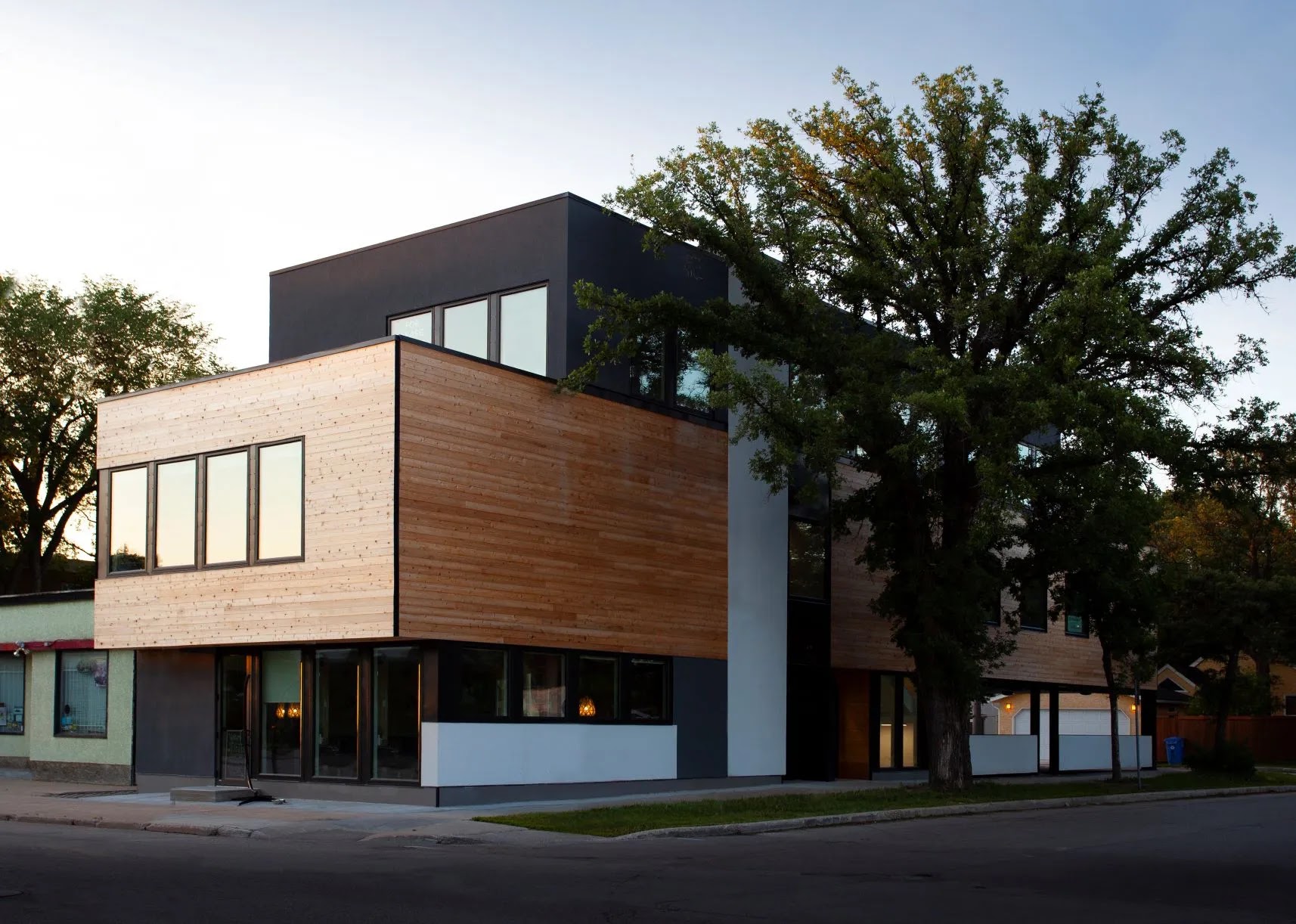
It is the two buildings next door that are now being redeveloped in much the same way as Cantafio's. The former comic book store and hair salon and a house next door that looks like it was used for offices are going to be demolished. In its place will go up a three storey building with three commercial units facing out to the street and two floors of offices including a rooftop terrace.

Put together with the Cantafio building next door, it is a continuous commercial curb side development. It has a street front profile. Anyone walking down the street has reason to window shop. The difference between Corydon and Osborne Street until recently was that almost no apartments existed directly on Osborne as it went through the Village. Corydon has always had apartments and houses on it and this should remain so.
If Covid has shown us anything it is that neighbourhoods that are all offices or all retail will suffer without people living close by. Neighbourhoods such as Bridgwater which are more mixed use and have transit within them tend to do much better. Corydon is mixed use for blocks but these occasional tweaks will make more a fuller neighbourhood experience.
The economy and growth rate in Manitoba is improving although it is still hard to see it. Population growth is up and GDP growth as well. Productivity is still in need of improvement. However, one of the ways to improve productivity is logistics. Try to ensure the every neighbourhood has what it needs to be sustainable makes it a more productive place to live. Not to mention move livable. No grocery stores or pharmacies means you have to leave to find those things.
The new building seen above features two floors of window facing the street on the second and third floors. The first floor will be the three shops which may include a restaurant. As seen in the pic, the building blends into the corner building. The highlight if the rooftop terrace.
There are still gaps in Corydon which could could use a re-fresh but organic growth means, it is a small piece at a time. Likewise, we are not likely to see a Day of Wine and Roses festival in full throated street party as in the past. Even Osborne has found that it can interfere with business as much as support it. What does work is a consistent organic upgrading. 

The city planner can help by not mandating setbacks from the sidewalk. It is uninviting to shopkeepers and a waste of space in general. There are a few other places along the street getting touchups but nothing so quick as to alarm. However, it is interesting to note that when people who have been away from the city from a year or two come back, they notice the changes. This is markedly different than when the city went through long periods with few changes to areas. In some cases, showing a bit of wear and tear. This is no longer the case for some streets such as Corydon.

Edit: A reader reminded me that the corner in question is Wilton, not Wentworth. She mentioned the shop next to Cantafio's was Sandy's, a candy store. The house in the picture was mentioned as Dr. Schwart's dentist office in the past.

Across the street was the Belgian Bakery and the opposite corner Sal's, Mclean's Tomboy Waugh's Annex General Store. Before it was Sal's it was the Purple Parrot. She recalls a soda shop and a small shop with hardware next door. Today massage therapy clinic and yoga places are on the corner.

Corydon Hardware further down Corydon which is closing is part of a bygone era. The only grocery further down is Foodfare.

Monday, June 10, 2024

A New Core Area Initiative


Considering how important the Core Area Initiative was from 1981 to 1991, it is odd to think it has faded from many memory. The big thing is that for all public money from the city, the province and the federal government, it attracted a ton of private money as well. The territory it covered was expansive over downtown and into Osborne Village. The $196 million was spent on such a variety of things that had impacts in so many areas that helped Winnipeg for decades to come. Certainly without the program, we might not have see The Forks develop nor Portage Place.

And while Portage Place is derided as a failure, it got the parkade built that has been the funder for The Forks for decades. No lie. Money from that parkade kept The Forks afloat. It is also the most attractive feature for the Chipman/Thomson bid. The $3 million or so revenue from the parkade will help pay for their purchase and support the True North Arena.

The connectivity of all the different areas of development and renewal has to be understood to assess it's success. The example above with the Portage Place parkade. Quite simply without it, there would not be the money needed to keep The Forks going through the roach patches. Portage Place investment helped other private interests such as Air Canada, Investors Group and Relax/Holiday Inn from setting up shop on north Portage.

So was Portage Place a failure? The apartments, commercial building all around it say no. As a mall, it has faded. But on the bones of that development, residential and medical towers will go up. The problem with Winnipeg's downtown, as has been described many times before, is that it is fairly spread out which means there are large gaps where there is open space usually of parking lots. A city like Toronto, for example, has much closer distances between city and provincial government offices, central hospitals, universities and shopping. Winnipeg seems to be blocks away from everything.

The plan for the Core Area Initiative redux has various interest groups thinking it mostly will go to this or that. Bike interest groups believe it should go to bike lanes down every street. Business Improvement Zones believe it should go into street beautification programs. This ignores how widespread and how much leverage the old CAI had in getting millions upon millions from the private sector for work small and large. It wasn't supposed to go to one group to gorge themselves on. What is the point of bike paths on every street if there are houses on it?

The 1981 to 1991 CAI triggered so much downtown development but it also renovated tons of housing improvements from Osborne to Centennial. Unlike the 1960s urban developments the feds did across Canada that cleared land for major developments or concentrated a big low income housing project, money was allocated over a longer time to a larger variety of projects and social services and to a greater size area. There could have been a risk of diluting everything but the key always was to leverage other investments in the area in terms of people and money.

As mentioned before in this blog, 1980 was a horrible year for Winnipeg. The deep recession hit here early and hard. We lost the Tribune, Swift's and Canada Packers plant and thousands of jobs all within a few months. It was a deep recession and a long one. It hit all of North America but places like Winnipeg lost their place in Canada. Edmonton and Calgary with resources to pull themselves out of the slump, surpassed us in population and we saw head offices migrate there over the 1980s from the city.

The north part of Portage was always the poor sister of the south of Portage. The Eaton's and the Bay and stores on the south side were still a going concern. Movie theatres were still well attended downtown. However, the north side was often video and pinball halls and adult theatre. There were a few areas of strength like Kennedy Street which had Stagewest Dinner Theatre, Benjamins nightclub and a few other businesses but the northside was losing buildings to fire and there was a worry of steady decline extending to the south side.

This wasn't an idle concern. St. Vital Mall and Kildonan Place were very recent additions to suburban malls and population in the suburbs was booming. That is not to say there were no malls going up downtown. Winnipeg Square and Eaton Place went up just as the 1980s were starting. To a certain extent those malls achieved what they hoped for those areas of town. Winnipeg Square was a fine business mall with a very large parkade and Eaton Place gave Eaton's a new lease of life and additional parking while preserving the catalogue building.  However, neither mall was going to be able to forestall the difficulties elsewhere in the downtown.
Despite a very diverse economy, Winnipeg was in for a a much slower growth rate than our western neighbours. Population was leaving in steady numbers for the oil economy of Alberta. And for retirement, Winnipeg couldn't beat Vancouver's temperate climate. Still, as many will attest to Winnipeg was a good place to live in but in need of a plan.

At the time, Lloyd Aworthy made the jump from provincial politics to federal politics and became a powerful cabinet minister in the west. Some of that came as a result as being one of the only Liberals in the west. As an urban studies academic, he was well aware of what most cities were facing across Canada. Winnipeg became  a petri dish to see what would happen over a ten year period.

So what did happen? The Forks was probably the most successful outcome. Extensive consultations, funding for river paths, a national park and the clearing of rails but not the buildings for a long term plan. And The Forks continues to add piece by piece. Still, without Portage Place's parkade providing money every year, The Forks would have failed economically. It is where it is now because of that money. 

Portage Place is considered a failure. However, that can only be considered true if only the mall is looked at in isolation. The Prairie Theatre Exchange is a successful long term tenant. The mall had the first IMAX Theatre for the city. The three movie theatres were gorgeous. The parkade was the best. Axworthy had wanted an arena but local merchants were more keen on a mall. By the time Portage Place went up Winnipeg was over-malled. Polo Park went through a doubling up with a second floor which only added to the problems of downtown malls.

Portage Place was not the first mall to falter in Winnipeg. That honour went to Unicity Mall. Other malls like Garden City suffered as well. The end of Portage Place as a mall is likely in 2025 when the east side becomes the Pam Clinic tower and the west side becomes a residential tower. It is the in between part that will be interesting.

Lloyd Axworthy has identified in 2024 what might make the federal government interested. He has indicated it could be the relocation of the CP rail yards or the Little Forks National Park proposal. Both have transformative implications. One is where the Seine River meets the Red near Higgins while the other is an enormous tract running east-west that separates the downtown from the North End. The size of it should intimidate. The Forks was an enormous reach for Winnipeg but once the rails had moved it opened up huge opportunities.

A new Core Area Initiative could have a broad geographic area. The 1981 certainly did. Not all the money has to be dumped into one area. Nor does a project have to be completed within the timeframe outlined. The Forks started very late into CAI. And it continues to this day. The first Core Area Initiative had a lot of components to it and helped a lot of areas leverage investments in other projects for years to come. In recent years there seems to be a rush to spend in one area lest the money disappears and the planning is awful and the execution worse. A lot of planning went into The Forks and that has contributed to it's success.
The Core Area Initiative of 1981 to 1991 was followed up by the Winnipeg Development Agreement/Partnership of 1994 to 2001 and the Winnipeg Housing and Homelessness Initiative of 2001 to 2012. The fall off of any plan up till 2024 is probably one of many reasons we seem to be ill prepared for what comes next in the city. Taking a dozen years off has left sustainability off the table. One of the things that CAI did was not just invest in infrastructure but in people as well. Nothing works though if you don't do both. Later development plans invested in people but not enough in infrastructure to support/leverage other investments in the area.

It is a tricky business building sustainability into an initiative. A program should have a beginning, middle and end. In other words, it isn't solely an entitlement programs like old age security or an income support system. The program should be set up to help in such ways like renovate a home, help someone buy a home, seed money for some street renewal, plans for a park, consultations on larger projects, fund a security system, establish patrol offices and so on and so on. The first CAI was very much like this. While it did try to be leaders in some projects, there was an effort to repopulate central areas of the city and create more reasons to come to the central areas. And that was usually done as a secretariat or clearing house in partnerships with many other groups and levels of government.

A new CAI would probably be a good thing. Unlike past decades though there seems to be groups looking to gorge themselves on money directed to them alone. This will cripple the program if one neighbourhood wants $200 million of work or one lobby group wants that type of work only used for them. Quite simply, one neighbourhood getting $200 million for housing will only beggar other central areas or $200 million of bike paths won't revitalize the larger community. The success of this program will be covering a lot of areas with a revitalization and re-population goal. And if there is a very large project such as rail relocation or the Little Forks proposal, know that it the initial outlay of money should large come from other sources. But for the consultation stage or smaller projects that help launch the project, it can be the start of something great as it was with The Forks.

What is needed is vision. The big question is whether the province or Feds will be turned off by other requests for billions for suburban roads that look like highways. It sends the wrong message if the city keeps supporting sprawl it can't pay for later.

Wednesday, June 5, 2024

Violence In Osborne Village and Business Closures

Osborne Village isn't the only neighbourhood experiencing violence but it is the one with the highest density population in the city and the one mostly likely to see business flee and residents next. Already Unique Bunny and Starbucks have cited crime for closing. On a weekend a few weeks ago around 9 PM, a man was found unconscious after an attack right near Shopper's Drug Mart. It was dusk when many people were still out and about.

A series of violent incidents and closures have left Osborne residents nervous. All of this is happening with street patrols present. However, the patrols are overwhelmed by the sheer numbers of incidents and how widespread they are. It appears the Village is the recipient of these type of outbursts fairly frequently. But then again the entire city seems to having a steep rise in all sort crime.

It was a particularly bad weekend of fires, many arsons that kept police and fire on the go. Some valuable long term businesses that local residents use were either lost or threatened by fire. It was a weekend of endless sirens. In one case, a long term convenience store was a total loss. In another, a discount store was almost lost. Were they both arsons? At the moment they are being investigated.
The main reason given for the violence is the hardcore drugs, poverty and homelessness that has blown up all across North America in the aftermath of the pandemic. Some of this was becoming a problem even before 2020 but is has been compounded by adjustments to the economy everyone is making in terms of working from home and the slow scaling up of many businesses such as restaurants that are still not back to capacity.

It is very easy to squeeze the toothpaste out the bottle but a lot harder to get it back in. This is the pandemic aftermath of people still working from home, others who retired early, inflation that still hasn't let go and economic uncertainty. Mental issues abound. Some people are adrift which has led to addictions problems and chronic unemployment and lack of housing.
Osborne Village was called one of top neighbourhoods in Canada in the not to distant past and it could be again except security has to be raised for that to happen. Affordability in the area has dropped as small apartment units have disappeared in favour of luxury units and condos. Winnipeg is just a shade under what Edmonton's housing costs are and that is not good considering the wages are much lower here than there. The result is a lot of people cannot afford homes.

There are strong correlations on affordability and homelessness, poverty and addictions. All three levels of government have made a commitment to all sorts of housing going up this year but it a long process of gearing up. Approvals take forever, interest rates have affected budgets and supply chains are still struggling. Meanwhile, a number of people have fallen off any support system. The province is paying for overtime for police units to deal with the surge in crime.

The commercial strip along Osborne is getting a mix of new residential and commercial units. However, hundreds of residents in proximity to the latest attack shows that some people are not stopped by that. The drugs out on the street leave many in such a zoned out way that impulse control is lost. In other words, no shop or residence can afford to not keep doors locked and monitored. Step out of your place and you could be vulnerable. Even in your home, you might be vulnerable since arsons are everywhere.
The permanent closure of Starbucks for safety reasons is terrible. While not specifically stated, the open doors of their business as well as their washrooms meant staff felt and were facing increasing issues with security. Businesses like pharmacies and groceries with open doors are facing massive shoplifting issues that have only accelerated this past year. Not just here but everywhere. Big stores are reducing the amount of entrances to their business. Many stores are getting rid of self-checkouts and identifying it as problem area. 

Small businesses often require a knock on the door to get in. They never had self checkouts but layouts of stores not keep better sightlines. And no public washrooms. It is likely only increased security, changes in society and a more full court press on crime will help reduce the violence and property loss. The move by liquor stores to go to ID only entrance was able to stop the epidemic of violence and loss of goods inside. The cannabis stores never had to go through this because they had security built into their initial unveiling. A Safeway is not likely to ask for IDs. But it is entirely possible they set up more secure areas as they do with pharmacies. Stores in Britain and the U.S. are using bodycams for security. This could prove useful for identifying violent events and the people responsible.

The slow walking of actually approving housing developments puts pressures all along the system. It really can't take ten years to approve housing. Today's housing projects are likely the affordable housing 20 years down the road. The longer it takes to approve, the longer people have to wait. Meanwhile in that ten years houses are being lost simply due to age in some cases. It is worth mentioning this because the Osborne area has had people living on the riverbanks or various areas nearby the last few years. For many decades some of the most affordable housing was in the area. For Osborne to be safe or anywhere in the city for that matter, it can't have homeless desperately living through winters. Add to that struggling with medical, mental and addictions issues and you have communities that area struggling.

Unlike previous recessions, post-pandemic around the world has changed much about how we organize ourselves, work and look to have a civil society. Osborne Village will recover but much has to change. However, we are likely to see more store, restaurant and office closures before a handle is gotten on decline which is being seen here and many other places.

Thursday, May 2, 2024

Starbucks Osborne Village Temporarily Closes

A sign in the window says Starbucks Osborne Village is closing temporarily. This has led to all sorts of rumours. Some said it is because they don't have a drive-thru. Some said because of safety reasons. The one thing no one is saying is that there was not enough foot traffic. It is a very busy corner with some anchor stores right there as well as parking.

Starbuck has been having a difficult few years. The business model was not heavy on drive-thrus and in the pandemic that didn't work. The Starbucks within bookstores was also bad in this environment. And lastly, they had a lot of locations and their prices were higher than other coffee companies. Add all this up and there are a lot of corporate reasons Starbucks might close. However, this seems different. If it is a crime issue, the company should say so.

There was an assault just the night before steps away from the entrance. This might have been the final straw. Staff from the store are being transferred to other locations which makes it feel like this is something that could be indefinite.  Crime statistics are out of control for the area. There has been a 100% rise in overall crime according to the numbers. Drugs are out of control. Violence is out of control. Even where there are many people present, there is a threat of being attacked. And this isn't just hysterical talk. This is what is happening and what the Osborne Biz is reporting.

There are some good news stories for Osborne. The cat cafe is set to open soon. Some of the new residential units with ground floor commercial units are set to open. However, if addictions and violence continue to affect the area, even very well attended coffee shops might decide to close rather than have someone hurt.

The interviews from people on the street are downright gloomy. Businesses right across the street say they have been broken into in the last days. Seems like police could sit in the area and make a hundred arrests in only a few days. And that might be what needs to happen.  It isn't just a case of helping people with their addictions. We have real safety and violence issues and whatever sympathy someone might have, it can't come at the sacrifice of their personal security and safety. 

Major arrests have been made on dugs and trafficking. Good on Winnipeg Police on that. Lots of money, cars and guns are off the street. They are being pretty cagey about it all but we are likely to see it wind through the courts. It takes months to set these things up and the costs are high. But one vehicle taken by the police was just under half a million. There is a lot of money apprehended by the police and drug route that has been closed.

Police and addictions counsellors though say a drop in the supply equals more desperation though and the use of even more toxic stuff. As for Osborne Village, as the weather warms up it could see more encampments nearby that could be difficult for the community. Even as more efforts are made to find people homes, the sheer volume of addictions threatens to overwhelm. 

The people interviewed all seemed saddened and shocked. There has been a steady stream of long term businesses leaving even as building continues. The helpless feeling was pervasive. Crime will kill the Osborne Village and many other areas if the city can't get a handle on things. You just can't be in a line at the liquor store and get choked or at Shoppers and get stabbed. We'll see what the response is from elected officials. There are a lot of NDP members in the area and city councillors know that Osborne is not the only area in serious trouble.

Saturday, February 18, 2023

514 Wellington Crescent Approved for Condos

The above rendering from Prairie Architects was approved by city council in Winnipeg this week. The house was demolished a few years ago. It sat empty a few years before that. Known as the Gordon House, I only knew it through my entire lifetime as the house of Senator Doug Everett. It was a fine house, on a fine road in a fine neighbourhood. However, the story on Wellington Crescent over the decades has been apartments and condos stretching out from Osborne Village all the way down the Assiniboine River. Even when a house is demolished as in the case with Munson Park or converted like the Fortune House, there has been a lot of debate. In the case of the Richardson house that made way for the park, I think there is wide agreement that this was a wise idea. And Fortune House stands as an icon even though there was a lot of whinging happening at the time that it was turning into a rooming house.

It would have been amazing if Gordon House could have been purchased by a single family that could have afforded the upkeep. Unfortunately though, the size and the cost of upgrades is massive even for the fabulously rich. The structure of the houses in Crescentwood are not something that younger families look for as much. Large empty dining rooms, lack of family entertainment rooms, kitchens that are too small and rigid structural walls are among the problems not easily corrected. And parking. Some families want lots of parking.
Crescentwood continues to have many well maintained homes but all of them are aging rapidly. Wellington Crescent was fairly unchangeable till the last decade but the amount of houses being demolished and re-built is quite large. Someone visiting after ten years away might not recognize it. The protests to put historic status on a number of houses does not always translate them being sold and preserved. And even if a single house is re-built on a property, there is likely going to be complaints regardless that it doesn't fit the neighbourhood.
I'll admit when I watched the house get torn down, it felt it was the end of an era. I can't say I know that the rendering is attractive or not. It resembles a design you might see in St. Norbert or St. Boniface in that it has a French chateau look. Nothing wrong with that. Developers when they build a neighbourhood tend to make them cookie-cutter for cost reasons and also that no one wants to stick out.  Diversity in style tends to take years if not decades. City and neigbourhood pressures to conform run strong. Change your grass to a garden and someone will disagree with it.
This fight over one property has been going on since 2016. There are a few other properties that have been nearly as long. The age of the houses and the complex nature of their upkeep and restoration can often mean economically it is better to start over. But that will never mean an identical house to the one that was there before. A builder and a family would find that the costs to replicate prohibitive. And many don't want fireplaces or dining rooms.
The four storey, eight unit and near 50 feet high new building has been approved. It is doubtful that this fight will be remembered in ten years from now. Wellington Crescent, at least in this section, is a major commuter and active transportation route. The residence should attract professional in their first home and retired people looking to downsize, A frequent issue (of a few in the Crescentwood and River Heights) is that older residents have to move right out of the area because there is nothing suitable for owners who downsize.
A more pressing need for the area is that lack of pharmacy or grocery nearby. The neighbourhood is truly car dependent. But other amenities like parks, schools and proximity to work are standouts. It is no wonder that people want to live on Wellington Crescent. Expect a few more battles along the street in the area from Grosvenor to Kingsway.
With the expectation of 20,000 people a year moving to Manitoba for the next several years, here is a passing thought. If density cannot be changed in the area of places like River Heights or Crescentwood, it will result in more people racing through the neighbourhoods to get to further suburbs. It is already happening. Taking several years to decide on properties could result in them just being abandoned. Depending on rich people to rehabilitate and occupy old housing stock is just not in the cards. 

Friday, January 6, 2023

Nerman's Books and Collectibles Closing

Since 1996 Nerman's Books and Collectibles has been a South Osborne mainstay. Gary Nerman has owned the building since 2005. Like a lot of people working past retirement, the decision to pass on or sell or liquidate the business becomes impossible to ignore. All over the city, I've seen businesses announce retirement and closure. Covid has probably made it easier to thinking about doing so. And at 68, Nerman just needed the right offer and that came in the form of selling his building which not is in the hot community finally being appreciated by many in Winnipeg.
Starting off with the biggest used children's mail order business as a part-time job, Nerman's become a bricks and mortar store on a street that had a few empty storefront. The Park Theatre, for example, had been idle for 10 years. The beginning of closures of mom and pop video stores started around then and only accelerated until there was nearly none. For years there was a few on most commercial streets and they numbered over 200 at one time. Now we see that with cannabis stores.
Nerman's books will not be taken over by a cannabis shop. The owner of the Park Theatre has bought the building and has only said it won't be an extension of the theatre, Erick Casselman has turned the theatre into a cultural center on South Osborne. It has no doubt helped surrounding businesses. 

The South South Osborne Biz in some respects is looking like how things were in the late 1970s and 1980s in Osborne Village where a few families started businesses, bought properties and made the areas what it was in those years. Scott Tackaberry owns Game Knight, Grape and Grain and Dastardly Villian Brewing all on Osborne. It has the same feel of those early years back in the Village when so much was owned by a few entrepreneurial families. Today, it is larger corporations that own the land.

The area could use another used book store but it takes a special person to to it and owning your own property is a must. Rent has gone up so much that it is hard for small businesses to take root, South Osborne still has some possibilities for owner/operator businesses. Part of the long term success of these type of businesses is being able to sell your company/property to other owner/operator. In the past, Osborne Village owners kept the property as a rental which has made it harder for new start ups.

The city will miss Nerman's but the health of South Osborne continues to inspire.

Saturday, November 19, 2022

Yuk Yuk's Comedy Club Returns to Winnipeg

Yuk Yuk's Komedy Kabaret opened in Winnipeg in 1986 and was the 12th location at the time of the Toronto-based comedy chain founded by Mark Breslin. The Osborne Village location at 106 Osborne for years prior had been the Osborne Theatre but became well known in the 1970s for Floating Ecstasy, a waterbed store. It was a time when Osborne Village became the trendy and higher density community it is today. By the mid 1980s, the waterbed days were waning and it was converted to a sofa shop. However, the second floor became a Yuk Yuk's with the comedy boom that was sweeping the city.

In 1984 Rumors Restaurant and Comedy Club was founded when it took over for Kappy's in the recently renovated Tuxedo Village mall. Around the same time the Al Golden owned hotel began doing very local comedy and now the new owners do the same thing. Winnipeg was an embarrassment of riches for comedy.

By 1991, Yuk Yuk's had closed and a series of night clubs succeeded it. But Yuk Yuk's is back in a pretty upscale place in 2023.

In January, Yuk Yuk's will occupy the club space downstairs at Fort Garry Hotel. It follows a revived comedy boom in Winnipeg where several establishments such as Limelight, Wee Johnny's, Handsome Daughter and The Basement offer up talent.

The Fort Garry Hotel continues to find ways to enhance what it offers. The patio and renovation of the Palm Room, the spa and continued service as a locally owned place keeps it relevant. The days of cabarets and nightclubs has declined. Hotels that used to have multiple dance clubs are finding new audiences with sports bars, karaoke and comedy clubs. Live music still has a place. The Marion Hotel for example is doing an only original music night. However, there is no denying that comedy has had a resurgence.

Winnipeg took the genesis of the last comedy wave to create the long lasting Winnipeg Comedy Festival. Make no mistake, we are movers and shakers in this industry.

Saturday, July 30, 2022

Crime and Safety in Winnipeg in 2022 Part 1

Crime in Winnipeg in the post pandemic period has been raising concern for many people. It would be a mistake to say it is solely media driven. Despite a news conference from Chief Danny Smyth from the Winnipeg Police Service set to reassure people, many in the city are anything but. Being randomly attacked or being a victim of crime are probably first and foremost of concern for citizens. Simply telling people they are statistically unlikely to be a victim of crime does not change the perception of safety.

One of the reasons why The Forks has generally defied perceptions that downtown is dangerous in the past is because the area is clean, looks cared for and has activities associated with tourism and recreation. The presence of a lot of people and that the area is secure has served The Forks well. The pandemic emptying out nearly all downtown and protests originating or ending up at The Forks has changed the dynamic. Instead of being an area of gathering for trade and celebration, it has become a seat of power to express dissatisfaction. 

Freedom of speech is the hallmark of our society. However, the polarized nature and confrontational style of protest has turned The Forks into a sometime hot spot. It is a kind of messy situation because unauthorized political gatherings are probably not exactly what The Forks had in mind when hosting cultural and musical events.

Why is this important? It is important because while it may not be a crime to gather to protest the government, it may make people wonder about their security. If your intent is to go for dinner at The Forks, go for a walk and browse the stores, a large and vocal government protest might seem something to avoid. The peaceful gathering of many people is what the strength of The Forks is. If people think their safety is at issue, they make different choices. It is why crime and safety blur. Perception that The Forks is safe and that crime is rare cannot only be about words but deeds. More on that later.

As for violent crime, it might be rare but it can't be ignored. The Forks is not the only place in the city experiencing it. Polo Park has had a number of incidents too. It is something that the largest shopping mall in the province has to deal with or risk looking more business to Seasons of Tuxedo. For the first time, it appears that there are no vacancies in the Tuxedo mall. Can Polo Park say the same? With one of the largest property managers in the land as owner of the mall, those that run afoul and cause a disturbance can be banned from the premises. 

Still, multiple bans still can't protect people when they are outside. Grant Park Mall is not a place one would associate with violent crime and yet a carjacking took place there in broad daylight. And then a few days later three people stabbed near the mall in a reported attempted break in. None of the victims knew their attacker. There have been a few of those lately. A stabbing took place at a Charleswood bush party same weekend as the carjacking. Those have been going on for decades and suddenly one turns into a near homicide. And the police shot someone in Osborne Village. It really does seem the summer of discontent. The randomness makes anyone say: Are we safe anywhere?

Wednesday, December 29, 2021

Leopold's Tavern Coming to Cornerstone in Osborne Village

Osborne and River was like a small town at one time. On the southwest corner once stood a drug store and across the street stood bank. Osborne was a commercial street in a residential neighbourhood. However, by the 1970s some of the more sprawling estates around river gave way to apartment buildings. Along Wellington Crescent, not too distant from the corner, apartment after apartment went up along the Assiniboine River. And along Roslyn even more apartments went up.

The tallest apartment of them all in western Canada for a number of years was 55 Nassau built in 1970. While none was as tall in years after, there were several built in surrounding area all over 20 floors.

The increasing density brought foot traffic to the Village but affordability didn't come from high rises, it came from single family homes being turned into multi-unit housing that was far cheaper than places like posh 55 Nassau. Stately family homes became several apartments in the 1970s and through the 1980s. Not condos but small apartments.

In the last several years some of the older multi-units houses have been being torn down for posher condo and apartments. The economic diversity is not nearly what it used to be in the Village but the density has increased. The rent overall in the city has increased leading to affordability issues. This has translated into increasing commercial rent on Osborne properly.

In New York they call it luxury blight where a commercial street that once hosted banks, barbers, greasy spoons along with hardware stores now has dress shops that attract suburbanites for a frock that might be a month's rent for someone. Winnipeg never had the same sort of really posh shops but it did have a few more exclusive retailers in the area. Some started earlier enough in the less expensive days to actually buy their property. Those places turned out to last the longest. However, as owner operators turned to straight landlords, the renters paid rent but were not able to have equity in the land.

Restaurants can come and go but they are at least able to offer something that Amazon can't easily disrupt. But a start up is not going to be interested in a 10 year lease unless it has corporate backing. And so you see a lot for lease signs. And in some case whole buildings that go unused year after year. For what? For the perfect tenant. It seems no consideration is given that empty storefronts or buildings can perpetuate more blight.
In Osborne Village there are spots that have sat empty for years. Some spaces such as Osborne Village Hotel have been demolished and sit empty with no construction start in sight. Presumably, if they could have gotten away with it, they might have made made it paid parking. That is an old landlord game. Promise to develop and then have a parking lot for decades.

Osborne Village has been resilient although cyclical in major part due to a grocery store and pharmacy that are all within walking distance for thousands who live nearby. Throw in some convenience stores, some fast food joints, a post office and liquor store and a resident could walk in minutes to and from home. Not even a need for a bike with that type of proximity.

The River Avenue to Confusion Corner part of the street is the commercial part of the Village and in recent years, the most unstable. As mentioned, the high price of commercial rent and the long leases requested by landlords is a disincentive to start-up shops and restaurants. The size of some of the spaces is also tough. If a restaurant's business model depends on a lot of parking then Osborne is not the right place.

What surprises a lot of people about Osborne Village is the scale. Even after decades, it is still no higher than three floors most of the way down. A large amount are one floor buildings. There has been an attempts to go higher at the Gas Station Theatre but it has failed to gain traction. Closer to Fort Rouge station, a taller office building has gone up and beside it is a stalled residential tower. 

There has been a cry for more parking but it is unclear how maybe 300 spots on a place, say like...the Osborne Village site would work. You would have to have security, a time limit and if it was privately owned...a price to pay. No doubt if the city allowed this, buildings would be knocked down here and there to offer parking. But how would it help the commercial area? Large gaps would be windswept and still a fair walk to where you were going. It would be a series of strip malls where constant vigilance would be needed so that people only shopped in your store rather park and head elsewhere.

If the point is getting more foot traffic, the lack of places to reach on foot is an issue. It would like being in a mall with a store only open every few spots. The mall would not survive that way. A street is not a mall. A street survives with some parking but in Osborne Village, public transit and walking is more important than limited car spaces right in front of the shop. A company like Creative Audio, former long time Osborne Village resident, only had two spots out back that they had to constantly police. Someone buying thousands dollars of audio couldn't even guarantee they could load their purchase anywhere near the shop. They eventually found a home on Provencher which is a lovely high streets that I've said good things about in the past.
With that in mind if River and Osborne is gateway proper to the majority of Village commercial activity, the businesses on that corner should be a big draw for people as early as possible in the day and as late as possible. It is why restaurants and coffee shops have proliferated over the years. If the business model of your company is lots of cars parked nearby 9 to 5 then Osborne is not a good match for you. For many, success has come from operating outside normal hours

Since 1975 Papa George's was that place. The sign even said open till 4 AM.  It lasted till 2012 with a retirement of the owner. In principle, the late hours meant that people finishing late shifts, night owls and those coming from bars, movies and hockey games had a place to go to. And parking was easy to come by after 11 PM. Several businesses had this idea including the Osborne Village Inn. And various shops and services blended into that model, some opting for the earlier opening to take in breakfast and coffee models.

Cornerstone replaced Papa George's in 2014 after renovations were complete. Were it not for Covid 19, Cornerstone's grub pub fare might still be holding sway on that corner. Indeed, there was a feeling that Osborne Village was poised to for a new uptick with all the approvals for new housing that had gone through. In fact, many housing units went up even as Covid locked things down. But restaurants such as Segovia and Cornerstone could not very well capitalize on restrictions as their customers dried up. No one was on the streets.
But there has been a few indications of what is to come even as we battle yet another wave of restrictions with the Omicron variant of Covid 19. Cannabis retailing ramped up in the pandemic. Osborne Village saw an early wave of openings. While they don't have much street presence because of rules that make them frost their glass, they draw foot traffic and pay rent which should be sustained for some time. But cannabis shops don't make for a neighbourhood or streetlife.

Stores, restaurants, bars have created vitality on the Osborne strip. The loss of the Osborne Village is beyond awful for what was lost. The nightlife, streetlife, vendor, restaurant is just a hole in the ground. It is unlikely that anything replacing it will be as important as that hotel was. Everyone awaits what will go up and when.

Still, when Covid restrictions end, the corner of River and Osborne will see the closed Cornerstone restaurant turned into a Leopold's Tavern. At the moment Leopold's is badly wounded with staff out stick with the virus. This affliction is hitting a lot of places. It is in interesting to note though how Leopold's has been opening and operating locations in various parts of the city and succeeding. The opening of a location right at the entrance to the commercial area of the street is a real shot in the arm.

Leopold's, a Regina-based group of restaurants, has tapped into the faux dive bar motif. The evolution of the bar/restaurant has evolved over the years. The lounge, beverage room and cabaret doesn't always fit with a desire for people to stay in their neighbourhood in a place more scaled to the "everyone knows your name" size. The proof has been in the pudding because Leopolds's has expanded to places others overlooked such as South Osborne, Academy Road and Bridgwater.

There is every indication that Leopold's at River and Osborne will be entirely successful and a real draw for people in the area as well as visitors. And perhaps in 2022, the revitalization of the commercial strip of Osborne Village will begin a new iteration.

Friday, May 28, 2021

Corydon Avenue Construction 2021

It was scheduled for spring of 2020 but put over to this year. Why? Not sure. With the pandemic and everything closed and I mean everything, it seemed construction was the only thing running. But not in this case. Nothing happened till this year.
Corydon has always been an oddball. You have two autobody shops next to posh coffee places and barber shops. It has apartments on one side a lot of the time and commercial on the other side.
Sidewalk cafe at Cocoabeans might be a little dusty and noisy.
Corydon remains a street where you have to slow down even when construction isn't happening. Unlike some streets like Jubilee that banned parking, stopping, loading, Corydon by its nature can't be a speedway.
I didn't enquire about the boarded windows at Corydon Cycle but I have seen it a bit all over the city. Thom Bargen Coffee windows smashed for a bike inside, CPR Cellphone window smashed across from St. Vital Shopping Centre. So tough for small businesses.

We have had some arsons. Twice in one abandoned house recently.  Drug addiction, grinding poverty, lack of housing and the pandemic. And crime rising. We need to do better.

If we can see shop windows smashed on major commercial streets it suggests a desperation, a brazenness. It doesn't go away running to the suburbs. Or exurbs. Or cottage. It follows you around.

The end of the pandemic will help populate the outside. But will it stop the desperation? And sending people to prison here results in deaths that even U.S. prisons would find hard to match.
Corydon remains attractive for a lot of reasons that Osborne Village struggles with on the main strip. It has people living in higher densities right on the street. Now, the Village could make up for it with people of Stradbrook and River but there have been empty spaces for years as result of land hoarding.

And while it might seem like a lot of restaurants on Corydon, there are grocery stores, convenience stores and hardware stores on the street. Never underestimate what 7 Eleven is in a neighbourhood. It is a place to buy a paper, get a lottery ticket, Slurpee.
There are a few street killers that are more effective than front facing parking. No offence to these businesses. They do try with patios and have parking for their customers but is a big open area when you walk past. 
The service window for restaurants is something that should continue for pick-up and delivery for yeas to come even without a pandemic. Bar Italia here has one.
Another example of how front parking kind of kills the street vibe. It always will.
The King George Courts built in 1913 is the type of building now fought in neighbourhoods all over as not in characters with the area. It is gorgeous but resisted by many. However, it is what is needed for higher densities and for people starting out, downsizing and the like.
Character homes so close to Corydon at Jessie and Cockburn.
At Jessie/Cockburn with Corydon in background. This was a 1/ 1/2 size lot. Not sure what house condition was but as you can see already sold as it nears completion.

Not sure how it will look when complete. As houses age past 100 years, some will fall to wrecking ball.