Showing posts with label Minneapolis. Show all posts

Saturday, May 16, 2026

Uniqlo Opens in Polo Park

When I lived in Japan, Uniqlo was just a few years open and only really known by Japanese or foreigners who lived in the country. While a lot of people were focused on international stores opening in the country such as Virgin Records, not as much attention was paid to a number stores opening in Japan that would take the world by storm. In 1984, the first store in Hiroshima was called Unique Clothing Warehouse. By 1988, because of an error in registration for brand name in Hong Kong, someone slipped a Q in and by 1989 Uniqlo was the official name. This is when I arrived in Japan.

People said the company was fast fashion but the reputation even then was for durable and enjoyable clothing. Affordable, which Japanese had not seen much of, during a steady luxury brands and stores entering the market. Living there as long as I did, I appreciated goods that fit and were not insanely priced. As Japan's economy went through a prolonged stagnation in the 1990s, Uniqlo grew in popularity as a staple of men and women's closets.

The first store in Canada was Eaton Centre in Toronto in 2016. Last years there was a flurry of stores in places in places like Vancouver and Calgary. Now Polo Park and later this year, St. Vital Centre get their Uniqlos.

How important is Uniqlo to the malls of Winnipeg? Very important. Generation Z is very much into a return to the mall. Unlike some Millennials who only order online, only text and don't like social settings, Generation Z is into experiences and socializing. It has been this generation that lined up for the store opening and showed a general enthusiasm for the event. Other generations also went but Uniqlo and Zara are among a few stores that have helped malls in Winnipeg find their mojo.

We are not nearly as over-malled as the U.S. nor have some of the long contracts that crippled some malls such as Mall of America. Sears, which has been closed for a very long time, has a 99 year lease at the mall so the space remains unoccupied. Columbia Mall is nearly abandoned in Grand Forks, North Dakota. At one time, the mall in Grand Forks led the way of what people in Winnipeg hoped to see in their malls. Overall, most cities seems to be absorbing the lost space left by retailers like Sears and The Bay.

Uniqlo had some of the best marketing we have seen in some time. They hired local as many times as they could in entertainment and food and product. The brought in influencers, They bought ads, And they invited media. It was a masterclass of how to make a grand entrance. And their target audience came even though it was a school day. I don't think this is the last retailer we see that draws a crowd but it might be harder to find leasable space since Polo Park and St. Vital seem to have a plan to attract stores people want.

Sunday, January 11, 2026

Abercrombie and Fitch, Uniqlo Coming to Polo Park, Eddie Bauer Closing

Polo Park remains the top mall because it continues to adapt and attract tenants. Having said that, it must be exhausting some of the big retailers like Eaton's, Sears, Zellers, The Bay and others who have collapsed over the years. Even now, the mall and St. Vital are trying to figure out what to do about the empty Bay stores. It is likely we hear more in 2026 but it is unlikely that there is any big retailer is about to grab the whole space. Even Simons would not occupy that much space as seen from their recent expansion from Quebec into Ontario.

This story is not about the anchor stores though. This is about the smaller retailers that make up the corridors between the anchors. After Christmas every year changes are made and there will be periods where some retailers are looking to to downsize or close and others are looking to the opposite. There will be attempts in the mall to move retailers around so they can occupy bigger spaces or to be in an area where each retailer attracts a certain type of customer. For example, jewelry stores like to locate in the middle of the mall where two or more corridors intersect.

Polo Park has kept up as the top mall because it constantly invests in the building and seeks out unique stores no one else has. The Apple store does huge business. However, even having one exclusive store can have it's time and close. Eddie Bauer has been around for years and was part of a huge upgrade in 2014. There is only one in the city and on January 7, it closed. It is unknown whether this is a lease that was not renewed or whether Eddie Bauer itself made the decision. 

In the end, it doesn't matter because the mall has been moving tenants around to accommodate incoming retailers. While it is suggested Gen Zs are not going to the mall, Canada cannot merely assume what is true in the States is true here. There is some evidence to suggest that certain stores can indeed attract young people. And malls have been trying to add attractions and activities that attract families. Ask West Edmonton Mall and Mall of America about those.

Malls are like hotels in that renovations and changes within an existing framework need to be done each decade to keep things fresh. It is worth noting that Polo Park was late to the food court crowd in the 1980s. They had mall restaurants as tenants and in department stores but nothing like the other malls until their late 1980s reno. That was the way to attract young people back in the day and still is.

The constant change in recent years hastened by Covid means just as a mall settles one issue or need, they get bulldozed by new announcements of store closures they perhaps didn't not anticipate. As mentioned, Eddie Bauer is closed. The company has been closing closing locations over the last few years. However, the location closure has given Hollister a chance to re-locate and do a re-fresh. The California-look store has been at Polo Park since 2010. It is unknown if they will restore the video walls of Huntington Beach webcam that the company has broadcast since the early 2000s. Most of the stores have dropped the beach hut like entrance for a brighter, open window look. Apparently, Gen Z likes brighter lights. Also gone in the new design is the heavy scent and loud music.

In Hollister's old location near Zara, sister company Abercrombie and Fitch is set to come to Manitoba for the first time. They have had their ups and downs, CEO problems and the like. The store first started in 1892 so they know something about adapting. As a new store to the province, it will attract a lot of interest from young to mid-range age shoppers. Abercrombie has gone through several iterations as most successful brands have done. The opening of the store in 2026 should cement CF Polo Park's hold as the top mall in Manitoba.

To cap it off, the mall is adding Uniqlo, the Asian-inspire store that has fans across the world. This will be the third in a series of Asian stores to open at Polo Park. It likely won't arrive before St. Vital Center's own Uniqlo arrives. The southeast mall continues to be the main rival to Polo Park. The large Asian population of Winnipeg and those that love Asian fashion and beauty is changing the retail industry.

The goal of any mall is to transform and not leave big empty gaps in the building. To that end, what Polo Park does with the old Bay will be one to watch after these latest stores open.

Friday, January 2, 2026

The Most Overrated Holiday of the Year

Truly the most overrated day of the year is New Year's Eve. It isn't a religious holiday. It doesn't make a special time in Canadian history. It isn't a personal day of importance like a birthday. There are no meals associated with it. Drinking is usually connected the day. 

Those that have to work the day get paid time and a half. Most, if not all, stores are closed. The day can fall anytime of the week so it is not an automatic long weekend. This year Christmas and New Year's Day fell on a Thursday. In 2026, both fall on a Friday creating a long weekend each time.

In general though, New Year's Day has been quiet in Canada. The change in the retail act in 2020 means many stores are open in the day including malls such as Outlet Collection and St. Vital. It used to be that everything was closed on New Year's day and there was nothing in the way of public activities. This began to change in the 1980s and 90s with activities at city parks including fireworks as well as family-friendly activities. 

Today, there is an anti-fireworks movement in Winnipeg. It appeared that there was only one listing for fireworks on New Years Eve. The fireworks in Naples, Italy and in Los Angeles are purely citizen driven. The risk in curbing public fireworks events is that citizens will do it without permission and dare you do to something about it. Diwali fireworks are a good example. Citizen complaints on Reddit, notwithstanding, it is unlikely any police will go arresting Indian Canadians.

In the post pandemic, I'd say we are in a bit of a lull for what to do New Year's Eve and day. Drinking is way down and so are the restaurants and clubs that provide those services. It is a long way back in years when casinos and convention centre had regular events. The Winnipeg Convention Centre used to have major events.

I expect the only way things change is with time. Canada is such a young country. Even now we add new holidays or create names for old ones. Christmas and Thanksgiving evolved and keep changing even now from what they were as Canada developed. Who is to say what New Year's Day will be like in the next 5 to 10 years?

One thing is clear that probably all retail will be open holiday hours. It still not everyone but that is the direction it is going. I can't say that Christmas will be like that but I'd be not surprised if retail is available year round even if it is holiday hours. It will be important to distinguish it from any other if this is the case. And if the government doesn't do anything about that, the public will.

Sunday, December 28, 2025

What Makes Winnipeg Great?

A lot of focus has been on the negative aspects of Winnipeg both in mainstream media and social media. Sometimes that results in very public announcements of people leaving or commenting about how happy they are since they left. Every now and again, there is someone who says just how much they love about this city or how glad they moved here.

Geographically, Winnipeg at the center of the country has been an important aspect of its attractiveness for business, cultural gatherings and shelter. The rivers were the key aspect of that growth but it was when the railways came that the city's development took off. It sometimes comes as a shock when people learn that Winnipeg was once the third largest city in Canada until the Panama Canal was built in 1913.

Ports by the sea or with access to the sea have always been attractive places for commerce as well as places to live. Steamboats travelled all the way from Winnipeg to St. Paul Minnesota and back again. However, the rivers were shallow, winding and frozen part of the year. After 50 years, railways changed all that. And all rails led to and ran from Winnipeg.

The dynamic of trade changed as well from north to south. The Canadian Pacific meant east to west travel exploded and those railways lines continued to help the city prosper although cargo, rather than passengers were the big economic driver. Air and road service became the other important developments. The first international flight in North America was from Minneapolis to Winnipeg.

Early boosterism in Winnipeg and Manitoba in general was about land. The flat plains of the Red River Valley and the rivers that met at The Forks were ideal for commerce and travel. It is what made the city great. The trails that grew from settlements that expanded from the forts became the next great thing for the city's growth. While the first fort was built near the Red and Assiniboine, the first business independent of the Hudson Bay Company decided to open at the corner of the Portage and Main oxcart paths in 1862. The province had not even been formed yet.

Nothing really except for the land and the resources gave indication of how great Winnipeg would be. It was a harsh climate at any time of the year. Literally everything had to be brought in by boat or trail because the land was was not providing in abundance for a rapidly increasing population. And even the indigenous population was one that followed game north to sound across the seasons.

The permanent settlements were one of hardship due to extreme temperatures, flooding, insects and disease. The fifty years of transport by water or trail was slow going in terms of development. Funnily enough, the first locomotive arrived in Winnipeg via steamboat. It began the longest era of greatness with explosive growth from 1879 through to 1913. Thereafter, growth was still propelled by railway but not as the boom levels once seen. The building of the Panama Canal meant that traffic could bypass the railway and arrive by ship in Vancouver. Everything didn't have to pass through Winnipeg anymore.

Given the traffic back and forth to Pembina, North Dakota and beyond via steamboat and then rail, it is only the the coming of the Canadian Pacific Rail that re-arranged the dynamic of east to west than south to north. This took place in 1881 when the railway and bridge over the Red River brought huge amounts of people to the city. At least Winnipeg was incorporated by 1874 and had street planning and a nascent business community ready to go. Still, the growth was beyond crazy. Literally thousands of people poured into the city and then out to the country and to the new territories to the west.

All this made Winnipeg great because the economy and fortunes were on an upward trajectory. Still, the Panama Canal in 1913 and World War I a year later in 1914 cut Winnipeg off from capital and immigration as the war ground on year after year. Add to this the Spanish Influenza and the Great Depression and you had a few generations dead to disease and war. And to cap it off World War II took another generation of young people in terms of death and injury.

One effect of the war was a level of industrialization and new population growth that lasted from 1945 to 1970. Many of the largest present-day companies like Manitoba Hydro, Canada Life (Great-West Life) and New Flyer and others grew out of this post-war industrialization. Many family run businesses grew and prospered. Even through the 1970s, Winnipeg was larger than Calgary and Edmonton but oil would soon change that.

Oil crashes in 1973 and 1979 along with inflation and a stagnant economy slowed growth, By 1980, Winnipeg was going through massive layoffs.  Even during this painful time economically, Winnipeg benefitted from a diverse workforce, tree-lined streets, good schools and a cultural vitality. Even during tough times new festivals were created, new school programs were introduced, new professional leagues of sports started and so on. This is an important thing to point out to those who might think that nothing was going on in the city. 

The diversity of the Winnipeg economy and stability of  it made it a fairly good place to raise a family. It was too easy to take for granted our universities and colleges that churned out graduates that became leading Canadian citizens in a multitude of fields. And many of the family businesses grew each decade to become national and international players. 

Winnipeg is still a leading destination for immigration. The province with its provincial nominee program has gone out and found people to come here and has jobs for them. Each decade has added to the depth of the population as well as the rich tapestry of shops, restaurants and businesses.

Winnipeg has had a long time reputation has been a tough city. Crime has long been listed as a problem. Still, anyone who knows the city is aware it isn't the entire city rife with violence. Crime has been coming down the last two years according to reports but it probably doesn't feel like it for those watching crimes take place in stores, buses and the like.

What makes the city great has been the citizen driven initiatives to help on addictions, housing and poverty. There have been shelters built, rehab centres, lower income housing and foundational support for programming and education. It has pushed governments to act as well. United Way Winnipeg punches above its weight in fundraising. The Winnipeg Foundation and other endowments donate as much as the United Way. But it has been a hard year for many charities that still have not recovered from the pandemic just as demand as increased so much.

Still, the thing that makes Winnipeg great is that the city continues to adapt and grow. It has had good times and bad times but not end times. There communities all over Canada with declining populations as people move elsewhere. Winnipeg is not one of them although the fastest growing areas in the suburbs and metropolitan area. This spreading of population is not sustainable economically. It is why attempts to do infill such as Seasons of Tuxedo are transforming former industrial land.

It is great to see parts of Winnipeg have a second coming. The East Yards, Fort Rouge Yards and Tuxedo Yards have all been converted to commercial and residential uses. The density in the city as well as most of the country has dropped as suburban and exurban residential growth has exploded. The fact industrial and parking space is being repurposed is very good. True North Square was built atop a parking lot. Portage Place is being converted to Pan Am Clinic and residential units.

The year 2026 is to be determined but a lot of projects started earlier will be completed or near completion in the new year. A lot of initiatives on addiction, housing and poverty will also be well underway. The trick this time is not to take breaks as we have in the past because things like homelessness and rising rent is in part a capacity and programming failure. Winnipeg went years without adding any rental units or put roadblocks so long that it took years to get anything built. 

Winnipeg in a fit of urban pride once had a campaign called One Great City which its own citizens mocked in song and commentary. However, on a all too frequent basis we do things that are great and make the city great. We can't rest on our laurels though but it is important to see the greatness from time to time. 

Friday, December 19, 2025

The Winnipeg Sun Re-Design

The Winnipeg Sun under the Klein Group has tried to distinguish itself from Postmedia Sun and National Post papers since the purchase in 2024. The first obvious step was the paper format with a switch from tabloid or broadsheet. It's actually a hybrid with sports tabloid inside a broadsheet. The font and the marquee also were also new. In fact, some said it looked like Free Press. I credited the Sun for local ownership which the Sun had lost way back in the 1980s.

It is expensive running a newspaper. However, it is possible to generate income if the product gets subscribers, advertisers, sponsors and finds their audience. Print newspaper remains where best profit is but newspapers like the New York Times, Wall Street Journal and Minnesota Star Tribune make money in a variety of ways digitally and with specialized products like Wordle in the case of the Times.

The Sun digital web page leaned too heavily on the Sun look. Now it looks cleaner and more focused on news with sports and opinion following. Video media was left to the bottom of the page. The Toronto Sun and their group has the videos prominently on the side. It always looks cluttered,

The Conservative opinion in The Sun is not a problem unless it can't make money. If the Klein Group doesn't look at increasing its sports and entertainment as well as news reporting, it risks not growing its audience. It really needs to have a reporter who travels to away Jets games. How that is funded, I'm not sure. I think it has to be a presence on something like YouTube that pays for the news content.

Make no mistake, I want the two main local papers to be successful. And to be successful, it means covering a range of subjects from news to sports, appealing to men and women, having stuff that kids will like, offer entertainment and advice as well as opinion. It isn't an easy task. I approve the new look of the print paper and the digital format looks much better than what they had previously.

In 2026, there is likely going to be a new Manitoba journalism initiative. While the PCs and NDP disagree on parts of it, it is likely the broad strokes of a plan will be to spend 25% of the provincial advertising budget locally and to have tax credits and other initiatives to support newspapers, radio stations and even newsletters. A number of federal programs are in place and others about to start although big online companies want to kill them. It is interesting to note that even in the U.S. antitrust and national security is raising some concern ala TikTok and Middle Eastern investors making a bid for Warner Bros. and CNN.

The Winnipeg Sun and other news companies across Manitoba might benefit from greatly from a province that is not spending their considerable amount money on American-owned media. The Manitoba government won't even say how much they pay for Facebook. Politics aside, The Sun can be a lot more and will be if it keeps looking to increase readability from print to digital. Keep working on it and for goodness sake, start sending a reporter on the road for Jets and find a way to monetize it.

So, good job to the Sun. Winnipeg has to local papers whereas it doesn't exist elsewhere in the west. Let's keep building on that. Build your audience, push for better anti-trust protections and find ways to monetize the product. That comes from the best look and feel of content produced here at home.

Tuesday, September 3, 2024

Media Changes in North Dakota and Minnesota

Media shake-ups abound on both sides of the border. in 2024, Winnipeg Sun was spun off from National Post media group to locally owned Kevin Klein Group. It marks the first time that both major newspapers in the city have been owned locally in their history. For the Sun, it has led to more local news columnists. It also led to breaking more stories.

The Winnipeg Free Press has also added more local columnists over the years even if some have been controversial such as Charles Adler. Local is what newspapers and TV/Radio news need to stand out and yes, make money. Large conglomerates cut and cut again and then often just close and add the tax loss to write off debts. They are rarely builders. Free Press ownership is shared by Winnipegger Bob Silver and former Winnipegger Ronald N. Stern.

Two local owners of major newspapers in Canada is so unusual that is you can count on three fingers the cities they are in. For the west, it is only one city: Winnipeg. And so far they are fighting a battle against what many in Europe call the six gatekeepers: Amazon, Alphabet (Google), Apple, ByteDance (TikTok), Meta (Facebook) and Microsoft. Even those who receive no government money, companies such as these can control access to their platforms. The breakdown of Microsoft update shutting down the Internet is one 2024 example of how bad things can get. And digital ad money gets swooped up and AI from these giants creates content mined from creators all over. In other words, an independent journalist who breaks a story can see it used by the biggies and not get paid for it.

The gatekeepers can do this to even larger companies too. Artificial Intelligence is being used to create new stories. But where does that information come from? It is often mined from companies such as the New York Times. If the largest newspapers, media companies and the like are vulnerable from the super giants, how do the rest of us even cope. Those saying that the government tinkering in business ignore the fact anti-trust moves are to keep things competitive in a capitalist market. For example, the modern Internet became possible when AT&T was broken up. It triggered some of the biggest investments in telecom ever seen which was essential to a widespread, faster Internet.

The questions of what to do about the supranational giants will remain the question of the day. In recent weeks, Google's search engine has been declared a monopoly by the U.S. government. It remains to be seen see what the federal agencies will decide to do. In the meantime, news and media companies are coming up with new strategies to stay relevant and profitable. North Dakota and Minnesota have seen some of their largest media companies make moves in 2024.

The Minneapolis Star Tribune has dropped the Minneapolis part and it is now Minnesota Star Tribune. This would be in keeping with their sports teams that have always been wise to using Minnesota for their NHL, NBA, NFL and MLB teams without fail. Minneapolis and St. Paul are truly Twin Cities and there are communities of some size all through the metropolitan area. Changing the name makes sense.

A competing broadsheet in St. Paul, Minnesota also dropped their city name in favour of just Pioneer Press. It is not owned locally and have experienced massive cuts over the years. In 2006 they had over 200 unionized writers. By 2023, that number was down to 23. The MediaNews Group that owns the paper and has a reputation of cuttings. Still, like the Star Tribune, it is trying to extend its readership and their website to include all of Minnesota. Their website is twincities.com which doesn't even mention Pioneer Press.

The Twin Cities also has MinnPost.com which is a non-profit digital news for the region. TV and radio stations have substantial news and sports content in Minnesota as well as North Dakota. PBS has extensive coverage of the regions. While there is less local ownership of TV and radio stations in big markets likes Minneapolis, there remains some. In this way, they are not much different than Winnipeg where nearly all local TV and radio has ownership outside Manitoba.

It is the digital audience that everyone in media is trying to capture. Just as landlines are being cut, people are cutting their print newspapers and cable. The problem is that digital ads don't pay as much as print or TV ones. Plus, the gatekeepers scoop up all the money that is there as well as use the content for their own ends. It is the definition of antitrust. 

What the big digital companies don't do as well is news that people might want or need locally. Reddit has discussions on local stuff but it isn't curated in news, weather and sports categories in the way other media is. To that end, local news and TV/radio in North Dakota and Minnesota are offering much more local appeal. Having a local meteorologist reporting is standard for TV stations in the U.S. where some of the wildest weather keeps them on our toes. Winnipeg does not make this a priority. Also, the new digital sub-channels that a station like WDAY Fargo as makes local sports a priority. Al the high school football games in the Fargo region is on the WDAY sub-channels. We don't have digital sub-channels on TV or radio in Manitoba yet and none seem to be happening in Canada. It would appear media empires and the CRTC just don't see the need. If it is Canadian content guidelines that are required, there would seem to be enough library material of older shows to put in place.

In terms of Minnesota, the 157 years old Star Tribune is hiring more writers, not less. The are focusing on placing more reporters outside Minneapolis-St. Paul and covering areas such as business, downtown, regional state issues and investigations. Cannabis stores are new in Minnesota so they will cover that. This is a familiar area for Free Press who covered cannabis with a dedicated journalist for a while. Overall, the state-wide focus means that the Star Tribune will be reaching large audiences but still remain hyper-local. Large media networks just don't cover those areas except in general terms of news, weather and sports.

There will be a lot of eyes on the Star Tribune's investment in expanded coverage. Glen Taylor, the billionaire local owner, is spending new money on top of the $100 million that he paid for the paper in 2014 has turned the paper around. It makes money and has maintained around 225 writing staff and a total of 1,000 or so altogether. The Free Press, by contrast, has 50 reporter and 580 total staff. The Free Press also have community newspapers, Brandon and Steinbach journalists which adds to total writers in Manitoba.  

The Winnipeg Free Press, like Star Tribune, have rich owners. The Free Press is owned by Bob Silver from Winnipeg and Ronald N. Stern, formerly from Winnipeg but now based in Vancouver. Bob Silver is the director in charge. Stern owns companies valued just under $2 billion including many based in Winnipeg. Some wags have suggested that only papers with deep pocketed owners, preferably local, will ever invest in local media. Examples abound in Canada and the U.S. of this.

Digital subscriptions, as the New York Times has shown, is the way for the newspapers to find success. However, the big six grow ever more powerful so that that they can simply use artificial intelligence to create news stories largely harvested from what others report. All the money flowing to the big six even threatens the major industrial nations. It is the inherent danger if antitrust is not pursued. Total monopolies bullying nations.

The Star Tribune is probably not finished evolving. Both the Star Tribune and Free Press are doing newsletters and podcasts. Those are likely a lot of better for a newspaper than X/Twitter or Facebook. As the fifth largest newspaper in America and the addition of hiring six more Minnesota reporters, it will be creating considerably content.

In Canada, TV and radio conglomerates such as Corus, Rogers and Bell use their news teams across platforms. However, they have all made cuts and likely overpaying for show rights in the U.S. This makes them routinely ask to cut Canadian content. Rarely do they use Canadian-made content such as news as part of their commercial success. The mergers and acquisitions and overpaying for product brings inevitable cuts. And for what? Some of the radio and TV stations that get bought get closed down. Often enough there isn't even an attempt to sell the enterprise. Luckily, in Winnipeg, the National Post sold three papers including the Winnipeg Sun to Kevin Klein so they could be owned locally. There is a strong possibility that the papers might have been closed otherwise.

Throughout North America, the rate of closures is about two newspapers a week. Often this mean no local coverage of any regional issues which can lead to poor performance from local officials who face no scrutiny. You don't need a billionaire for a small media company but you sure could use a leading citizen or two interested in running and operating something that can't be treated like a franchise 
with identical reporting.

The Star Tribune has a billionaire owner in Glen Taylor and a local interested in investing in more reporting. The competitive market in Minnesota will be very interesting to keep an eye on. However, Minnesota is not the only state to keep an eye on. North Dakota has seen their own local media become regional in focus.

In the case of North Dakota, Winnipeg has been able to watch the growth of this media company much more closely. Anyone from Manitoba has been able to read the Grand Forks Herald and Fargo Forum newspapers has been exposed this Pulitzer-prize winning companies. The Herald won the Pulitzer for its coverage of the 1997 flood and fire which flooded and burned down their building.  The Forum won the Pulitzer for coverage of the 1957 F5 tornado that killed over 100 people. It was the northern most F5 today until the Elie, Manitoba F5 in 2007. 

The Black-Marcil family have built their business from the Fargo Forum platform. The newspaper was started in 1878 and took on the name Forum in 1891. The Black-Marcil family have owned it since 1917 and took over the Grand Forks Herald in 2006. Forum Communications is also a TV and radio owner. Most in Winnipeg will be familiar with today's WDAY (formerly WDAZ) that has been on the cable band for decades. Along with Prairie Pubic Broadcasting (PBS), these two station remain the only North Dakota stations still seen in Manitoba.

Forum Communications, from their Fargo headquarters, has run a large news team from their newspaper as well as their TV station. WDAY began in 1953 and was originally a NBC affiliate with a helping of other network programming from CBC, ABC and Dumont. A sister station in Grand Forks was started in 1967 because the region needed a station since Fargo's signal was now powerful enough to reach the area with CBC Winnipeg's broadcast. WDAZ ended in 2006 except for a news bureau of WDAY.

The Marcil family has had to adjust to the size of the state and but to go where their audience is. The state capital is down the highway from Fargo and has to be covered so a Forum bureau reporter is based there. The WDAY network maintains a bureau and sales office in Grand Forks. All of the newspapers that Forum Communications has purchased from big media companies have been folded into a news service that covers North Dakota, Minnesota and South Dakota.

In 2024, Forum Communications continues to pick up independent TV stations in places like South Dakota with the intent of establishing a regional media presence. The company has been expanding rather contracting. While it was a blow to Grand Forks to lose WDAZ, the trade off has been great state broadcasting of local sports throughout the region including Grand Forks. No national media corporation will ever be interested in this type of work.

Forum also owns WDAY radio but literally everything in radio is owned by huge conglomerates. Forum contracts out management to a North Dakota media group. Almost everything in American AM radio is conservative or Christian broadcasting. In many cases there is not a single employee working aside from some technical person. It has been problematic in disasters as there is often no one to even broadcast emergency signals as mandated by the FCC.

Bismarck, which is the second largest city in North Dakota, literally has no media that is locally owned. Were it not for  Forum Communications, it would not have any North Dakota owned media. So much of newspaper, TV and radio industry is controlled from somewhere else and often, they would rather shutter the business than attempt to sell it. It has been Forum Communications that has picked up these assets when they have come available.

In Canada and the U.S. we have seen newspapers, TV station and radio stations closed down with very little attempt to find buyers. Assets are trades by big corporations and then dumped after after a while. It is only local owners who will care such as we see in Minneapolis and Fargo or in Winnipeg. And the goal of the local owners is to expand coverage and reach a larger regional audience.

Friday, February 9, 2024

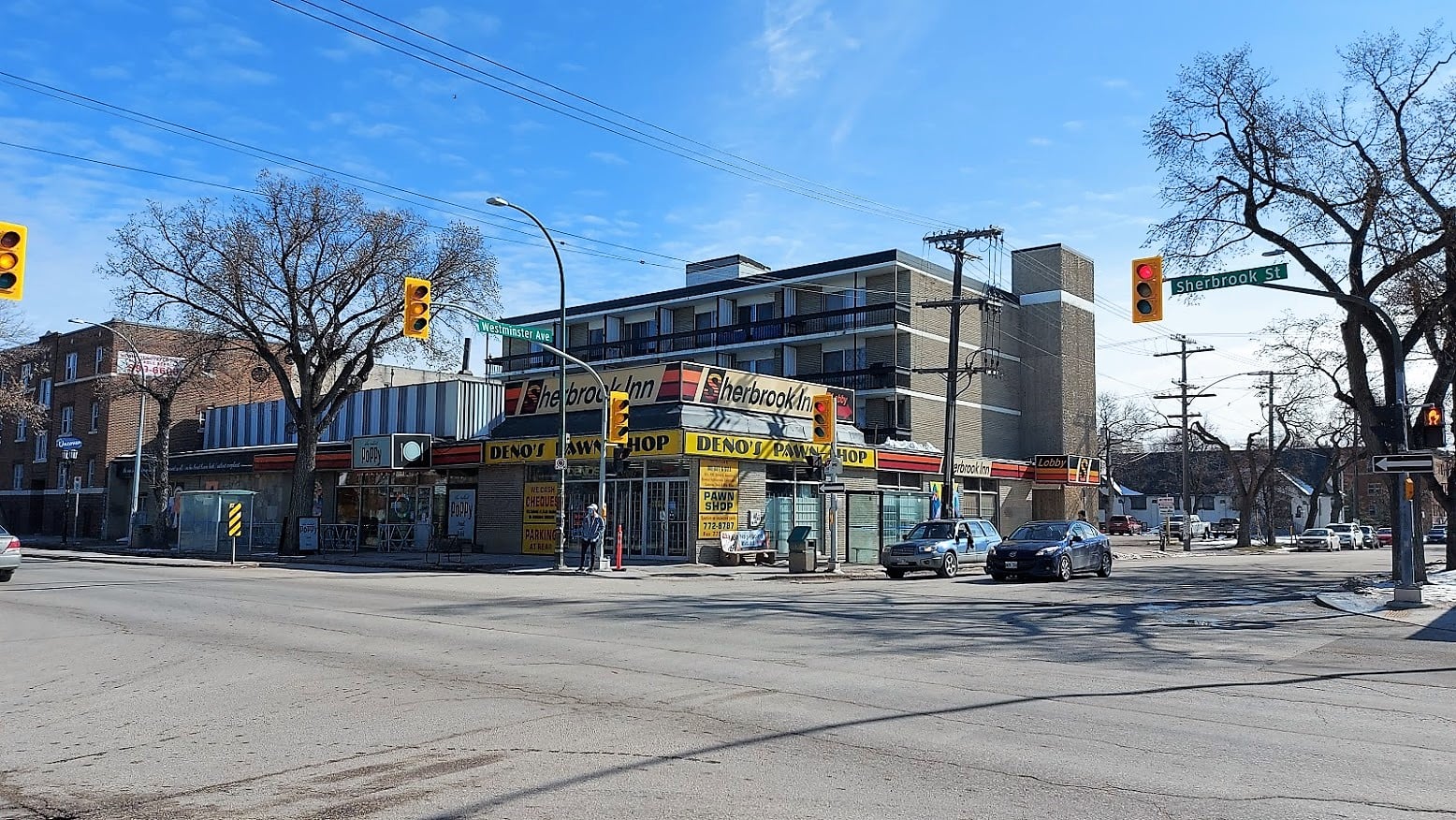
Sherbrook Inn and Vendor Closed

The announcement that Sherbook Inn had closed their vendor and lounge in the last weeks has been met by stony silence from the owners. The pawnshop and other businesses located in the building have as much information as the public does. The Tallest Poppy closed sometime ago.

The hotel sits in an area that has seen some spark of business but for decades, it has been the proximity to violence and perhaps even the source of problems in the area. It remains a question of whether parts of the neighbourhood are the problem or the hotel is the problem. Perhaps they feed off each other.

In the 1990s the area was suffering over a good part of the west end. Arson was a major problem as was rooming house murders. The hotel itself was scene of a murder back then and the reputation was a rough one. Since then we have seen part of Sherbrook and Maryland have new housing built, assisted living by the hospital and some new restaurants and shops.

The last few years have seen a return of arsons and nearby there were four people killed in a shooting. In another recent murder, the victim's truck was found in the hotel parking lot. The possible killer died after a police interaction. Drugs and alcohol have always played havoc in Manitoba. The harder drugs are hurting the entire continent. 

The province has been very slow on supporting rehab programs and supportive housing. Mental health supports have been just as challenging. The one thing that people in the West End all seem to agree on is that the Sherbrook Hotel has been scary and despite the efforts of some in the community to put wrestling in and Tallest Poppy, it has gotten worse, not better. 

The Free Press article ripping Sherbrook was one of utter contempt and disgust. The big question is: Will this compel the owners to sell? And if they sold, would it be another hotel operator to own it? At this point, the building may not be worth anything whereas the land might be. There is potential to turn this site into something that might enhance retail on Sherbook as well as provide housing. There have already been a few hosing projects along Sherbrook as well as Maryland that show developers are interesting in investing.

One thing for certain is that each block of an area has to be part of the solution to a vital neighbourhood. If the hotel is a no go zone then whatever success you have near the hotel or across from it is blunted by the feeling of danger.  A hotel by itself doesn't have to be a bad thing. The Osborne Village had at times been a vital part of the business and culture of the area. It remains to be seen whether its demolition and what is coming will contribute to a real street life presence on Osborne. Perhaps with some of the developments down the street, we might see Osborne be reborn again. But the rent for commercial and residential people has to be more sensible.

The backlash against high costs has hit even McDonald's which has taken hits for $3 hash browns in the U.S. The company has declared they will be looking at the affordability issue. This was major news worldwide as the CEO said the complaints have the company looking at this issue. This can be said of so many industries where they have kept increasing prices.

It is always somewhat amazing sometimes that commercial space goes unrented for so long. One of those reasons often is that some owners refuse to sell or bring down the price or subdivide. It will be interesting to see if the owners of the hotel will sell it as a hotel or for the land. Or maybe the wait goes on forever as we sometimes see. 

As with the 1990s, Wolsely is on the edge on either a slide downward or a turn for the better. In the past, a revival of property values, people investing in property and security, a downturn in crime helped west of Maryland become a favoured community to own a house and some businesses thrived. The hotel closure and something new happening on the land might help change things extending down Sherbrook and spread to surrounding streets.

At the moment no one knows what's happening. It can be a slow burn of empty properties just siting and doing nothing. Even on major roads like Portage Avenue it is surprising how many places remain idle year after year. Former hotels have been converted at the Clarion and now the Balmoral for medical visits from the north. By all appearances they seem to be a practical solution for a need that is growing with an aging population. In Minneapolis, some older hotels have been converted for local income housing for those who have been homeless.

The mayor and the premier have both said they want faster solutions to the housing crisis in our region. An old hotel on Sherbrook might be what is needed.

Saturday, June 10, 2023

USA Today

The above is the cover of USA Today first publish on September 15, 1982. For those Winnipeggers looking to get a copy at the international newsstands, it wasn't easy. Even in the States it was limited to only a few metropolitan areas. However, the colour pages, graphics and weather map of the entire United States would go on to influence every other print paper including the Winnipeg Free Press. Derided by the big news groups at the time as being McPaper, it lost money until 1987.

It was in 1984 that USA Today's began to show up in Winnipeg. Unlike the U.S., it cost 50 cents. Canada got the U.S. version rather than the newly developed international version. Eventually USA Today boxes that looked different from any other news box arrived in the city. In various parts of the downtown and even in neighbourhoods like River Heights, the USA boxes shaped like TV stands appeared, usually by bus stops.

It would be wrong to call it the great era of newspapers in Winnipeg as each era has had great and sometimes terrible moments. The historical start of Winnipeg had many scrappy English and non-English newspapers covering the region and beyond. The 1970s had an epic battle between the The Winnipeg Free Press and the Winnipeg Tribune with many innovations for subscribers. Sadly, that ended when the Tribune closed in 1980.

Luckily, Winnipeg only went a number of months before a number of local business people and former writers of the Tribune got together to start the Winnipeg Sun. While tabloid in format, it was local and distinguishable from Sun counterparts for nearly 20 years. The sports department was excellent and the yellow news boxes were easily recognizable. From 1980 on there were often four or five news boxes on prominent corners. Local, national and international. And a good book store or new store might have copies of everything from New York Times to the Calgary Herald. It was a heyday for print media.

And why not? There was no Internet and print was the best way to report news and make money from advertising. Our family at one point sometimes had four newspapers in the house. With no Sunday shopping till the late 1980s, a weekend paper would stretch over two days. The Sun eventually added a Sunday paper and people took a section each to read whether it was local, sports, comics or opinion. 

USA Today had a Friday, Saturday and Sunday version that I'd pick up. The price of 50 cents a day was too rich for me but a weekend paper often had special sections. Their "Labor" weekend paper was usually something we picked up when down in Grand Forks, North Dakota. The early 1980s Columbia Mall had 71 stores along with Target, JCPenney and Dayton's. Prior to the 1978 opening of Columbia, our family had made a few trips to Fargo, North Dakota for the 1972 built West Acres Mall.  Often it was just a day trip from Grand Forks where we'd have our hotel. In Grand Forks, as young kids I remember shopping in downtown Grand Forks.

By 1984, we mostly stayed only in Grand Forks at the Westward Ho. And we always picked up a Grand Forks Herald and a USA Today. The Sunday Herald was thick with ads that we perused before shopping. The USA Today on Labor Day would feature the upcoming TV season. I had occasionally bought TV Guide's Fall Preview but found it less satisfactory than reading USA Today.  Our family was fairly well informed about what might be good in the coming season. A lot it was revealed in the TV listings of both Free Press and Sun. But USA Today compared and contrasted the offerings and got me excited about shows I might like.

USA Today also ran special sections for baseball and the NFL that were popular. I'd liked the graphics for the various shuttle missions. The most impressive thing that often attracted the eye was the full page weather map. I contend that more geography and sense of America came from looking at the 50 state weather map than what appeared in any national media or in education. It also listed much of the world fairly well.

I loved the USA Today logo. The new one since 2012 feels more washed out and even years later I'm still not used to it. Truth is, since the pandemic, I have only been to the States once since 2019 and that was this spring. One thing had changed and that is, it isn't easy to find print newspapers of any kind. Where they used to be at every gas station or news boxes outside restaurants, these things have gone missing. And hotels used to have newspapers at front desk for free or dropped by your room. I still see newspapers at some Winnipeg hotels but not once in 2023 south of the border.

Perhaps the assumption is that people will get all their information and news online. However, the roaming charges for Canadians makes use of a cellphone prohibitive except when using WIFI. The good news is that WIFI is far more available than it was prior to the pandemic. But I'll be honest. I don't like reading newspapers or magazines very much on a cellphone. As such, I sought out USA Today and found it hard to find a print copy. I had to do a search about retailers who sold it. Some grocers and gas stations. But far less than a few years ago. And far less copies!

Contrast that to Winnipeg where there are quite a few Saturday papers at most 7/11s and grocers. And a good supply any other time they print during the week. The digital wave is only a part of the assault on news. Polarization means that many people stick to their silos when it comes to news and media. USA Today has some editorial and opinion content that is ranked left of centre but there is enough to appeal to many with sports, weather and entertainment as well as news stories from across the United States.

I hope papers like USA Today survive in print. We have seen books and records make comebacks in part because people have preferred the format instead of a digital option. The newspaper once called McPaper has been far more resilient, colourful and national than than the regional fare that came before it but it wasn't really meant to replace your local paper. The national scope of the newspaper was what made it different and special. Here's to many more years of USA Today.

Sunday, May 28, 2023

May Long Weekends

The Victoria Day weekend in Canada and the Memorial Day weekend in the United have followed one another almost the entire history of our two countries. Above is Fargo from a recent visit.

There is meaning behind both day although a lot of it seems lost in the rush to get to campground or beach.

Given geography, it might have been better for each country to exchange the week. Canada’s May 24 is often three different weather events over three days from snow, rain to sun. A week later might at least drop the snow part.

As for the U.S., they seem to have a lot of severe late May weather. Still, the general feeling is that the weekends are the kick off of summer as school age kids have that last weekend before most end school in the weeks ahead.

Travel is usually required. And barbecue and family often a must. As my dad was a teacher, the Victoria Day weekend was a getaway to either Grand Forks or Fargo. We didn’t get as far as Minneapolis except when travelling in the longer summer break.

Others in Manitoba took the time to officially open the cottage if it hadn’t been open already. As mentioned the weeks leading up to the May Long could be fabulous or terrible. A cottage weekend on Victoria could be three days of cold rain playing cribbage, trivial pursuit or puzzles. High speed, cable and satellite are more recent cottage attractions. Still, not every cottage is so equipped.

In Winnipeg, those remaining in the city made a sci-fi weekend a main attraction. And it should be pointed out that not everyone travels. For university and college students, it is a busy work weekend.

However, for our family, it was a chance to be in a pool, shop at stores not yet arrived in Canada and watch more TV channels and programs than we thought possible.

For Canadians, the Memorial weekend in the States meant the kick off the Hollywood blockbuster from the mid 1970s on. This weekend, of course, is Disney with a live version of The Little Mermaid.

But it also means seeing channels with Memorial Day programming. This means movies about war, many WWII movies. The second war is as important to Canada as it is to the States and Hollywood made a few films with Canadian angles. However, we did not have the industry then that we do today. Nor do we do nearly enough Canadian stories for the big screen. Blackberry this past month in the first in a long while that we have seen.

Still, the two weekends represent family, friendship and a chance to do something we don’t do nearly enough, get together and share something in common.

Friday, December 2, 2022

Can Housing in Winnipeg Keep up With Demand?

As 500 apartments are built at Bison Drive and Centre Street in Bridgwater, you have to wonder if they will go up fast enough with Winnipeg's growth. The $200 million development of three buildings ranging from 6 to 8 storeys is underway with the first to be completed in 2024 and the last by 2030. With 11,000 people added to the area since 2016, it is only getting bigger and there is new construction on other places in the neighbourhood and beyond.

The present PC government is focused on turnpikes all along the Perimeter Highway presumably to add even more housing just outside the city. However, single family dwellings just won't cut it with the amount of people entering Canada. Winnipeg can expect a huge influx over the next few years. And for those asking why, the answer is a huge amount retiring from the baby boom. Business is already crying for more workers. And wage is not the only factor in not filling jobs. Unemployment is historically low and well paid jobs are not being filled simply because we don't have people in Canada either trained or available for the job. It is hard to unretire someone who has left the workforce and spends six months a year in Arizona.

For those who resent immigration, it is difficult to imagine who would staff manufacturers, healthcare or technology companies without it. Quebec has said they will limit immigration for language reasons. It seems that is a race to extinction of another kind. Want to see what a very rapidly aging population looks like that is not replacing its workforce, look to Japan where non-urban areas are being abandoned and no one is alive to keep them going. Japan's population is going down rapidly which has has major implications for prosperity and caring for that aging population.

The cost of business materials and shortages of workers is making it harder to build units of housing just when we need it the most. And people feeling costs but moving out of the city find that those costs don't stay low because of rising support of infrastructure and transportation costs to get to jobs. It is a vicious circle. The federal government is contributing money to affordable housing, Notable of the 500 units going up in Bridgwater at EpicCentre, 50 of them will be at 30 per cent below market rates. The federal absence from housing over the last decades save for financing was a mistake. Provinces often used transfer payments for tax cuts and other CMHC policies on mortgages favoured those buying detached houses.

The lack of a more coordinated effort of all three levels of government, four if you include school divisions, has meant affordable housing has gotten harder to get. This is reflected in growing amounts of people homeless. Rent can't keep rising 10% a year without more fallout. The lack of single room occupancy in Winnipeg has created a situation where a few thousand people are without permanent housing. 

Some tiny homes are coming onstream on Main Street shortly but they are millions over budget and very late because of the pandemic and supply chain issues. The closure of so many Main Street hotels discharged so many people onto the street. There were two few conversions like the Occidental and now the Bell hotel into small and affordable housing. Minneapolis has accelerated their plans to converted worn out motels to these affordable option. Government have bought these places rather than let them go to demolition. In Winnipeg we have cleared land and demolished hotels that stand vacant today.

As yet another homeless camp burns down, the need seems even more deadly apparent. Even in the 1970s when alcoholism was perhaps as destructive as the drug problem was now, you did not see homeless camps everywhere. Single room occupancy was the stopgap even if people thought it was not desirable. Today, small places and some form of support for income-based housing has to be the rule of the day.

As for the housing for other incomes, recognition that building massive highway, water, sewer, police, fire, social, community and education services for a low density area will only result in its failure. Greenbelt encroachments around cities like we see in Ontario takes up agriculture space that we don't get back. Worse, it creates demand beyond those greenbelt evens further afield. In Manitoba, we see urbanization outside Perimeter and those areas still rely heavily for coming into the city for jobs and services.

The new mayor has said he realizes he needed the suburbs to win election but that the problems of crime, public transportation and downtown will simply affect the city as a whole. Those won't be fixed by expanding Kenaston and Peguis. A serial killer caught and three missing indigenous women makes it difficult for elected officials to pretend that their job is limited to infrastructure. The deaths of these women is world-wide news and the vulnerability of our population, poverty and issues surrounding violence can't be overlooked.

The only way out of this cycle is to build housing like what is happening in Bridgwater with an affordable housing component. There just isn't enough. And while there are a ton of apartment housing going up along streets like Pembina Highway, it is generally not as affordable as it should be. It also points to the utter and complete failure of the University of Manitoba to build enough housing for the nearly 30,000 students it has. When students rent illegal room houses near the university, it shows that failure boldly.

Canada will grow most certainly but the housing policy has to grow or we will not be able to take students in, immigrants in, serve our elderly, end homelessness or make room for kids. And we certainly won't be able to take care of vulnerable people who are ending up dying every week.

Thursday, May 24, 2018

Winnipeg Goldeyes 2018 Season Three-peat?

They did it once and then did it again. As other Winnipeg sports teams struggle to get to the play-offs and win, the Winnipeg Goldeyes have done it twice in a row and look to make it three in 2018.

This year's Goldeyes home opener is this Friday at Shaw Park and sees the return of several players who helped propel the team to victory last year. As in past years, the Goldeyes are down in Texas getting their season started. They just swept their last series which is a strong indication that the team is looking strong as ever.

This year marks 25 years for the return of the Winnipeg Goldeyes and things look pretty good when reflected back over the years. In 1994, the Goldeyes joined the one year old Northern League as a transfer team and played in Winnipeg Stadium. It was less than ideal but the team itself was the real deal. In the first year, the team took the title.

The Pan-Am Games was a turning point in 1999. As the city was still reeling from from loss of the Winnipeg Jets, the chance to build a baseball field downtown reached fruition. It was not without controversy and lots of public money spent. Through three phases in 1999, 2000 and 2003, the stadium was transformed into one of the most beautiful baseball parks in North America. In 2010, the Winnipeg Goldeyes switched leagues to join the American Association and that is where they are today.

The American Association is looking the healthiest in a lot of years. A few of the teams like the Fargo-Moorhead RedHawks and St. Paul Saints are strong markets with equally strong teams. Generally, it has been the southern division that has struggled with failing teams, shared teams, low attendance and poor competitiveness. Things may have stabilized for the time. Baseball seems to be on the upswing in many markets with new stadiums and ownership groups.

This year the Chicago Dogs join the league playing out of Impact Field that was just constructed this year in Rosemont, Illinois right by O'Hare International Airport. Next year Milwaukee gets a new stadium and team to join the league in 2019. Things look very good moving forward.

The continuity of the team in both front office and the field is the recipe to success. Rick Forney is back in his 13th year managing the team. Returning players are fan favourites like Reggie Abercrombie, Josh Mazzola and solid pitching group with returning Edwin Karl and Charlie Rosario among others.

At the independent league level, it is professional ball but players are making something like $800 a month and have room and board all over the city. There is no big TV contract. The radio broadcast with Steve Schuster is at an elite level on CJNU. This gets as close to on the ground sports and fans involvement as you can find. The players are heroes but earn less in a year than a Winnipeg Jets player makes in game.

As with any independent league, what happens on the field is enhanced with what happens off the field. Young and attentive cheer squads, ballpark food and beyond and simply sitting outside downtown watching a train chug along behind the grandstand so that even players watch in bemusement. And all of this that an entire family can see without breaking the bank.

When pointing out what things have happened in the last 20 years that have turned Winnipeg around, the Goldeyes and their ability to attract thousands of people downtown consistently has to me mentioned. Their success and ours have been mutual and they are back this year to entertain once again and to hopefully, take home the prize for a third year in a row.

Winnipeg Goldeyes home opener is this Friday, Many 25.

Tuesday, September 6, 2016

Goldeyes Make the Play-offs

The unrelenting rains on Sunday pushed the Goldeyes/Redhawks game to Sunday and a double header was scheduled on Labour Day. It quickly became known that the Goldeyes needed one more win to clinch a play-off spot ahead of the hard driving Laredo Lemurs.

The first game of the double header was won by 6-1 by the Goldeyes and the result was a jubilant celebration on the field with all the players and managers. It is the 18th time in the 23 year history of the team that they make the play-offs. Only a very strong performance in the latter part of the year got them the spot this year.

On Wednesday, the Goldeyes will face another old rival in the first round of the the play-offs. The Saint Paul Saints will arrive for a best of five series. Shaw Park will host Wednesday and Thursday and CHS Field in Saint Paul will host game three on Saturday and if need be games on Sunday and Monday.

This past weekend also saw the Goldeyes make history with the first play by play called by a woman in radio broadcast. Danielle Doiron did an excellent job and will continue to be a force in the Goldeyes front office.

Monday, March 24, 2014

Factory Outlet Winnipeg - Outlets of Seasons

Outlets of Seasons
It looks like the development across the road from Seasons of Tuxedo will be known as Outlets of Seasons. Forster Projects and Harvard Developments look to open the first part of the new factory outlet mall in summer of 2015.

It is a race to see who gets their factory outlet mall up first. The factory outlets of Tanger indicated they were interested in building in Winnipeg in 2011 and are only now starting to build across Canada. They may be beaten the punch by Outlets of Seasons.

The area across from Seasons of Tuxedo is 117 acres and has been zoned for residential as well as commercial. The retail available for leasing is a shade over 850,000 square feet. Just over 330,000 square feet is set aside for factory outlet stores.

To put that into perspective, the 100 stores of the Albertville Premium factory Outlet mall in Minnesota occupy 400,000 square feet. Best guess is that Winnipeg could be hosting upwards of 80 factory outlet stores in the configured space.

Outlets of Seasons across from IKEA
A typical factory outlet mall might have Nike, J. Crew, Pottery Barn, Ralph Lauren, Tommy Hilfiger, Lacoste and Kenneth Cole. Some of these stores already exist, some don't in the Winnipeg market.

Factory Outlet in Yellow
The building of this factory outlet does not preclude the building of another but it is the rare city that hosts more than one.

The idea of a hotel and a movie theatre on the site seems unlikely now but there are a few places it still might be possible north or south of the Sterling Lyon.

A few key open spaces available
Some retailers like Target have been stung by not being ready for the Canadian market and have lost a bucket full of cash. Still others have been quite successful and U.S. retailers still look at Canada as an uptapped market.

If Winnipeg can only have one factory outlet mall, you can better believe the race to get started is well under way. Expect a lot of work between now and 2015.

Tuesday, June 11, 2013

Scheels Superstore to Open in Columbia Mall Grand Forks

Scheels Sports
It isn't new news for those in Grand Forks, North Dakota but it might not be known by Winnipeg people who go to Columbia Mall in the U.S. The announcement really was made in 2011 and it was about the disposition of the old Target store at Columbia.

The old Target closed in 2001 in favour of the SuperTarget across the street on 32nd Avenue South. And thereafter, it has sat empty. The four screen movie theatre and Office Depot were also shut and that side of the mall became a sad reminder of how vital that area had been.

The mall built a new Sears in 2000 when the old location at the South Forks Plaza closed.

Columbia has been a favourite of Canadians since 1978 when it opened. However, the closure of the Target was a major hit. Not even the the 2005 renovation that added a 430 seat food court was enough to undo the fact that one part of the mall ended in a dead end.

For more and more people, the trip farther south to Fargo and then again to Albertville and Minneapolis too. For many people, West Acres in Fargo and the surrounding retail area has been sufficient attraction for many people to bypass Grand Forks.

Despite the attractions of a Super Walmart and a SuperTarget as well as the Grand Forks Marketplace across the street from Columbia Mall that has Kohl's,  Best Buy, Lowe's Home Improvement, Ashely Furniture, Gorman's and Old Navy ... it still didn't match the heyday when Grand Forks was the destination to go for Winnipeg shoppers.

Well, the days of the empty and blocked off Target store will be coming to an end next year. In 2014, Scheel's Sports will be opening a 120,000 square foot location at Columbia. It will coincide with the closure coming at the end of their lease at their Columbia Road location across from the hospital.

The giant location of Scheels won't be the same size as Fargo's world beater 200,000 square foot  and two floor colossus but it will very big and roughly double the employees. It won't have a Ferris wheel but it is likely to have the shooting simulators plus a large selection of stock.

The arrival of Scheels's will likely kickstart the mall a great deal. Interest by movie theatre companies and other retailers will be piqued.

And a revived Columbia Mall will make more Winnipeg travellers south stick.

Now...I wonder if we can ever get Scheel's here in Winnipeg. We get excited about a 17,000 square foot sports retailer opening up. Imagine something as big as a Scheel's.

Friday, October 29, 2010

Radisson Hotel Downtown


Two views of the Radisson Hotel Downtown Winnipeg

In the last year, under the new ownership of the Canad Inns, the Radisson Hotel Downtown has undergone a $5 million renovation of its rooms. Reviews have improved in the last year of the hotel itself.

One Man Committee wrote about the downtown hotels as well as some of the newer airport hotels going up on October 25.

I wrote about some of the new hotels back in July. They are still under construction and I will try and get some pictures soon of them.

I agree with him that construction of hotels downtown has hit a slow patch.

Winnipeg, unlike many places in North America, has never really had a hotel district. They are spread out all over the place.

We have been seeing a little more of a congregation of hotels in the airport/Polo Park area. That is not surprising given that this is the main retail area of the city and one of the place that would attract out of town guests.

I remember when the Northstar Inn (now the Radisson) was built in 1971.

Here is a commercial for it from 1980.


Of interest to note, parking was free back then. Today for guests, I hear it is $10.

I used to go the Northstar Cinema in the basement of the hotel through much of the 1970s and 1980s. For a time, it was the most modern theatres in the city and it is where I saw Star Wars in 1977. I can remember line-ups out the door and around the corner.

There were times during the summer when you could see lines for the Northstar, the Capitol, the Garrick and the Metropolitan all on the same night.

The Polo Park Cinema in the basement paled in comparison. I hardly went there in all the years it was open.

The North Star had great screens, great seats and the best sound in those years.

I would park in the parkade that towered over Portage Avenue. I knew several people who were terrified of that parking lot but that is where I would park my Plymouth Suburban station wagon that was the length of what the Cineplex Odeon used to be in Eaton Place.

The building was under construction starting in 1968 but fell way behind schedule. There was a flurry of building in that period with hotels and offices going up all over the downtown, albeit spread out from one another. Th hotel opened in 1971 officially but the theater and parking lot were up and running before that if I recall correctly.

The proximity to the MTS Centre is a plus for the Radisson. My personal view is that Canad Inns owner would do well to promote that fact in its other center of business operations, namely Grand Forks, North Dakota.

Our tourism promotion in North Dakota and Minnesota is negligent. Tourism info should run weekly in the Fargo Forum and Grand Forks Herald. Instead of going to concerts in Minneapolis, students and other folks from our southern neighbours should look to their friend to the north.

We have to put on our best face, gussy up our hotels and deliver a message that we are open for visitors.

The idea of an arts and entertainment area around the MTS Centre is not a bad idea. It is what the area used to be like when the movie theatres were on north and south Portage.

I think that if the focus is on enhancing that idea, we might see additional hotels and boutique hotels at that.

Till then, I hope the Radisson Hotel continues to spruce up its little corner of Portage Avenue.

hit counter javascript

Friday, September 3, 2010

The Grand Forks, Fargo, Minneapolis Trek


The Metrodome in the foreground of the skyline of Minneapolis.

Every long weekend (and often any weekend), a steady and sometimes very large stream of traffic flows south down Highway 75 to the U.S. with the intent of combining a shopping trip with a holiday.

The three primary destinations usually are Grand Forks, Fargo and Minneapolis.

Grand Forks has generally been the quickest destination for a family with young children, those that don't like to drive far or those with only a few days. Columbia Mall has always been a favourite with Winnipeggers ever since it was built in 1978. With Target, JCPenny and Dayton's as it main attractions, Winnipeggers flocked to hotels nearby and shopped in a fairly stylish mall for the time. For a time in the 1970s, many Winnipeggers by-passed Grand Forks to go to Fargo's West Acres Mall which was built in 1972.

I remember that I felt there was a huge difference in the look and feel of Columbia Mall and that West Acres felt like it was from a different era. Through the 1980s and 1990s, Grand Forks remained the closest and possibly the best regarded shopping excursion destination for Winnipeggers. The opening of the first Wal-Mart in 1990 in Grand Forks and rise of the Canadian dollar for a time led to huge crowds in the city. At roughly two hours away from Winnipeg, it seemed everyone was going down to shop.

The Wal-Mart Supercenter opened in 2008 to compete with the Target Supercenter that had opened across from Columbia Mall in 2001. Columbia Mall has never quite been the same since it lost Target. Even with the opening of Sears in the mall in 2000 and the change of Dayton's to Macy's, the mall has not found anyone to occupy the boarded up Target. The movie theatres in the parking lot closed a few years ago as well. The mall in 2009 completed a food court but there are still empty store fronts today.

After the 1997 flood, one of the hotels we stayed at was never the same. The Westward Ho was badly damaged. We stayed there twice after the repairs but the flood damage was too much. It was around this time that our family started making a journey to Fargo as Grand Forks re-built.

I believe that we weren't the only ones to see that the street where the mall was located 12th Avenue had become a hub of big box stores not found in Grand Forks. Barnes and Noble became a favourite stop if only for a day trip from our Grand Forks hotel. Eventually, our family started to by-pass Grand Forks altogether.

While Grand Forks remains a big attraction for the people of Winnipeg, it is not unusual to see many Manitoba licences all over Fargo on a long weekend as well.

The more intrepid travellers and avid shopper makes the full trek to Mall of America in Minneapolis. The casinos and sports teams also are destinations for many people. The Minnesota Vikings, Minnesota Twins and Minnesota Wild draw regular Winnipeg visitors year round. The Mall of America opened in 1992 and has probably contributed greater number of Winnipeggers by-passing Grand Forks and Fargo altogether. Combined the mall with the factory outlet stores in Albertville, Minnesota and most power shoppers can't resist making it a four day weekend.

Over the years the rise and fall of the dollar and the steady march northward of retailers Winnipeggers like has caused ebbs and flows of traffic down Highway 75. Still, there is likely nothing that will stop the travel south of the border for a getaway that involves a little relaxation and shopping.

hit counter javascript

myspace hit counter

Saturday, July 31, 2010

Winnipegs needs a new PATH


Illustration from Number 10 Architectural Group on the latest section of the Winnipeg Walkway.


The completed Winnipeg Walkway via second floor of the Delta Hotel.


Map of the Toronto PATH underground walkway.

Winnipeg has recently filled in some of the last sections of its walkway system that traverses the downtown area via second floor overpasses. It has taken nearly 40 years of work to do and runs about 2 kilometers. Our system, modeled on the Minneapolis Skyway System developed in detail in 1959, began ten years after Minneapolis began their efforts to create a counter to the suburban movement of enclosed malls.

In 2010, Minneapolis (and St. Paul next door) have one of the largest skywalk systems in the world. The largest skywalk system could be Calgary's +15 system which runs 16 kilometers versus Minneapolis's 11 kilometer system.

The most recent expansion of the Winnipeg Walkway connected the existing walkway system through to the Winnipeg Convention Centre with an overhead passage from CityPlace Mall to 330 St. Mary, above Hargrave Street, and in front of the Delta Hotel connecting to the established links at the Convention Centre and 155 Carlton. It can be seen in this picture from earlier entry on the Walkway.

I have commented before about the ugliness of some of the second floor overpasses. The ones over Portage Avenue are particularly harsh. While I understand the intent of the skywalks, I often wonder how things might have been done differently.

While researching this article, I found this claim made about Winnipeg's skywalk system.

Wayne Bollman, supervisor of property management for the City of Winnipeg, said the first skywalk, which connects the Medical Arts Building, on the western edge of downtown, to its parkade, was built in 1973.


Clearly, the walkway from Eaton's to the Woolworth building was first as seen in this picture from 1969.

In any event, Winnipeg modeled its skywalk system on what Minneapolis was doing but one wonders if we mimicked Toronto with its PATH underground system.

The Toronto system has evolved into a "28-kilometre subterranean city, which connects more than 50 buildings and office towers, 20 parking garages, five subway stations, six major hotels and City Hall."

I included a picture above to show how extensive it is.

The Toronto PATH system wasn't planned but evolved from the tunnel Eaton's constructed in 1900 from its department store to The Annex, a 10 story office and discount store owned by the company. The next stage happened in 1927 and connected Union Station and the Royal York Hotel.

The linkages in Toronto resumed in the 1970s when some of the large banks were asked to consider underground shopping by planners to mitigate crowded streets above. Some people resisted the idea in favour of Jane Jacob's philosophy of maintaining a vital street level retailing presence.

It was the underground tunnel system that prevailed although the street level does not seem to have been devastated it as a result. Perhaps this has something to do with the densities in Toronto's downtown or the fact that it has multiple forms of well used public transit systems both underground and on the surface through subways and streetcars and trains. However it happened, the results are that the largest underground shopping mall consisting of 1200 stores.

Most of PATH in Toronto is privately owned with some key parts owned by the city. And the future looks bright for the system as even further expansion is planned.

So what bearing does this have for the city of Winnipeg? Well, it seems that our city has both the underground component and the second story component, both of which have had their share of problems.

The difficulties for the Winnipeg system is that downtown is so spread out and we have never had a subway system that would help feed foot traffic below grade as what happened in Toronto. Winnipeg's main underground components are the Civic Centre tunnel system built between 1962 and 1967 and the Winnipeg Concourse and Winnipeg Square built at Portage and Main in 1979.

The Civic Centre tunnels connect City Hall, Public Safety Building, Concert Hall and Manitoba Museum complex. There is no retailing in any of the tunnels between the buildings.

The Portage and Main Concourse, Winnipeg Square and Richardson Concourse are all tunnels built with retailing in the makeover of the famous intersection in 1979 that saw the building of the Trizec complex (now 360 Main Street).

There has been much debate, most of it negative on the coercive move to force Winnipeggers below Portage and Main. And the result has been a retailing experience in Winnipeg Square that is almost exclusively geared to supplying the offices above with quick service restaurants and supplies such as paper, pens and ink cartrides. There are no retailers selling clothes in the 40 plus stores in the mall. Also included in the retailing at Portage and Main is the Richardson Concourse which is undergoing a $10 million renovation along with the surrounding Richardson buildings. There are only 11 stores in this offshoot to the Concourse and they too are mostly retailing and restaurants useful to towers above. A small food-court also sits under the Canwest Tower.

Neither the Winnipeg Concourse or the Civic Centre look to be linked in the foreseeable future due to the distances involved and the amount of heritage buildings that might require quite a lot of work to make their basements suitable for a connection. Still, the idea out to be encouraged. My suggestion is that the Union Bank Tower where Red River College is building their culinary school should be connected to the tunnel system once completed. Likewise, the Pantages Theatre and Manitoba Theatre Centre might makes for another idea linkage in the space between the two buildings.

Winnipeg needs a more uniform plan on connecting buildings. The idea is a sound one although it is quite apparent that skywalks are wholly inappropriate for some sections of the city. Efforts should be made to slowly connect Exchange buildings with underground connections. The skywalk system looks to be the chosen system south of Portage.

There will still be problems with the two approaches but if Winnipeg endeavours to make up a more comprehensive plan, it could attract people to live and shop in the area in a way that doesn't happen today.

hit counter javascript

myspace hit counter