Showing posts with label Richardson family. Show all posts

Tuesday, June 30, 2026

Portage and Main Open One Year 2026

Hard to believe it has been one year that Portage and Main has been open but here we are. I think we can agree that it hasn't backed up traffic to Portage la Prairie as some critics once thought. Was it wrong of them to think traffic chaos would happen? Who can tell? So many infrastructure projects have been messed up so that this could have indeed been the result.

A number of people were upset because a referendum rejected opening it and many believed that a new one had to be called to change that. The same people who that believed this also believed that no referendums needed to be called for other infrastructure projects such as Kenaston. It is easy to see why. Citizens might reject any project not in their immediate area.

Referendums that bind future governments can cripple governments. If it isn't in the Winnipeg Act set by the province, there is nothing in law that keeps it from being overturned. Or even ignored. It is the electorate who should vote for who they want and not govern by referendums over. At best, a referendum might be useful for finding a direction and seeing what support it has. But it is only as good as the facts before it. There was a lot of missing information such as the cost of maintaining the Concourse and water damage sustained and future damage. The other information missing was just how much the cost of opening the intersection would be and what sort of traffic problems it possibly could create if the barriers came down.

The information that was provided suggested that no action was required and there would be no cost for it. This was resolutely not true. However, even now we don't know the costs for fixing the Concourse. We did know that there was at least a cost of either fixing or removing the barriers as they were decaying along with the road at the intersection. Ultimately, it cost $21 million to remove the barriers and restore the corner. The $73 million estimate for the Concourse repair could be less or more. Hard to say. No one running for Council wants to loo under that rock.

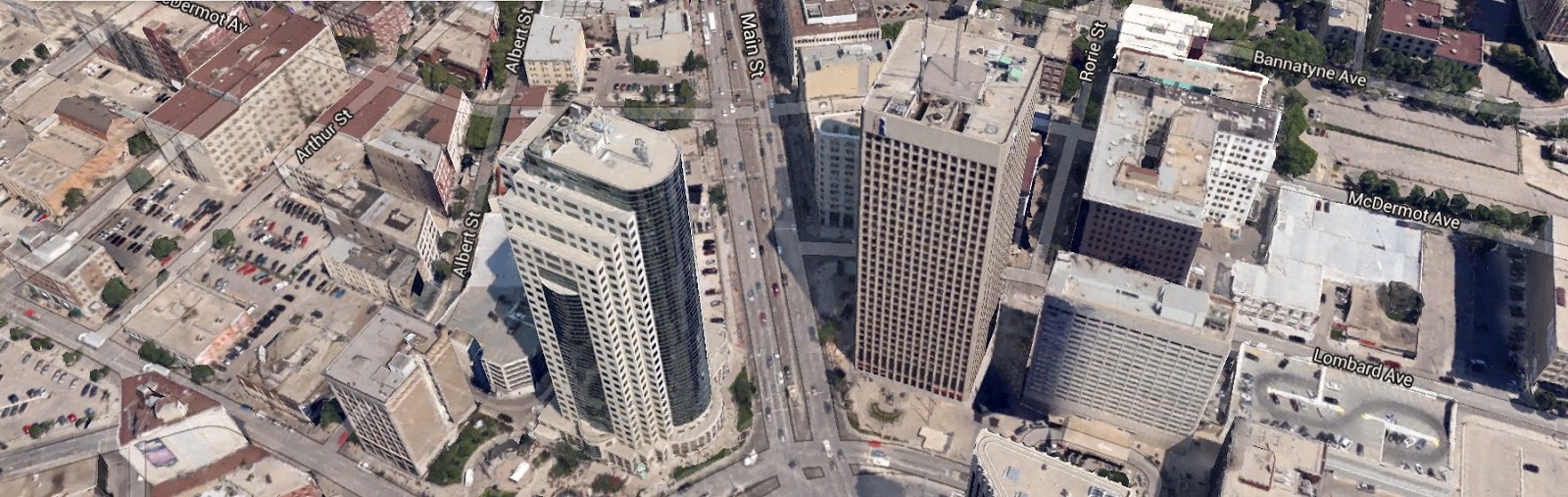
So what has been like after one year? The truth is the flow of traffic is not terrible and the sightlines are are so much improved. It is worth noting that assaults and sexual assaults were able to happen at the corner because no one could see from the buildings or the road. Now the intersection is so wide and open. The lanes and the pedestrian crossings are clearly marked and there appear to be enough turning lanes. There is still a lot of construction beyond the intersection but the corner itself seems to flow nicely.

And there seems to be some life in the corner. The Richardson Building has been getting upgrades and a new tenant in the form of a law firm is moving into three floors. The Fairmont will close this week for near a year for $120 million in redevelopment. The Manitoba Metis Federation is busy working on the former BMO location to turn it into a cultural center. Easier pedestrian access will go a long way for tourism. 

 All in all, the opening has not resulted in the chaos at Portage and Main. Some of this can be attributed to better turning lanes, fewer buses shunted through, well lined car and pedestrian lines on the road and probably fewer people working at the corner than in 1976. Also in the mix is the fact that the Concourse remains open through the hours of 6.30 AM to 10:30 PM daily. The cost of filling it in could be around $11 million so the city is weighing the options which won't come till 2027. Still, in 2026, the corner feel fresh and works well and the critics are melting away/

Sunday, February 4, 2024

Richardson Family Re-acquires Fairmont Hotel Winnipeg

The Fairmont Hotel Winnipeg was originally the Winnipeg Inn and part of the Richardson family led development of Portage and Main. It was a long delayed grand presence on the corner that the family had held off on till better times. It was striking that the corner had long had a gas station on the site for many years. A testament to just how much a car city we were even at the historic corner.

Between 1968 and 1970 the Richardson building and the then Winnipeg Inn were constructed. One became the tallest office building and headquarters to Richardson operations across the world and the other became one of the grandest hotels in the city.

The buildings are closer together than people realize. And the Richardson family has spent the last number of years improving the outside with public artworks and doing their part to ensure safety on their corner by moving the much feared entrance to the concourse into the secure are of their building.

From 1970 to 2000 the Richardsons owned the hotel but sold it that year. As a private company, it was probably just asset management. In 1996 they had sold Richardson Greenshields to Royal Bank for cash and shares and owning a singular hotel that needed upgrades probably seemed a poor use of resources. Certainly, in 2003, Richardson was back in the brokerage business and it was likely cash heavy as an investment initially. Today, Richardson Financial is a heavyweight again in the industry.
While the hotel might have been sold, the Richardsons invested $10 million back in their concourse connecting to the former Bank of Canada building at 161 Portage. Upgrades went into the building as well.

In 2020, the Richardson Innovation Centre was completed in the middle of the pandemic and really didn't get the big splash it ought to have gotten. The 62,000 square foot building is sleek and modern and the heart of the research and development side of what the company does in agriculture.
The Richardsons have a campus thinking for their area of Portage and Main and having a hotel in the middle of the property that they no longer own did not fit well with that thinking. They have major upgrades planned according to the exec in charge. In fact, they have stated they believe the business case for owning and upgrading makes sense in the post pandemic era.
Given the Free Press story in the last day stating that office workers are going to continue to work hybrid schedules. Local restaurants are saying that Mondays and Fridays are low points. Some of the workers coming in just two days a week are resentful thinking there is no need for coming in any days.
This is likely up to the companies and workers to sort out. If productivity remains good, they might be right. At its high point, the Richardson Building had 3000 people working in it and 150 support staff. It is possible it might have that many people again but it will be a process. One thing is up though and that it is the hotel and convention business and the Fairmont figures to be part of that.
In 2024 the Richardsons seem to want to make a splash in Manitoba. Their foundation has just helped donate 193 acres of peatland in the province this week. This and supporting the arts over the years has ensured vital aspects in Winnipeg and surrounding areas.

In terms of supporting downtown, it is better the Richardsons own the Fairmont than not owning it. The investment talked about is not idle chatter either. This year will have some substantial building and renovations going. It will be difficult to see how it all meshes together. The gaps between projects in terms of space is always problematic. It will be interesting though to see a number of downtown hotels get built or spruced up in the next year.

Tuesday, August 3, 2021

The Hy's Patio at Portage and Main

Hy's Steakhouse is like a lot of restaurants that have had to shut down multiple times. In their case, the loss of the office crowd the last 18 months amplified the pain.  Many places have had to come up with other ways to reach their customers.
For the last several months the Richardson Family has upgraded everything around their buildings. With so many office towers going up or being upgraded, it would not do for Winnipeg's iconic Richardson Building not to get an upgrade. Public art, trees, lighting and paved areas with garden and greenery have really helped.
Hy's first came to Winnipeg and stood on Kennedy Street from 1958 to 2005. It was known as Hy's Steak  Loft back then. The original was Hy's in Calgary in 1955.  It went on to spread to locations across Canada.

The move to the Richardson Building was accompanied by a name change to Hy's Steakhouse and Cocktail Bar. The same rich textures and colour of the old Kennedy building remained as well as the continued success.
However, as mentioned, Covid 19 has reduced or closed restaurants over the last 18 months. Even now, it will be a slow return to offices and schools. As such many long time restaurants and hotels and open patios which they might not have done had they not had to think innovatively. The Fort Garry Hotel put up a lovely patio and Times Change(d) and Modern Lunch took over last year's Beer Can to set up the Blue Note Park. Beer Can moved to the Granite Club.

Hy's Steakhouse has opened a patio that looks out to Portage and Main. It is hard to imagine that they would ever think of going back to not having one. It certainly looks like it belongs.
As more festivals, concerts and other activities begin all over town, the restaurants that put up a patio will have a new customer stream that wishes to enjoy the outdoors.
The inward looking of some hotels and restaurants over the last decades may have turned a corner during the pandemic. Hope they keep the outdoor aspect in the decades to come.

Monday, July 29, 2019

Portage and Main 1967

In 1967 Portage and Main was preparing for the development of Canada's famous corner, For decades its stood as a gas station and parking lot when the Great Depression stalled plans for a building for Manitoba's richest family: The Richardsons.

Following World War II there was growth in all aspects of the economy as soldiers returned from overseas, went to school or entered the workforce and then had families. Downtown Winnipeg remained the center of activity even as the suburbs grew through the 1950s and 60s.

Still, it took a long time for gas station/parking lot to become what we now know as the Richardson Building. The announcement came in 1967 and by 1969 the 34 storey building was complete. It became the first of a number a towers at Portage and Main but retained the tallest title until 1987.

Prior to being built though, it was possible to see billboards from a long distance away. Coca Cola took advantage of that and built a clock billboard that that can be seen in the picture, Another clock/billboard is in the foreground and can be seen by anyone coming down north Main Street.

Billboards of this kind were banned in later decades by City Hall for the downtown area.

Friday, February 1, 2019

Gas Station at Portage and Main Street

1940s Portage and Main with the gas station that would occupy the space where the Richardson building is for decades. The iconic corner did not see major change until 1969.

Tuesday, January 22, 2019

Lombard and Downtown Winnipeg - Richardson Innovation Center

The Exchange side of Lombard is like a movie set except in Winnipeg's case, the facade is not a few feet deep. Each building on the north side has depth, character and history. And now in the old Great-West Life headquarters, they have a Salisbury House.

It is tough with the Richardson building. It is an iconic building started in 1967 and completed in 1969. The site where it stands now was to host the original Richardson family building but the stock market crash of 1929 and the Great Depression that followed nixed that. For 40 years Winnipeg's famous corner was a surface parking lot and and gas station covered with billboards.

The building stands 34 storeys of which ten floors house various Richardson family entities. The Fairmont Hotel (formerly Winnipeg Inn/Westin/Lombard) and 161 Portage which used to be the Bank of Canada building but is now called Tetratech Building as they occupy two of the eight floors are all Richardson owned as well as the parkade and the Richardson Concourse underneath.

By 1970, the corner was transformed and indicated just how powerful the family was in Manitoba and in Canada. This will now continue with the Richardson Innovation Center being presently built on a surface lot at Lombard and Westbrook near the Nutty Club building.
Surface lots are often the most desolate of places. Owners resist doing anything on them accept monthly rents. Any attempt to landscape them or place a building on them is often scorned. The RBC Winnipeg Convention Centre was nearly thwarted from expansion by the province who did not want to lose their surface lot. They were shamed into it. However, the net result is that the city has seen every trade show and convention expand accordingly. Hotels have a fairly good occupancy rate in the city and the development along with the BellMTS has triggered other long time parking lots to be used for hotels and offices.
I think many Winnipeggers are coming to realize that it is on us to find ways to build employment and livability. Family companies have been doing that for generations in Winnipeg whether it is retailer, financial services, restaurant or manufacturer. The family firm of them all is the Richardsons and each year that goes by, they continue to invest.

The Richardson Innovation Center will be 62,000 square feet and be a research center for the ag division of the company. It will bring top researchers under one roof and look to develop food science technologies to bring to market.
Upon completion, a walk down down Lombard will be a walk down history for Winnipeg in terms of architecture and business. Only a few parking lots on the surface will remain and another building block will be in place for what everyone hopes the city will be. And that is a vital community, with meaningful paid work and a future for us all.

Tuesday, January 15, 2019

Portage Avenue 1960s

In the 1960s it was so hard to get a parking space on Portage Avenue.

Well, not really. This picture was taken across the street from what was the Mall Hotel and Centre which was complete in 1964. A British American Gas sign logo marks where one of their stations was once and a Perth's in the retail block ahead of it. Kitty corner is the University of Winnipeg. The 7 floor Mall office building housed the corporate headquarters of Winnipeg Supply. It was also where the 16 bay bus terminal was.

Sadly by the 1970s the Mall Hotel was one of the most dangerous hotels in the city and one of the seedier ones.

The Gaiety Theatre from Famous Players was later to become the Colony Theatre in the late 1970s. In 1964 it had the longest marquee of any movie house in the province as well as 700 seats in stadium style. A Red Rose Tea sign sat atop the theatre in the 1960s. For a time after 1973 and Gaiety was an adult movie house showing soft porn. It lasted maybe four years before becoming the Colony and showing regular fare again. In mid 1980s it was demolished in favour of Investor Group headquarters which moved from Broadway.

Winnipeg had a fairly lax billboard law in the 1960s and signs were everywhere. Looking way down to Portage and Main a Coca Cola clock sign can be seen. It would be a few years before the Richardson Building and Winnipeg Inn (Fairmont) would be built. The same corner had a Royal Dutch Shell clock sign on the buldings that eventually became the Trizec development (marked with TD logo today).

Overhead of the street are trolley bus wires. One final observation. Look at the awesome VW van parked on the north side of the street.

Friday, January 11, 2019

Portage and Main 1965

In 1965 Portage and Main had two billboard clock. The first was a Coca Coca clock where the Richardson Building is now and could be seen the entire length of Portage Avenue. The second clock was Royal Dutch Shell and was atop the present TD building and could be seen heading toward the intersection from North Main.

For many decades the area of the Richardson building was a gas station, parking lot and Hertz car rental place. It was marked by multiple billboards and looked anything vibrant business districts on the other corners. It would be another five years before the Richardson Building and Winnipeg Inn (Fairmont) would be constructed.

What can be seen in this picture is the 1965/66 construction of the 17 floor prairie headquarters of Royal Bank. It is on the left side in the middle of the block. This was the first of many modern towers to follow that would begin to change Portage and Main to what we see now.

Monday, October 22, 2018

Portage Avenue 1970

In 1970 Portage Avenue was still a going concern commercially. The Bay and Eaton's were still packing them in. There were several 20 storey towers that went up all over downtown bit the most iconic was the over 30 story Richardson Building seen here all lit up in more or less its first year. The Northstar Inn (Radisson) on the right was up at near the same time built by the owner of Famous Players. It contained the city's newest and swanky movie theatres as well as highest parking lot in Winnipeg.

It was still possible to find a gas station downtown. A Gulf station is seem on the south side of Portage Avenue.

The north side of Portage was always a little less glamourous. By 1980 it was in full decline as the city plunged to the hardest economic times since the Depression.

Sunday, September 16, 2018

185 Smith Street Public Housing in 1971

185 Smith under construction in 1971 for Manitoba Housing and done in 1973. Background Canadian Grain Commission completed in 1972. The 21 story building sold this past year to private company for housing after three years empty.

The Richardson building in the background was completed two years earlier in 1969.

Wednesday, September 12, 2018

Let's Talk About Langside Street - University of Winnipeg

Once upon a time the University was one block square. Portage Avenue was it's beautiful face although for years it was a bit crumbly despite green verdant land right to the street. Balmoral was one tough border street with belching buses idling at the station and and even toughener Mall Hotel with seemed to be a permanent police presence right through to the 1980s. Furby Street was greener and a had a few private apartments where students stayed and older residence that were slowly decaying, one filled with dozens of cats. The rump end of it all was Ellice where Lockhart hall rose high up to the street but unlike the front of the campus had no curbside appeal despite it being one of the newest part of the campus.

Welcome to the 1980s. The building phase of the University of Winnipeg in the 1960s and 1970s was over. The decade of cuts began even as student enrollment began. Classes were cut, programs cut. Men's hockey team...gone. Men and women's residences...shut down. They became offices since there was no budget for new infrastructure. Infrastructure was aging every year, tuition going up and a recession was smacking Winnipeg harder that anything since the Depression.

Despite all this University of Winnipeg coped, had excellent instructors and and enjoyed a strong reputation even as students had to attend a year or two more to get the courses they needed because of aid cuts, tuition cuts and courses that were not offered the year a student wanted and needed them.

The University of Winnipeg's sports facilities might have been the worst in Canada, Riddell Hall basement where the school volleyball and basketball teams shocked rivals across North America was a disaster. For a dozen years the university begged for funding but everything was frozen in 1977. It was only in 1982 that a new government allocated spending of over $8 million for what became the Duckworth Centre. The University of Winnipeg Student's Association was so committed to the new building that they allocated money from students via a vote.

Flash forward to 2018 and the U of W has spread across four blocks and more of the city. It has seen the return of student residences, one of the largest downtown daycare centers, restored facades and re-construction of Wesley Hall and top notch Collegiate, a science building, enhanced student dining, better bookstore and and grown its programming and student services. It isn't perfect but until 1984 when the athletic fieldhouse was built, the university was in decline.

There have always been businesses near the university that students patronized but there was no student bar per se. Students and faculty sometimes went to the Union Centre down the street for cheap beer. A close by Legion served the same purpose. But it was haphazard and was not truly a center of student life. The three main cafeterias on the one block campus is where people ate and then left.

As for stores, there were a few across the street like Mother's Music that students went to the 1980s. Supreme Racquet Courts also had students who were members played but campus life was such that very few actually lived in the area. As a result, nightlight was quiet in the proximate area of the university.

This has changed with students living downtown and the numbers keep growing. I will save the discussion about south of Portage Avenue for later. For now, let us focus on north Portage surrounding the university, specifically the west side.

The stretching out of the campus along Portage west has begun a transformation of the street.

To be fair, business has been on the street for eons catering to local neighbourhood and ethnic communities, However, what we are seeing now are changes that seem to reflect that students don't just come to school for classes but live in the neigbourhood.

The stretch of street along the southside of Portage Avenue between Young and Langside would appear to affected by changes in the campus now surrounding them. Some businesses have been there for decades but other are popping up to serve the university. Take the case of Langside where some tiny businesses such as book store, hair salon and a restaurant have set up opposite Richardson Science Hall and McFeetors Hall.

Arzate Hair Salon, Elemental Book and Curiosity Ship and the new Not A Waffle (replacing Yo Tea) sit small and pretty across from the university. Just on Portage itself in the same building is a convenience store, nightclub and most importantly for students, a cellular phone store.

It takes a while for a neighbourhood to change organically. It can come in stops and starts but the presence of a local population and one not prone to a bunker mentality to change things.

Without a doubt, the move of the University of Winnipeg westward down Portage Avenue is changing thing. Further down the street in the block after the science complex, the Good Will restaurant and entertainment space would seem to be a good example of the change we can expect a larger student population can bring.

Everyone will have to keep an eye out for how things are being transformed on what once was a commuter campus.

Thursday, July 7, 2016

Innovation Centre for Richardson International to Build New Downtown Building

Closing of Public Lane
Building on parking lots
It was talked about last year and many people thought that perhaps the Richardson family might put their research and development arm in one of the new towers proposed by the MTS Centre. When that didn't happen, some thought it might go into one of the empty spaces left when some law firms at Portage and Main relocated.

It is now revealed that the Richardson family had other plans altogether. At the corner of Lombard and Westbrook between the Goldeyes stadium, a parking lot and lane will be converted to to the $20 million Innovation Centre for Richardson International.

The biggest division of the Richardson family holding is in agriculture and and the 2013 acquisition of Can Oat milling has triggered a need to consolidate research and development near the James Richardson and Sons Ltd. headquarters at Portage and Main. The work is being moved from Lethbridge, Alberta and Yorkton, Saskatchewan. The Winnipeg center will develop new canola and oat products such as margarine and oils.

The Richardson family often flies below the radar even in their own hometown but it is important to remember they run one of Canada's largest private companies and they spend hundreds of millions in development and acquisitions. The family is also one of the largest for charitable donations and have been significant sustainers across a host of institutions across Manitoba.

The new Innovation Centre will take over a Richardson owned surface lot as well as a public lane owned by the city. In essence a Richardson campus is being created that encompasses several family owned properties.

Urbanists often fret about all the surface lots and they are right. They are forlorn, wasteful and inefficient uses of space. In the last year, we have seen a number of surface lots become important parts of a greater development. In this case, we might see one that relies strictly on private capital.

Thursday, May 15, 2014

The Richardson Family

Richardson Building Portage and Main
The passing of way of George Richardson in the last day at 89 is being remembered by many in Winnipeg.

The family has been the richest family in Manitoba pretty much in the lifetime of every resident on the province. Suffice to say that the majority of the people really only knew the name of the family through the Richardson Building as it seemed eternal and as permanent as the corner of Portage and Main itself.

Winnipeg's first skyscraper and still premiere address. Some people are not aware that the property includes a number of buildings including the Fairmont Hotel, another office tower, a parkade and part of the Concourse.

Many people on the street when asked might be hard pressed to name the businesses the Richardson family were in. To say they were an agricultural company would be to overlook the many other areas of business they were dominant in.

In some respects the quiet eternal nature of the Richardson name is the story of Winnipeg itself. Hard working, understated and doing many things, some of them very well.

We probably will never know just how many people the Richardson family and George Richardson in particular touched. Many other business people have indicated the partnerships they had with the family have been part of their own success. Certainly some of the people who have worked with the the family have done so all their professional lives.

And let's not forget about the charity. The Royal Winnipeg Ballet would not be where it is today without the patronage of the family. It would be difficult to find any cultural organization that didn't see Richardsons as a faithful supporter.

George Richardson had handed over the baton sometime ago. That is a Richardson tradition. The family figures out how to pass things along, remain private, remain humble and remain eternal for Winnipeg and the province they call home.

In so many ways, Winnipeggers will really never know the family but they will always know the Richardson name.

Thursday, June 27, 2013

New Westin Tower for Winnipeg

Proposed design for new hotel, offices and condos
The Asper owned Creswin company has been working on the worst kept secret in the city: an office tower in the empty space beside their 201 Portage (formerly Canwest-TD building).  Like a lot of Portage and Main developments, the intent was to create more than one tower. Richardson was like that, Trizec was liked and the TD tower was like that.

Inevitably, in all of the cases mentioned, an economic cycle ended and plans for further expansion were shelved. In the case of 201 Portage though a huge gap tooth was left on Main Street where a once beloved building stood. The McIntyre building was actually town down in 1979 for a parking lot and not to support the later 1990 construction of 201 Portage Avenue in 1990 atop the CNCP telecommunications building.

A series of buildings got whacked in that block including one that used to house 13 CFRW's offices before they headed to Pembina Highway.

28 or 29 storeys
Winnipeg has not had a Westin Hotel since The Fairmont/Lombard rebranding of the Richardson-owned hotel took place. The company was looking for a way back for some time.

Filling a decades old gap 
The plan for the hotel, offices and condos is contingent on access from Main Street and the use of an alley. The hang up could be the loading docks and garbage pick-up for surrounding buildings. I have no idea how complicated that process is but if people work together this seems to be a problem where solutions can be found.

The inevitable criticisms of placing a hotel downtown and how dangerous it is and that no one will stay there seems to ignore the continued success and longevity of The Fairmont, home to visiting execs and NHL players. As far as I know, it isn't a haunt for activities that scare people off and if the restaurant and lounge activity around the place is any indication with Hy's, Brooklyn's and Baily's, there seems to be a circle of activity surrounding the area.

Please put that clock in as seen in pic
The only gap now on the street if the project goes through will be the pull-in to the hotel along Main Street. I am curious how busy it will be and whether it is problematic for pedestrians.

A certain connectivity takes place when the gap is filled. Whiskey Dix and Fox and Fiddle will no longer have the separation they do from Portage and Main. And the west side of Main can continue the vitality that seems to be taking root with Red River's Paterson GlobalFoods Institute tower beside City Hall.

The one thing that will continue to haunt Portage and Main is the lack of crossings because of the Concourse.  That discussion remains for another day.

Construction should start in August if all ducks are in a row.

This looks like a good project though as a top line hotel at the biggest business corner over a long time parking lot seems like a no brainer and a game changer for that corner.

The design of the building is a lot of glass as per usual now for such towers. The colours create some uniqueness. I am no expert on energy use or design flaws inherent in glass. All I can say is what we have paid dearly for provincial and city built facilities that used limestone cladding. Could this be another example of design issues? Anyone remember glass flying out of the Delta parkade?

Not to throw stone at glass walls...

I still like it and hope that things proceed and that all the bugs are worked out.

Welcome back Westin Hotel.

Wednesday, January 9, 2013

Portage Place

Portage Place Imax to Shut Down in March
I have written and talked a lot about Portage Place since 2008. Suburbanist and urbanists alike hate it. Not since Unicity Fashion Mall has a shopping area so universally been unloved. And we see what happened with Unicity.

The comments of the suburbanists run along this line:

You will never find a more wretched hive of scum and villainy. We must be cautious.

The outright hatred, dread and disdain of suburbanites of almost anything downtown is so deep, I have heard some people say they won't even go to a Winnipeg Jets game for fear of crime, parking and people who don't look like them.

The surprising thing is that some people do not believe The Forks is downtown and don't harbour the same ill feelings about the place. Why is that? Well, we'll get to that in another post.

All this city wide talk on Portage Place is a result of the impending closure of the Imax Theatre. The theatre built in 1987 with 276 seats has become obsolete in recent years due to its size and inability to land first run movies or 3D. The writing was on the wall. Polo Park's new Imax with 433 seats and 3D hastened the death.

Finding a new use for the theatre won't be easy. It represents challenges when it comes to its structure. That will be up to Peterson Group of Vancouver to decide.

There always seems to be the naive belief that the University of Winnipeg will swoop in and take over all the empty spaces downtown. I supposed it isn't inaccurate to say the university has indeed jumped on abandoned bus stations, racquet courts and army surplus stores. However, there is a limit to how much, how far and how often the university can do this.

The closure of Zellers and long term future of The Bay have a role in what happens to Portage Place. People forget that the goal of the mall was to link the north side of Portage from Eaton's to The Bay. Well, Eaton's is gone and the The Bay may be following. 

So what of the future of Portage Place?

Well, the one upside of Portage Place is the parkade. It makes money. A lot of it. However, the Peterson Group doesn't own it. If they did, they might be compelled to make additions to the mall such as a tower atop the east and west pads that have stood ready for years for whatever was desired above the mall.

The Prairie Theatre Exchange continues to thrive in the mall. 

Despite the common belief of a completely empty mall, the places does have tenants and more service-based businesses like dental clinics find the place useful as their downtown clients find they are convenient.

I still think the key to leveraging change lies with the parkade but North Portage Development Corporation seems reluctant to discuss that option since they use the money to subsidize other operations.

I have mentioned before and others are starting to repeat it: The food court attracts a bad element. It should be closed in favour of sit down casual dining to attract a hockey, business and an entertainment audience. However, that is a decision for Portage Place management.

It is possible that the LongBoat and Artis development will stimulate Portage Place to do their own makeover. Polo Park and St. Vital have all gone through major renovations whereas the downtown mall has not. Even Winnipeg Square and the Richardson Concourse have had upgrades.

Now that the Jets have returned, there are 10 years of labour peace in the offing. The Manitoba Hydro building is across the street, a hotel and office tower will be soon built. The potential is there for Portage Place to benefit if the ownership and the North Portage Development Coporation is willing.

As a few people have pointed out, it is always one fire after another being put out downtown. Still, we are seeing successes here and there. The continued growth of population around Waterfront Drive will be felt for years. Apartment conversions of hotels will bring a steady population to some streets. And new apartments will help cover surface parking lots. With people comes businesses. 

Portage Place is not going anywhere, anytime soon. And this is a problem in more ways than one. Still, there is no need to panic just yet. We have to see what developments around the MTS Centre will bring.

edit: Change CentreVenture to North Portage Development Corporation

Tuesday, March 20, 2012

Richardsons to Buy Part of Viterra


The Richardson family continues to be one of the strongest business entities in Canada all the while based in Winnipeg.

Today we learn, the Richardsons will pick up part of Viterra as the Regina-based company is bought up by Switzerland's Glencore International.

Despite the sale of large chunks of the Viterra company, it will remain headquartered in Regina.

We didn't end up so well when Viterra bought up Agricore United a in the past decade. Even now, huge gaps in the once filled Canwest building remain open due to the the purchase and closure of the grain offices (compounded by Canwest being grabbed by Shaw as well).

There had been some promises that Winnipeg wouldn't be so bad off from the purchase of Agricore United but alas, hundreds of employees were shed from the head office that was numbered around 500.

And Agricore's loss came on the heels of United Grain Growers and Agricore joining together. At that time, hundreds more lost their jobs. At least in that event, it was two Winnipeg companies joining forces.

As the Canadian Wheat Board ends (with the loss of hundreds of jobs there as well), the once great agricultural enterprises that employed so many seem to be dwindling.

I wonder how long it will be before we ask: how do we preserve the old Wheat Board building or what should go in there?

Anyways, it is hard to have too much sympathy for Viterra given we got thrown under the bus when they took over Agricore. The Richardsons pick up more grain trading business for a shade under a billion. Agrium from Calgary picks up all the retail stores. Glencore picks up the overseas businesses and makes Regina its base in Canada.

It is hard to measure what value that promise has from Glencore. As much as the promise Winnipeg had from Viterra?

Glencore is in the middle of a even greater $90 billion merger with a mining corporation. Hard to imagine where they will be or where their head offices might exist even a few years from now.

Th Richardsons are not likely to go anywhere. With any luck, this will result in more head office jobs and more economic spin offs for the city.

Likewise, Paterson and Cargill appear to be entrenched in the city.

However, the downtown continues to remain littered with hundreds of jobs lost in agriculture. It is hard to imagine that the end of the Canadian Wheat Board will spur a new movement of ag business that will replace what was lost.

And in many cases what does exist may ultimately be owned and controlled in places like Switzerland.

It will be an interesting year ahead.

Thursday, December 23, 2010

List Time - Top Manitoba Books


Here are the top books about Manitoba for 2010.

1. Coming of Age: 
A History of the Jewish People of Manitoba by Alan Levine. The definitive book on Jewish people in the province.

2. Winnipeg's Great War: A City Comes of Age by Jim Blanchard. Looking at explosive period from 1914 to 1919 in Winnipeg history.

3. Manitoba Politics And Government: Issues, Institutions, Traditions by Paul G. Thomas (Editor), Curtis Brown (Editor) Various contributions on political issues of Manitoba.

4. Winnipeg Love Hate by Bryan Scott The famous pictures of Bryan Scott in a book.

5. Manitoba Premiers of the 19th and 20th Centuries Barry Ferguson (Editor), Robert Wardhaugh (Editor) The story about the men who have served as premier of Manitoba.

6. Tales from the Back Room: Memoirs of a Political Insider by Michael Decter A high profile Winnipeg operative of the NDP reveals all.

7. Manitoba Wild by Bill Stilwell The story about some of Manitoba's unfamiliar or unknown charms in the wilderness.

8. Tales from the Underworld and Other Stories by Roland Penner & Norm Larsen Quirky stories about Manitoba.

9. Extraordinary Canadians Louis Riel And Gabriel Dumont by Joseph Boyden Riel and Dumont as seen by a Metis writer.

10. Just Common Sense: The Life and Times of George Taylor Richardson by Tim Higgins An inside look at one of the richest families in Winnipeg.

hit counter javascript

Tuesday, August 5, 2008

Wellington Crescent Part 1

Wellington Crescent began as an Indian trail along the Assiniboine River. It was names Wellington Street in 1893 after Arthur Wellington Ross, a landowner originally from Cornwall, Ontario who purchased land in Fort Rouge. He went on to become a Liberal MLA in Manitoba and later a Liberal-Conservative in Ottawa.

As Winnipeg steadily grew, land along both sides of the Assinibone River became attractive to the richest citizens. Between 1893 and 1914, large stately homes were constructed along Wellington. As it moved steadily west, it became Wellington Crescent.

From its starting point at the end of River Avenue, the Crescent eventually wound its way to present day Assiniboine Park.

Of all the houses built on the river side between River Avenue and Academy Road, only two remain: The Fortune House at 393 Wellington and the Ashdown House at 529 Wellington.

The Fortune House was spared demolition following a fire in the 1980s. The house was built in 1910 by Mark Fortune, a real estate investor. The family did not enjoy the house for long. Following a European vacation with his family, Mark Fortune and his son died aboard the Titanic in 1912. Fortune's wife and two daughters survived and returned to the city. The house was later sold to William P. Riley, President of Western Grocers in 1920.

In 1950, the house was converted into apartments following the Rileys departure for other Wellington Crescent digs. After a devastating fire in the 1980s, the house was faithfully preserved on the outside while converted into condos on the inside.

The other surviving house on the river side between Academy and River is the former Ashdown House at 529 Wellington Crescent. It was the fourth house built for James Ashdown. Ashdown was one of Winnipeg's most important businessmen and city movers. His hardware business operated out of the same downtown location for many years. In 1907, Ashdown served as the city mayor for two years.

In 1912, Ashdown built his newest house on Wellington Crescent. It was built in the Tudor style and Manitoba limestone walls. Immediately across the street was St. Mary's Academy, the oldest continually operating school in Manitoba. The school, started in 1869, moved to its present location in 1903.

Coincidentally, the Ashdown house came on the market in 1950, the same year that the Fortune House did. While the Fortune House was converted to apartments, the Ashdown House was converted to the headquarters of the Shriner's in 1956. Khartum Temple occupied the house until it moved to their new location on Wilke's Avenue in 2000. A meeting room addition was made to the house on the east side but the remainder of the house was unchanged aside from a parking lot built in the front yard.

There was a debate about what would happen to the house and eventually a restaurateur stepped up and the house has operated as 529 Wellington Steakhouse for the last several years.

Every other house fell to the wreckers aside from those two. The Isaac Pitblado and The William Mulock homes on either side of the Ashdown house were demolished.

Two houses adjacent to Ashdown house fell to the wreckers for the construction of Shaarey Zedek Synagogue in 1949. The house closest to Academy Road originally belonged to David Dyson whose family owned Dyson and Gibson Spice Mills. The company made Seven-Day Pickles. The other home was owned by John Gage, president of Consolidated Elevator which later became Federal Grain.

(to be continued)

hit counter javascript

myspace hit counter