Showing posts with label Portage and Main. Show all posts

Sunday, September 6, 2026

Progress Report on Metis Renovation of Bank of Montreal Building

The design of new Metis headquarters in the Bank Of Montreal building at Portage and Main had become clearer. It will be very well lit and features both the old architecture and new. The completion date still says 2027 but a work left to do. They have good company because the Fairmont Hotel's $120 million renovation will be complete around the same time.

The truth is hundreds of millions of dollar are being spent up and down Portage Avenue and beyond. Portage Place, The Bay and the former Bank of Montreal building as well as various hotels. It takes a lot of time for big projects. And a heritage building takes a long time to renovate versus a new build. At least the Portage and Main removal of barricades has really opened up the space and even critics have come around to the fact that the traffic is not backed up to Portage la Prairie. 

Step by step things are shaping up even as the issues surrounding encampments, drug addiction and mental health issues loom. Connecting the dots of the developments will be the key to success. At Portage and Main, the Richardson building and the former Trizec building across the street are all getting new tenants. The level of activity is probably the highest it has been in a few decades. It is encouraging that there is so much private investment as well. The government money has been mixed in but none it works without a lot of private cash.

I don't just buildings too much by the renderings. When I first saw the the drawings at the Inn at The Forks, I thought it was too dark and foreboding but it has been a success from the start and looked far better in person. We'll get a better idea of the BMO makeover soon. However, momentum has to be kept up. As so often happens, the focus shifts such as it did with apartment building. Going nearly two to three decades of slow to non-existent starts and zoning that the surpasses a decade or more is crippling. Both the city and the province have been guilty of this. They hoard land, take forever to make decisions and delay year after year. Worse, they let private companies do the same with vacant or underused buildings.

In about 24 months Portage and Main will look quite different. It is already look bright and more open and will soon have new attractions with a museum and spanking refurbished hotel. In future, the city needs to looks at building signage and lighting. We have some spectacular buildings but lighting and pizzazz will go a long way. We can be pretty boring in North America. We only have two video walls at the arena and Portage and Main. And they are low down and nothing like what you see in the UK and in Asia.

The MMF will be increasingly responsible for the look and feel what is downtown and are engaging the best designers and artists to it. Can't wait to see what they come up with next.

Saturday, August 8, 2026

GRETA Pub Coming to Former Garry Street Keg

If anyone had been interested, GRETA had announced they were coming to Winnipeg at the end of June. They didn't say where though. The retro arcade pub with locations in Calgary, Toronto and Vancouver is run by a former Manitoban who says he has had Winnipeg on his list for a while.

The Keg closed the Garry Street Keg in June to make way for their very large location at Donald and St. Mary. The old Keg built into a converted Hudson's Bay auto garage from 1911 was the first location of the national chain in Manitoba. Originally The Keg n' Cleaver, the restaurant kept the brick interior and in 1975 became famous for the lounge became an attraction for the young and poor crowd. This reputation continued for much of its early years.

As the menu changed and prices went up, The Keg attracted lawyers from up and down Broadway and Portage and Main. It was also a place where gay community people felt they could go for lunch and dinner near venues close by. Fort Garry Hotel patrons who skip across the street as well to enjoy steak dinners. For Jets fans though, the restaurant was just a bit too small and a just a bit too far from the arena. 

The new gigantic Keg will open close to Jets season start. At St. Mary and Donald, it is kitty corner to the arena and success. The permanent boarding up the old location that is iconic, attractive and has a patio seemed impossible. However, the terrible demise of the former Earl's, now former Boujee on Main, with three arsons and imminent demolition shows that problem with downtown properties. They need security and active use to keep them safe.

GRETA will have the patio active by Labour Day and the pub active by November of 2026. The vibe is retro but should appeal from Generation Z to Baby Boomers. However, it is the Gen Z crowd that is bringing back interactive retro. This could be their place. The street food menu of smash burgers and the like could attract a wider crowd. Young lawyers don't just love big steaks. Attracting a younger crowd than the partners of law firms might be the tonic the downtown needs.

With all the bad news we have seen downtown, items like this indicate that businesses are still seeing opportunity to invest and attract customers.

Tuesday, June 30, 2026

Portage and Main Open One Year 2026

Hard to believe it has been one year that Portage and Main has been open but here we are. I think we can agree that it hasn't backed up traffic to Portage la Prairie as some critics once thought. Was it wrong of them to think traffic chaos would happen? Who can tell? So many infrastructure projects have been messed up so that this could have indeed been the result.

A number of people were upset because a referendum rejected opening it and many believed that a new one had to be called to change that. The same people who that believed this also believed that no referendums needed to be called for other infrastructure projects such as Kenaston. It is easy to see why. Citizens might reject any project not in their immediate area.

Referendums that bind future governments can cripple governments. If it isn't in the Winnipeg Act set by the province, there is nothing in law that keeps it from being overturned. Or even ignored. It is the electorate who should vote for who they want and not govern by referendums over. At best, a referendum might be useful for finding a direction and seeing what support it has. But it is only as good as the facts before it. There was a lot of missing information such as the cost of maintaining the Concourse and water damage sustained and future damage. The other information missing was just how much the cost of opening the intersection would be and what sort of traffic problems it possibly could create if the barriers came down.

The information that was provided suggested that no action was required and there would be no cost for it. This was resolutely not true. However, even now we don't know the costs for fixing the Concourse. We did know that there was at least a cost of either fixing or removing the barriers as they were decaying along with the road at the intersection. Ultimately, it cost $21 million to remove the barriers and restore the corner. The $73 million estimate for the Concourse repair could be less or more. Hard to say. No one running for Council wants to loo under that rock.

So what has been like after one year? The truth is the flow of traffic is not terrible and the sightlines are are so much improved. It is worth noting that assaults and sexual assaults were able to happen at the corner because no one could see from the buildings or the road. Now the intersection is so wide and open. The lanes and the pedestrian crossings are clearly marked and there appear to be enough turning lanes. There is still a lot of construction beyond the intersection but the corner itself seems to flow nicely.

And there seems to be some life in the corner. The Richardson Building has been getting upgrades and a new tenant in the form of a law firm is moving into three floors. The Fairmont will close this week for near a year for $120 million in redevelopment. The Manitoba Metis Federation is busy working on the former BMO location to turn it into a cultural center. Easier pedestrian access will go a long way for tourism. 

 All in all, the opening has not resulted in the chaos at Portage and Main. Some of this can be attributed to better turning lanes, fewer buses shunted through, well lined car and pedestrian lines on the road and probably fewer people working at the corner than in 1976. Also in the mix is the fact that the Concourse remains open through the hours of 6.30 AM to 10:30 PM daily. The cost of filling it in could be around $11 million so the city is weighing the options which won't come till 2027. Still, in 2026, the corner feel fresh and works well and the critics are melting away/

Saturday, June 28, 2025

Changes to the Bus Routes 2025

Winnipeg is not doing anything by half measures in 2025. Today Portage and Main opens up to pedestrian traffic and on Sunday the entire Winnipeg Transit system changes. It is probably fortunate that school ends today and traffic will be cut over the summer during this time because it is likely we are to see adjustments to say the least.

Some bus routes that have been around for decades end on Sunday. Some in River Heights are mourning the loss of one of on Grosvenor and some in Charleswood are grieving some of theirs. There are few neighbourhoods without some big changes coming. The only one with no real changes is Bridgwater as they underwent the change in 2020. Many people will have to get use to transfers in other parts of the city as well as longer walks.

Winnipeg Transit will have guides out Monday but it will still come as a shock for some that the bus doesn't come down their street anymore. Or that the bus stop on their streets are far away. Literally a thousand bus stops have closed.  Some people moved to certain areas because of bus routes so to have one disappear must be depressing.

One major change is that Graham Avenue will no longer be a bus corridor. The goal is to change the street to pedestrian and bike path but how fast this occurs will be important. If on Monday, the buses just stop coming down that way and people leave, it could end up being degraded and a security threat. Worst case scenario is seeing businesses close if they don't get something in place right away. Or for arsons to take any empty buildings there as we have seen on Main Street.

There is a lot of building that will be coming on stream downtown in 2026 so how Winnipeg Transit works with this will be important. It shouldn't for forgotten how the industrial parks, residential areas and hospitals are served as well. Expect their to be some confusion and possibly complaints. And if security for those waiting at transfers isn't addressed, it could downright ugly.

Saturday, June 21, 2025

Portage and Main Re-Opening

In 1979 the most famous corner in Canada was blocked off and went underground. At the time there was about 3000 to 4000 people who worked within a block of the intersection. At every light cycle there were hundreds of people crossing and buses galore discharging riders. Some called it the windiest corner in Canada and they weren't wrong. In the dead of winter, you went out sans your coat at your peril.

The Trizec project of the city demolishing and putting up a massive parkade in support of a private 32 story tower changed everything. The city, cognizant of other cities like Montreal, Toronto and Minneapolis believed that skywalks and underground pathways were the favoured choice for cold weather cities. Some resented being forced downstairs to get across but there was wide acceptance of the development as it also came with a mall in Winnipeg Square.

The plebiscite on re-opening Portage and Main was defeated 2-1 in 2018. However, the issues of what to do about the crumbling infrastructure was never really addressed. For many it seemed like there was no need to do anything despite the fact that water had been leaking for sometime. Eventually, a report came out that fixing the Concourse was likely to be in the $70 Plus millions and involve road closures that could be lengthy.

Some disputed the price or the length of time it would take. The argument from many was that opening the corner would be dangerous and traffic would be a nightmare for the entire downtown as a result. It could get pretty busy back in 1975 at the corner. There were several grain handling companies along Main that seemed to have 500 employees each in their head offices. Truly. The Manitoba Wheat Pool, United Grain Growers, the Canadian Wheat Board and so on.

In the 1970s every major Canadian bank had a regional vice-president based in the city and Portage and Main was filled with banking, insurance and trust companies. The Richardson Building was the only tower on the corner and this had the new Unicity city council looking at proposals for projects all the over the place. One of them came from the Trizec corporation for a development on the southwest corner of Portage and Main.

The city demolished the five buildings already there, built a massive three deck parkade and it still took Trizec till 1978 to built the 32 floor office tower above. Just in time for the worst recession Manitoba had faced since the Great Depression. The year 1980 was as brutal a crash Winnipeg had seen in decades. The Trizec building had dark floors for years after it was built.
As for the Concourse, it largely served its purpose of moving people from corner to corner. Newcomers were often confused but those that worked in the area became familiar with it found it useful, especially to get to Winnipeg Square for restaurants and food court as well as shopping and services. As the Trizec building slowly filled in in the 1980s, Portage and Main adapted to the Concourse that connected it all. Thankfully, the security was such that it was never out of control there insofar as attacks, retail thefts and panhandling. It was the above ground entrances that could be problems. The concrete barricades prevented anyone from seeing someone being assaulted. The stairs to the underground also were places people used to go to the washroom or sleep. This didn't happen right away but over time.

Following the pandemic, the report on how much it would cost to rehabilitate the Concourse shook the Council. While there was some dispute about how much repairs might cost, it was evident that it was not going to be something like the Civic Parkade that you could keep putting up with until an engineer put up a permanent ban of vehicles lest the whole thing collapse. This is standard procedure with the city to let facilities and infrastructure deteriorate until they close. 
In recent weeks Winnipeg has seen indoor swimming pools close all over because they have been neglected to the point of failure. New road construction is the top of every agenda while road repairs sink lower. Begging happens every week with the city asking for more more money for things like the sewage plant while directing millions to new roads. The density has dropped in much of the city while the sprawl has expanded. Speed on the roads to get people out of the city has been a priority and various neighbourhoods suffer as people stream down residential areas above posted limits.

With the barricades now removed, Portage and Main looked nearly naked now. Work continues to pave roads and put up traffic lights.  The opening date still seems to be June 27, 2025. The total costs is just under $22 million to open the road up. It is unclear if the Concourse will require any work to protect it from collapsing.

The four privately owned four corners of Portage and Main have invested a fair amount over the last five years. The Richardson family have done quite a bit to improve the square around their buildings. They have some of the most impressive public art in the province. The who square has received and upgrade and the Fairmont Hotel has been re-purchased by the family and is going through a multimillion renovation.
All of this will coincide with changes to bus routes, the Graham transit corridor and constructions season. Fortunately, the summer break for students will underway so we won't have to bear the full force of rush hour for two months. The bus route changes will cause a lot of confusion. Some stops will be further away. Others are being moved so that merchants lose their street parking. Expect a lot of confusion and criticism during this process.

To that end, how many buses going through Portage and Main will be a challenge. In the 1970s, it was a major bus intersection and the source of complaints. It was also filled with pedestrians at every light cycle. There have always been complaints about people on the roads. Many would like to be able to drive at high speed until they arrive in their own neighbourhood which should be reduced to 30 kms.

It should be noted that Winnipeg now has wider and busier intersections. Kenaston and Sterling Lyon is very busy with up to three lanes turning one way and two lanes turning the other way. They manage this without forcing people under or over the road. Now, some might argue that the bikes and cars are a lot fewer and this might be true but that crossroads appears to be fairly easy to navigate for everyone.

The last item is panhandling. It is unlikely that it will be safe under any circumstances people in the middle of the intersection here. Police and social services will also have to make sure that the site doesn't become an encampment. Around Higgins it just continues to grow. Encampment comes down and is cleaned up and a new one goes up the next day. Transitional housing is coming but it is slow in getting funding, slow in getting built and with demand growing all the time. Compound that with mental health issues and chronic drug use.

It is too early to say good or bad things about the opening. Private business has done a lot to make the corner more inviting and likely will continue to. The new Metis Museum at the Bank of Montreal building could come to be a tourist attraction bringing people to the corner. The two steakhouses on the corner may get more foot traffic. In fact foot traffic might be a thing again.

No one is expecting this to revive retail. Some business like news stands have just stopped being a thing. There are some empty storefronts and it will be curious if landlords are interested in making deals or just leaving spots empty. There could real opportunities for pop-up stores, tiny restaurants and on the corner itself food carts. If Broadway is able to do that year round, why not Portage and Main?

We'll have to see how things go but the truth is Portage and Main is wide enough for people and cars. It remains to be seen how it all flows together. I think perhaps the group that will most have concerns are people on bikes who likely wanted dedicated lanes on Main, Portage and navigating the intersection. It is possible that Graham Avenue might be a more attractive option since with have four blocks on only bike and pedestrians.

Saturday, July 20, 2024

Manitoba Metis Federation Buys Two More Towers in Winnipeg

The Manitoba Metis Federation continues to put together quite the portfolio of real estate holdings in Winnipeg. The investments are very much a consolidation of space already being used by the MMF for their staff. The two towers with BellMTS logos on them will see MMF staff starting to move in right away. The towers beside the former Bank of Montreal building at Portage and Main which is being turned in a heritage centre are at 333 Main Street and 191 Pioneer Avenue. Bell is no longer supporting a large head office staff. Occupancy at 333 Main in recent year has dropped to about 68% vacancy. The towers were listed in recent years for sale by Artis in Winnipeg for about $33.5 million but the price of the sale this year has not been disclosed. As office workers start to move in, occupancy will rise so that the vacancy rate will be 32%. The MMF indicates that 160 workers will be moving in the taller of the two towers. A parking lot was part of the purchase.

Just down the street the MMF has offices in the the former Wawanesa tower at Broadway and Main as well as other offices in the former sport federation building. Wawanesa consolidated their five offices in a tower at True North Square. MMF has around 300 employees working out of the building at 200 Main Street. That office building also comes with both an underground as well as surface parking lot.

The MMF has other offices they have been using but as their leader David Chatrand explained, they have upgrades needed that need to be done. It is likely the move to to new BellMTS towers will be an upgrade on quality compared to some of the older buildings out there. As if to demonstrated the disrepair of downtown buildings, it was reported that the Canada Building is closed after flooding affecting Manitoba government offices.

The MMF is its own level of government as a Red River Metis, the leadership has chosen downtown Winnipeg as where their cultural, political and economic centre is. It is hard to peg how many employees they have altogether but at least 500 now will work along Main in the 24 floor 333 Main Street, the 13 floor 191 Pioneer Avenue and the 7 floor 400 Main Street location. The MMF have a total of 11 buildings downtown including 280 Fort Street, the former Carlton Club and Yoga Public location.

The 280 Fort Street is planned as a 36 room boutique hotel. There will be many watching that with interest to see how well it goes. The $154 million in land claim money awarded in 2018 has helped spur these investments and some such as RV park near St. Laurent are starting to turn a profit. A tree nursery is also a business owed by the Metis.  The total value of buildings and parking lots bought total around $122 million.

The MMF has signed a $500 million agreement for housing and has recently built 20 units of transitional housing at old Bell Hotel location for $4.3 million. Elsewhere in the province they are building houses and retirement residences. It is likely we will see more housing as there is a limit to how much commercial buildings the Metis want to be exposed to. 

The next 20 years the critical area for development in housing and the Metis will likely be critical in building that housing. Of course much of this will be for the Metis community but like their commercial buildings, it will likely have tenants across the spectrum. The business success for Metis will continue to come from from the diversity of their businesses that serve all Canadians. Listening to David Chartrand, he seems to take Winnipeg's overall health as critical to the success of Metis health. He isn't wrong. Partnership is the way to go for prosperity and long term healthy success.

The hotel that is proposed for 280 Fort Street could be a new business area for the Metis. First Nations across Manitoba are having success in hotels and tourism. We could see more of these hotels in Winnipeg and other provincial towns and cities. Real estate has always been one area where enormous wealth can be derived but there is risk in the business. It will be interested to see how the Metis handle their portfolio.

Sunday, June 23, 2024

RnR Restaurant (former Perkins) to Become Apartments

Portage Avenue was the site of a Perkins at 2675 Portage for many years until the restaurant group faltered under its new ownership and switched over to RnR Restaurant just before the pandemic along with two other locations. The year 2019 was terrible for Perkins which went bankrupt and only exists in Ontario in Canada now. The total in North America is likely under 250 locations. RnR took over three locations and now it is just down to the Portage Avenue location.

RnR Portage continues to operate but the location is just too big for 2024. The huge breakfast crowds and late night crowds don't exist anymore. The land they occupy has become far more valuable.

The low density along Portage Avenue has been very surprising given that it is the High Street of the city. It is a very long line of commercial buildings but surprisingly many are just one or two floors. A lot of times we see strip malls with parking in the front. There is a striking lack of apartment buildings along the entire length from Portage and Main to Headingley. For example, there is very little housing in the downtown area along Portage. The West End is spotty at best. Multi-residential units were recently built where the Palomino Club is.

St. James is where you see apartments of some size on both north and south sides of the street. In the 1960s and the 1970s, the apartments drove public transit and commuter demand up and down Portage Avenue that continues today. Since that initial construction, apartment building along the St. James stretch has been sporadic. Developers generally have shied away from already developed land in favour of land from closed schools and the like. Or on the fringes north of Ness.

The fringes just don't have as good road and public transit or developed. In Headingley there are a ton of apartments going up in the area beyond the Perimeter Highway. 

Elsewhere on Portage, it isn't easy to acquire land even when some places remain empty such as the former Robin's on Portage. Some of the strips of commercial land on Portage are surprisingly narrow. There is also quite a lot of zoning setbacks from the road which waste a lot of space. The city expects buildings to be built back 20 feet from the sidewalk. Many builders could use that space for more units.
In the above picture you can see the Courts of St. James to get an idea of scale of the new place. At 7 floors and 150 units it is not crazy big. And the building comes right to sidewalk. It gives the building street presence. An apartment of similar size is across the street with a parking lot in front has no street presence at all. A commercial unity is promised for the new apartment but I have no idea where it is based on the picture.
While restaurants are an important part of Portage Avenue, single floor buildings with vast parking like The Keg take up a lot of space. It should be interesting to note that The Keg was building a new location downtown as part of an apartment building when financing fell through. It was going to rely on parking in the surrounding area rather than having a surface lot. There are parts of Portage that have underground or parkade parking for their commercial or apartment buildings. Superstore is a good example.
Parking is in the back of the new apartment building with lane access. There are fewer parking spaces than units. There are many bike storage units in the underground parkade. The design is U-shaped.

Contrast the new apartment with the Courts of St. James and their mall next door with their setbacks. The city has pushed development back from the sidewalk for no discernible reasons. It isn't needed here.

Manitoba has the fastest percentage growth in 2024 than any other area except Alberta and Yukon. Every apartment that goes up is filled almost immediately. The city should move quickly to approve this build. As for the former Perkins now RnR, it will harken back to a time of larger breakfast focused casual dining places of a different era. Could that time come back? Anything is possible but restaurants seem to be decreasing their footprint and as we are seeing in other cities, restaurants on main roads are being bought for higher density buildings.

Monday, June 10, 2024

A New Core Area Initiative


Considering how important the Core Area Initiative was from 1981 to 1991, it is odd to think it has faded from many memory. The big thing is that for all public money from the city, the province and the federal government, it attracted a ton of private money as well. The territory it covered was expansive over downtown and into Osborne Village. The $196 million was spent on such a variety of things that had impacts in so many areas that helped Winnipeg for decades to come. Certainly without the program, we might not have see The Forks develop nor Portage Place.

And while Portage Place is derided as a failure, it got the parkade built that has been the funder for The Forks for decades. No lie. Money from that parkade kept The Forks afloat. It is also the most attractive feature for the Chipman/Thomson bid. The $3 million or so revenue from the parkade will help pay for their purchase and support the True North Arena.

The connectivity of all the different areas of development and renewal has to be understood to assess it's success. The example above with the Portage Place parkade. Quite simply without it, there would not be the money needed to keep The Forks going through the roach patches. Portage Place investment helped other private interests such as Air Canada, Investors Group and Relax/Holiday Inn from setting up shop on north Portage.

So was Portage Place a failure? The apartments, commercial building all around it say no. As a mall, it has faded. But on the bones of that development, residential and medical towers will go up. The problem with Winnipeg's downtown, as has been described many times before, is that it is fairly spread out which means there are large gaps where there is open space usually of parking lots. A city like Toronto, for example, has much closer distances between city and provincial government offices, central hospitals, universities and shopping. Winnipeg seems to be blocks away from everything.

The plan for the Core Area Initiative redux has various interest groups thinking it mostly will go to this or that. Bike interest groups believe it should go to bike lanes down every street. Business Improvement Zones believe it should go into street beautification programs. This ignores how widespread and how much leverage the old CAI had in getting millions upon millions from the private sector for work small and large. It wasn't supposed to go to one group to gorge themselves on. What is the point of bike paths on every street if there are houses on it?

The 1981 to 1991 CAI triggered so much downtown development but it also renovated tons of housing improvements from Osborne to Centennial. Unlike the 1960s urban developments the feds did across Canada that cleared land for major developments or concentrated a big low income housing project, money was allocated over a longer time to a larger variety of projects and social services and to a greater size area. There could have been a risk of diluting everything but the key always was to leverage other investments in the area in terms of people and money.

As mentioned before in this blog, 1980 was a horrible year for Winnipeg. The deep recession hit here early and hard. We lost the Tribune, Swift's and Canada Packers plant and thousands of jobs all within a few months. It was a deep recession and a long one. It hit all of North America but places like Winnipeg lost their place in Canada. Edmonton and Calgary with resources to pull themselves out of the slump, surpassed us in population and we saw head offices migrate there over the 1980s from the city.

The north part of Portage was always the poor sister of the south of Portage. The Eaton's and the Bay and stores on the south side were still a going concern. Movie theatres were still well attended downtown. However, the north side was often video and pinball halls and adult theatre. There were a few areas of strength like Kennedy Street which had Stagewest Dinner Theatre, Benjamins nightclub and a few other businesses but the northside was losing buildings to fire and there was a worry of steady decline extending to the south side.

This wasn't an idle concern. St. Vital Mall and Kildonan Place were very recent additions to suburban malls and population in the suburbs was booming. That is not to say there were no malls going up downtown. Winnipeg Square and Eaton Place went up just as the 1980s were starting. To a certain extent those malls achieved what they hoped for those areas of town. Winnipeg Square was a fine business mall with a very large parkade and Eaton Place gave Eaton's a new lease of life and additional parking while preserving the catalogue building.  However, neither mall was going to be able to forestall the difficulties elsewhere in the downtown.
Despite a very diverse economy, Winnipeg was in for a a much slower growth rate than our western neighbours. Population was leaving in steady numbers for the oil economy of Alberta. And for retirement, Winnipeg couldn't beat Vancouver's temperate climate. Still, as many will attest to Winnipeg was a good place to live in but in need of a plan.

At the time, Lloyd Aworthy made the jump from provincial politics to federal politics and became a powerful cabinet minister in the west. Some of that came as a result as being one of the only Liberals in the west. As an urban studies academic, he was well aware of what most cities were facing across Canada. Winnipeg became  a petri dish to see what would happen over a ten year period.

So what did happen? The Forks was probably the most successful outcome. Extensive consultations, funding for river paths, a national park and the clearing of rails but not the buildings for a long term plan. And The Forks continues to add piece by piece. Still, without Portage Place's parkade providing money every year, The Forks would have failed economically. It is where it is now because of that money. 

Portage Place is considered a failure. However, that can only be considered true if only the mall is looked at in isolation. The Prairie Theatre Exchange is a successful long term tenant. The mall had the first IMAX Theatre for the city. The three movie theatres were gorgeous. The parkade was the best. Axworthy had wanted an arena but local merchants were more keen on a mall. By the time Portage Place went up Winnipeg was over-malled. Polo Park went through a doubling up with a second floor which only added to the problems of downtown malls.

Portage Place was not the first mall to falter in Winnipeg. That honour went to Unicity Mall. Other malls like Garden City suffered as well. The end of Portage Place as a mall is likely in 2025 when the east side becomes the Pam Clinic tower and the west side becomes a residential tower. It is the in between part that will be interesting.

Lloyd Axworthy has identified in 2024 what might make the federal government interested. He has indicated it could be the relocation of the CP rail yards or the Little Forks National Park proposal. Both have transformative implications. One is where the Seine River meets the Red near Higgins while the other is an enormous tract running east-west that separates the downtown from the North End. The size of it should intimidate. The Forks was an enormous reach for Winnipeg but once the rails had moved it opened up huge opportunities.

A new Core Area Initiative could have a broad geographic area. The 1981 certainly did. Not all the money has to be dumped into one area. Nor does a project have to be completed within the timeframe outlined. The Forks started very late into CAI. And it continues to this day. The first Core Area Initiative had a lot of components to it and helped a lot of areas leverage investments in other projects for years to come. In recent years there seems to be a rush to spend in one area lest the money disappears and the planning is awful and the execution worse. A lot of planning went into The Forks and that has contributed to it's success.
The Core Area Initiative of 1981 to 1991 was followed up by the Winnipeg Development Agreement/Partnership of 1994 to 2001 and the Winnipeg Housing and Homelessness Initiative of 2001 to 2012. The fall off of any plan up till 2024 is probably one of many reasons we seem to be ill prepared for what comes next in the city. Taking a dozen years off has left sustainability off the table. One of the things that CAI did was not just invest in infrastructure but in people as well. Nothing works though if you don't do both. Later development plans invested in people but not enough in infrastructure to support/leverage other investments in the area.

It is a tricky business building sustainability into an initiative. A program should have a beginning, middle and end. In other words, it isn't solely an entitlement programs like old age security or an income support system. The program should be set up to help in such ways like renovate a home, help someone buy a home, seed money for some street renewal, plans for a park, consultations on larger projects, fund a security system, establish patrol offices and so on and so on. The first CAI was very much like this. While it did try to be leaders in some projects, there was an effort to repopulate central areas of the city and create more reasons to come to the central areas. And that was usually done as a secretariat or clearing house in partnerships with many other groups and levels of government.

A new CAI would probably be a good thing. Unlike past decades though there seems to be groups looking to gorge themselves on money directed to them alone. This will cripple the program if one neighbourhood wants $200 million of work or one lobby group wants that type of work only used for them. Quite simply, one neighbourhood getting $200 million for housing will only beggar other central areas or $200 million of bike paths won't revitalize the larger community. The success of this program will be covering a lot of areas with a revitalization and re-population goal. And if there is a very large project such as rail relocation or the Little Forks proposal, know that it the initial outlay of money should large come from other sources. But for the consultation stage or smaller projects that help launch the project, it can be the start of something great as it was with The Forks.

What is needed is vision. The big question is whether the province or Feds will be turned off by other requests for billions for suburban roads that look like highways. It sends the wrong message if the city keeps supporting sprawl it can't pay for later.

Sunday, February 4, 2024

Richardson Family Re-acquires Fairmont Hotel Winnipeg

The Fairmont Hotel Winnipeg was originally the Winnipeg Inn and part of the Richardson family led development of Portage and Main. It was a long delayed grand presence on the corner that the family had held off on till better times. It was striking that the corner had long had a gas station on the site for many years. A testament to just how much a car city we were even at the historic corner.

Between 1968 and 1970 the Richardson building and the then Winnipeg Inn were constructed. One became the tallest office building and headquarters to Richardson operations across the world and the other became one of the grandest hotels in the city.

The buildings are closer together than people realize. And the Richardson family has spent the last number of years improving the outside with public artworks and doing their part to ensure safety on their corner by moving the much feared entrance to the concourse into the secure are of their building.

From 1970 to 2000 the Richardsons owned the hotel but sold it that year. As a private company, it was probably just asset management. In 1996 they had sold Richardson Greenshields to Royal Bank for cash and shares and owning a singular hotel that needed upgrades probably seemed a poor use of resources. Certainly, in 2003, Richardson was back in the brokerage business and it was likely cash heavy as an investment initially. Today, Richardson Financial is a heavyweight again in the industry.
While the hotel might have been sold, the Richardsons invested $10 million back in their concourse connecting to the former Bank of Canada building at 161 Portage. Upgrades went into the building as well.

In 2020, the Richardson Innovation Centre was completed in the middle of the pandemic and really didn't get the big splash it ought to have gotten. The 62,000 square foot building is sleek and modern and the heart of the research and development side of what the company does in agriculture.
The Richardsons have a campus thinking for their area of Portage and Main and having a hotel in the middle of the property that they no longer own did not fit well with that thinking. They have major upgrades planned according to the exec in charge. In fact, they have stated they believe the business case for owning and upgrading makes sense in the post pandemic era.
Given the Free Press story in the last day stating that office workers are going to continue to work hybrid schedules. Local restaurants are saying that Mondays and Fridays are low points. Some of the workers coming in just two days a week are resentful thinking there is no need for coming in any days.
This is likely up to the companies and workers to sort out. If productivity remains good, they might be right. At its high point, the Richardson Building had 3000 people working in it and 150 support staff. It is possible it might have that many people again but it will be a process. One thing is up though and that it is the hotel and convention business and the Fairmont figures to be part of that.
In 2024 the Richardsons seem to want to make a splash in Manitoba. Their foundation has just helped donate 193 acres of peatland in the province this week. This and supporting the arts over the years has ensured vital aspects in Winnipeg and surrounding areas.

In terms of supporting downtown, it is better the Richardsons own the Fairmont than not owning it. The investment talked about is not idle chatter either. This year will have some substantial building and renovations going. It will be difficult to see how it all meshes together. The gaps between projects in terms of space is always problematic. It will be interesting though to see a number of downtown hotels get built or spruced up in the next year.

Monday, July 3, 2023

The Future of Canada Day Events

Canada is 156 years old as of this July 1st. 

Canada Day has been an evolving thing. Formerly, Dominion Day, it didn't even have federal supports for any celebrating until 1958 and only in Ottawa with a paltry amount of money. Canada had a coming out party in 1967 when it hosted Expo in Montreal but the name Canada Day didn't even become official until 1982 and with a great deal of controversy. Even the national anthem did not become official until 1980 and subsequently, has had word changes as part of its evolution. Canadians were calling it Canada Day unofficially since the 1970s.

The traditionalists in support of Dominion Day in name didn't really conceive of what a celebration it would become in practice. Parliament was usually in session July 1 and the first funded event had to require the prime minister to ensure his cabinet were ordered to attend rather than work. Less than ten years later, you couldn't hold Canadians back, they wanted a day to celebrate.

For the 150th birthday there was a reflection about colonialism and its affect on indigenous people in Canada. While celebrations continued, there were criticisms that there wasn't anything to celebrate at all. And in some cases, protests resulted in the toppling of royal symbols on the Manitoba Legislature grounds and renewed vandalism this year.

This year's celebration at The Forks featured a drone show with an indigenous theme. Most of the day was dedicated to indigenous music and stories. Assiniboine Park has activities and food but it winds down before dinner time. The days of tens of thousands at both sites for fireworks is over. It is possible we'll never see a fireworks again downtown unless it is at a baseball game. As for Assiniboine Park, the place where they used to launch fireworks was where The Leaf is now. The Conservancy has said that this, and proximity to the zoo and complaints about fireworks, means they will never have them again.

Assiniboia Downs had fireworks for $10 a head with other activities present. There were only two fireworks publicly free at either end of the city. This has been a change from the past for sure. Another change is that many stores were open as well as malls. Not all have opened but quite a few. 

The pandemic and consideration for unmarked graves was cause for many celebrations across the country being cancelled in the last years. Only now are they beginning again. However, there are abundant changes. Debate over whether a celebration or a somber event or if anything at all should be happening continues. Tentative steps but far more indigenous involvement for the major events. The Forks was very heavily indigenous in all its programming.
The aftermath of colonialism continues. Action on things like boil water advisories and damage from residential schools are a few of the numerous areas that indigenous people look to Canada for real reconciliation. How this changes what happens on Canada Day is evolving.

As Canada takes in 500,000 people a year and 20,000 in Manitoba alone, many will look to Canada Day to reflect their experiences as well. And for the 40 million who call Canada home now. One of the most Canadian things that happens is the swearing in ceremony of new citizens. It is a joyous occasion for so many and in Winnipeg, it was held at Assiniboine Park.

It will be for the coming generation to decide what Canada Day will be. It would be terrible if there is not an attempt to be as expansive as possible. If people retreat to their own silos and say: This event is not for me because...I can't afford to pay, it doesn't have a location near or central to me, it doesn't reach me or conversely, is too focused on me to the exclusion of others, doesn't include citizenship ceremonies for newcomers, doesn't have any indigenous content, is too somber, too celebratory, doesn't have food, music and dancing, ends too early, too traditional, too modern and so on and so on.

There are only so many central gathering spaces. Assiniboine Park has opted to close at night and The Forks doesn't have citizenship ceremonies. None have fireworks. We'll see if this matters. There were a lot of community gatherings this year and that might spread. If you ever see Los Angeles on the 4th of July, every street is setting of fireworks it seems. The days of 30,000 plus people going to a central place might happen less if community centres and streets take over the party.

It is probably in the next year or three that we see how the day is commemorated going forward. They day always seems to adapt but I fear there will be a push to end activities by dinner time in some of the large public spaces as Assiniboine Park has done. It raises the question of just how public our public spaces are when they cease activities by 5.

Hope everyone had a good Canada Day. Ultimately, it should be about your own personal experience with where we live.

Tuesday, May 16, 2023

Office/Warehouse Conversions to Apartments/Condos

Photo above supplied by Alston Properties.

Warehouses are not the only buildings being converted to residential units in Winnipeg and around North America. Office buildings are being converted or adapted to apartments and condos right in the city. This is a good thing but its only now gaining steam, Just as it took the Exchange District many decades to see warehouses adapted, it is a slow process to get offices converted. The Ashdown Warehouse and Prairie Housing Co-Op in the 1980s were but the first although many arts studios in the area have always doubled for apartments even if not lawfully zoned that way.

It is difficult to create connectivity between living units spread out as such. They grow organically with some economic supports. They trigger further developments such as Waterfront Drive which is probably Winnipeg's most successful new downtown housing development now into it's second stage. Just prior to the pandemic, the entire downtown was starting to show the vitality that gave people real optimism about where things were going. In 2023, it has been a slow process recovering. A lot of projects have taken a few years to build and are just leasing or selling now.

Above, the former United Growers Grain HQ which once housed 450 head office worker was converted over to a residential/office mix. The 433 Main Street location is a classic example of newer offices being adapted over rather sitting with a swath of unleased space. Office space is still used for the Passport Office but everything above the offices is now apartments.  The company that did the Main Street conversion Alston is also converting over part of the offices at 175/185 Carlton. The picture up top is that building which has been part of the Lakeview Square office complex. Sometime this year 72 residential units will be built.
Lakeview by the Convention Centre was one of the first mixed use facilities in Winnipeg and one wonders why it was not replicated more often after it was built in 1974. Even today, it has two residential towers, five office buildings and Winnipeg's largest hotel all connected via skywalk to the convention centre. Two of the low-rise officers that are adjoined are being converted to residential units. They should be right at home with the two other residential towers there. No changes are likely for the restaurants that have been there there for decades such as the Ichi-Ban.

But as you can see from the pictures above, we have a lot of surface parking lots, many owned by the province. They literally had to be shamed into giving some up for the expansion of the convention centre. There really wasn't a loss of parking there since they went to a parkade below. It is hard to build more mixed use buildings with parking underneath when hoarding of surface space is so rampant. However, the post-pandemic trend of work from home may make holding these spaces less lucrative.
The above is the Keeewwayden block that was almost lost to fire in 2019. It had been left abandoned when finances fell through for a hotel. Squatters had been seen entering the building and fires inside could have been attempts to stay warm or outright arson. The rise in fires has devastated even operating businesses. Largely, we don't hear much about the investigations after. However, the devastation left is hard to ignore. In this case, it was heavily damaged with an elevator shaft collapsed and visible fire damage outside.

The Keewayden which had been a combination of warehouse and offices will now be a mix of new and old as a $36 million, nine storey, 158 unit apart block. Two storeys will be added and a new section attached with those 55 units having balconies. An experienced Winnipeg company is at the helm that sticks to their knitting even during the pandemic. Steady wins the race in conversions. They aren't fast but they have a profound effect on a neighbourhood. If a place clears out at 5 PM and there isn't a soil around, it has a poor street presence and it can be a security threat. Below are supplied renderings of what the Keewayden will look like.
It simply isn't true that people don't want to live or work downtown although the pandemic has changed how people work. Many work from home even now. But does that mean in the suburbs? It could. But it could also mean in a condo or an apartment downtown. If safety is a concern, keep in mind that a machete attack took place at Polo Park inside the mall. We've talked about crime here before about addictions, mental illness and trafficking have led to issues of security. Housing of all kinds is needed. As bad as the 1970s were violence, we didn't see a few thousand people living outdoors in Winnipeg.

To be sure the population after many years of decline downtown is slowly rising due to a slow but steady pace of adaptive use building.  But even around places like Keewayden are massive amounts of surface parking lots, many empty in evenings and weekends. It will take a steady hand to fill in the space as we have seen in places like Toronto where a surface lot is far less lucrative than doing something with it. Some developers in recent statements have said it is often takes four years of planning and four years of construction. And likely two years of leasing before fully occupied. In that period the market can go up down and back up again. 

Sadly, a few projects have come to a halt for financing reasons even as they are half built. Such is the case with the apartment at St. Mary and Donald. It was to feature a 10,000 square foot Keg on the first floor but after 40% completion, it is stalled. The apartment itself was to be about 19 floors. Developers picture of what the tower was to look below.
The project might be saved with new investors but we have seen projects like One Wellington Crescent stall after initial work was done and stay that way for decades. Some projects on Assiniboine were stalled for years from bureaucracy and sometimes financing. No one wants shoddy work to go up or work that work that displaces other communities already living there. However, sometimes the criticism might be: no buildings over two stories, no multi-family housing, leave as a parking lot or make a park.
Seven new towers are the centerpiece of the True North Square. A new hotel will be added to the mix as well. 

The older offices that companies are relocating from older buildings to True North could be candidates for conversions. This isn't as new as people think. All along roads like Portage Avenue are offices that were once government, banks or social services buildings. As their needs change, they move elsewhere and their old offices are taken over by small businesses, accountants, union offices, law firms and so on. 

The only difference now is that instead of offices, we are seeing housing being put up. Or at least a mixed use building. The real growth remains housing of all kinds. With at least five years of increased immigration, Winnipeg and the province in general need thousands of units of housing on an already short supply. The 400 units at 300 Main Street coming on stream July 1 are exactly what you might expect from a mixed development. The timeline to complete this was six years. Or if you want to be blunt, the base pad for development had been there since 1979 and it took decades for anyone to build on it.

The pandemic has slowed supply chains but even before that time, the process of zoning, rejection, revision and a go or no go timeline could take years. The city and province have been so used to slow growth and have built out suburbs instead of looking at aging neighhbourhoods. As the population has aged, they have had less less need of large detached houses. But there are often no multi-unit buildings anywhere in the area they used to live. People living in River Heights looking for something for senior living usually have to move out of there area. My parents did.

There are only so many developers out there that are good at restorations and reclamations. Many stick to new builds and newly serviced land. The ones that do the older work take their time and do it well. In their wake over the last decades, their work has created neighbourhoods. And the thing about neighbourhoods is that they take a while to show their character. In other words, a new subdivision might not show what it is made of till you see schools, community centres, local coffee places emerge.

The city and the province need to expedite housing conversions because in the post pandemic era, we may only see a two thirds restoration of people returning to the office. Imagine if the empty office spots were housing?

Sunday, April 30, 2023

Portage and Main Redesign

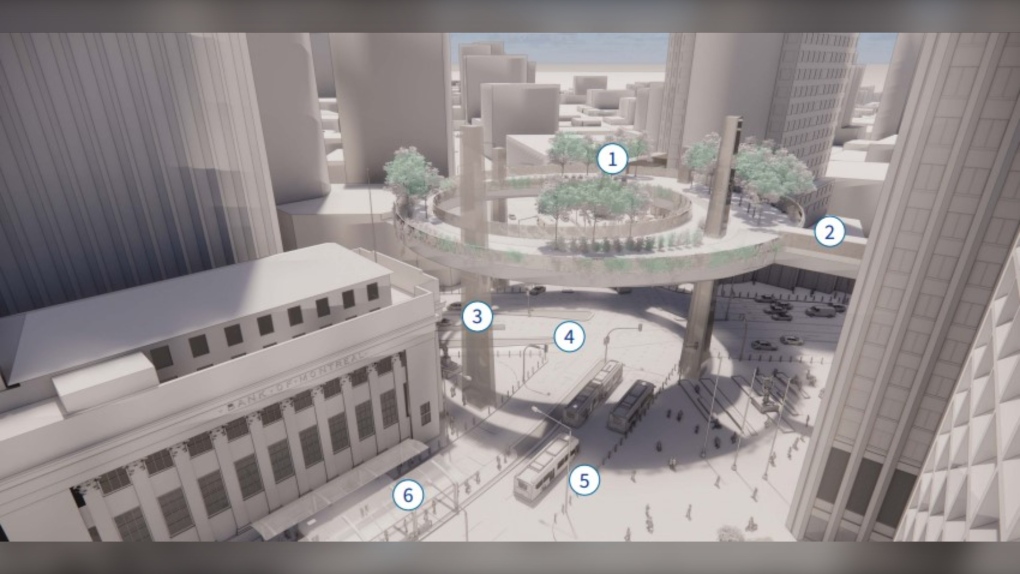
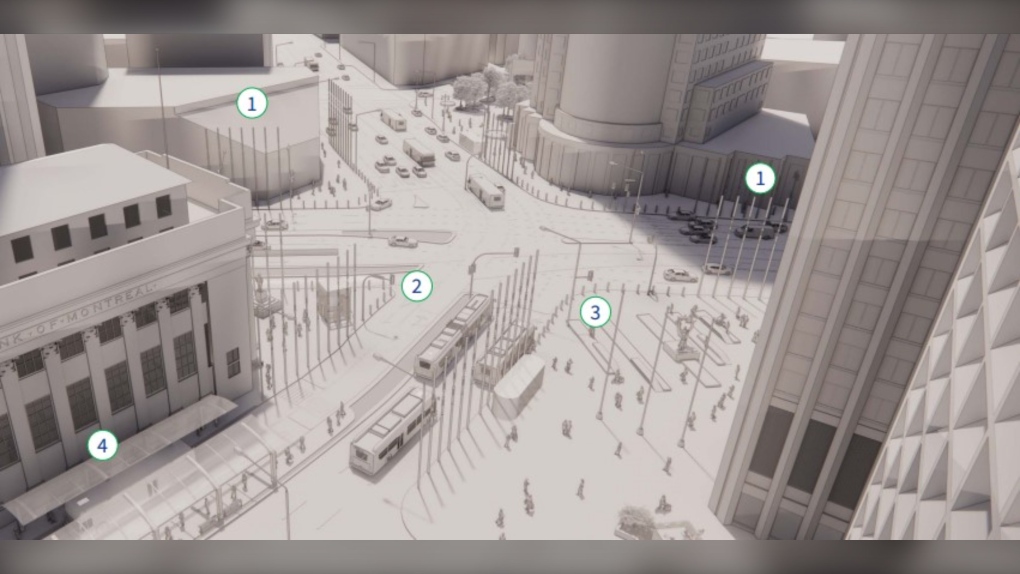
No matter what anyone thought who voted in the plebiscite, Portage and Main was always going to come back to city hall. The Concourse is leaking and will become the biggest pothole in North America. The advocates of don't let people cross because the Concourse is sufficient can't very well use that argument given the vapour barrier can only be replaced by removing the road atop it. I'm not sure that happens without closing part of the road and part of the Concourse for lengthy periods. The pictures here are supplied by the city for discussion.

This week some proposals for second floor pathways were proposed. No budget listed for them. No idea what the costs to fix the road. The concrete barriers themselves are built into the superstructure so they have to be demolished too. A good deal of the reason for not opening Portage and Main was because many people thought it would cost money as well as delay traffic. The saving money is out of the question now. As for delaying traffic, the repairs will do that for a few years.
Even if you believe Portage and Main should be closed, I think we can all agree that the walls that divide the sidewalks from the streets are ugly. It is hard to believe that this Soviet design continues to exist and painting rainbow colours does not make it less a Berlin Wall. Can you imagine this design at any other corner? It isn't safe to approach the entry ways to the Concourse. They are blindspots from the road and if you are unlucky, they are closed when you go to them. If you are really unlucky, someone is there is commit a crime against you knowing you have no escape and no one to see you assaulted. 

In some of the pictures they show the use of bollards and railings. Can you imagine how the intersection would look if it was designed with bollards and rails as seen below.
The above is safe in that vehicles cannot pass by bollards as they are anchored to the ground. The railings prevent children and most leashed animals from entering the street. It is high enough to discourage most people from climbing over to enter the street. Traffic planners might prefer higher and thicker walls but then they are in office to keep traffic speeding through and not protecting citizens behind that walls that no one sees scared to walk in peace on the sidewalk. Visibility from the street is an important safety feature.

The debate online has been ferocious and polarized. In some cases people have argued that people should not cross under, through or over as the entire area as it is a crime zone. The only safe place is in your car at high speed running to Saskatoon. I wish that was an exaggeration but often you hear people talk about how they don't go downtown anymore. Mind you, the same people sometimes are strongest for keeping the corner closed.

On the opposite side are those who want Portage and Main opened and lanes on both streets dedicated to bikes. Scramble crossings have been suggested like Shibuya. Thoughts are speeds should be reduced and cars redirected elsewhere. These are the people arguing for dedicated, protected bikes lanes on every street in Winnipeg and reduced speeds as a city-wide mandate.

Now, these two sides have dominated the debate. It doesn't help the many businesses and offices who work in the area including some of Manitoba's biggest need solutions. Presently, they have a leaking underground Concourse that is not open 24 hours anymore. So if someone attends a Jets game and stays at the Fairmont Hotel, they cannot either get to the game/concert or come back from the said events when entryways are closed. If they cross at a light, they have to make a fair detour. The promise that was made when people were diverted to the Concourse is that access would always be there. It isn't.

Many city councillors are likely squirming over the whole issue. They should be. Asset management has been so poor for decades. How they let city owned parkades collapse to dust and city buildings get mismanaged such as Public Safety Building and new police headquarters is enough to shake any faith they can fix this problem. The desperation of many councillors to get billion dollar suburban road projects through with little indication where the money is coming from is downright scary.

Still, the engineers report is indicating they could be in for a big problem if they don't address the issue. The whole of Portage and Main could be affected. Still, you feel they are irritated they have to deal with it and are not prepared to put themselves out on any policy. Lawsuits will abound if the Concourse has to close with no solution of any kind is in site.
A consultation phase is supposed to happen. Some councillors are calling for a plebiscite. Some are wary knowing that plebiscites could easily be asked for on their own projects. Imagine voting on Peguis Trail or Kenaston. Councillors and mayor would hate that. Why elect officials at all if we can have a clicker at home we can press yes or no? You think the British are happy they voted on exiting Europe? Do you think Canada will be happy with another vote on separation? It is an abrogation of responsibility in being elected. People are voting on decision-making borne of policy on persona. It is about acting and not reacting. Duff Roblin did not seek to have a vote on the Red River Floodway. He was voted in to govern, set a policy and it is one we have benefitted in for decades.

There is no substitute for solid policy initiatives backed by data. Some time ago, the sum of $20 million for membrane replacement was tossed around but that seems painfully low. No engineering and design specs were shown. Even a layman can see the walls are crumbling and the road built forty-five years ago in 1978 needs tending to. By the time that actually happens could be as the road nears fifty years old. No mere asphalt is likely to suffice.
Millions have been spent in the last few years by owner bordering Portage and Main. The Richardson have done major work on the street presence, 201 Portage has done work above and below with addition of BMO and 529 still being worked on. And the 42 storey apartment block is complete and starting to lease spaces. Let's not forget Goodlife, Earls and OEM breakfast place. Friskee's has opened in the old Earls. There is a lot riding on making sure the Concourse doesn't reach the point where it is too dangerous to pass through. And no telling what the legal liability is if it isn't. Or what might happen to the road above if there is trouble below.

So whatever people think of the downtown, if the concern is to keep this as major travel route, it is incumbent on the making sure this is dealt with and not to neglect make it as a crisis as we have seen all too often in Winnipeg.