Saturday, October 22, 2022

Civic Election Debate 2022 - Charleswood-Tuxedo-Westwood/St. James Debate


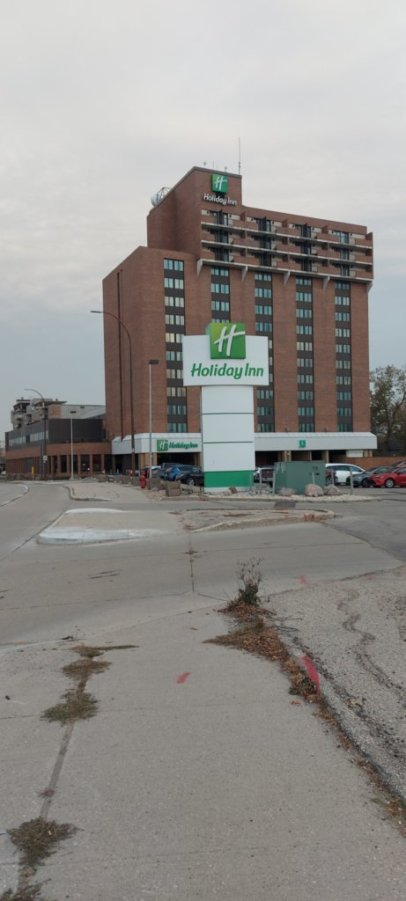
Kudos to Assiniboia Chamber of Commerce and to the Holiday Inn Airport West for sponsoring and hosting the candidate debates for for two city council wards at the same time.
Video of the whole event is here:

https://www.facebook.com/AssiniboiaChamberMB/
Each ward had 5 candidates for the open seats left by Scott Gillingham in St. James and Kevin Klein in Charleswood. However, only four candidates each came. Word was Covid kept someone away although that was not conveyed in any announcement

A big hall was needed for those in attendance. Thanks to Holiday Inn Airport West. People were truly needing a final look at before deciding who to vote for. Certainly, I was in that category.

I voted the last next day after the debate based on what I heard and saw. Election day is Wednesday, October 26, 2022.
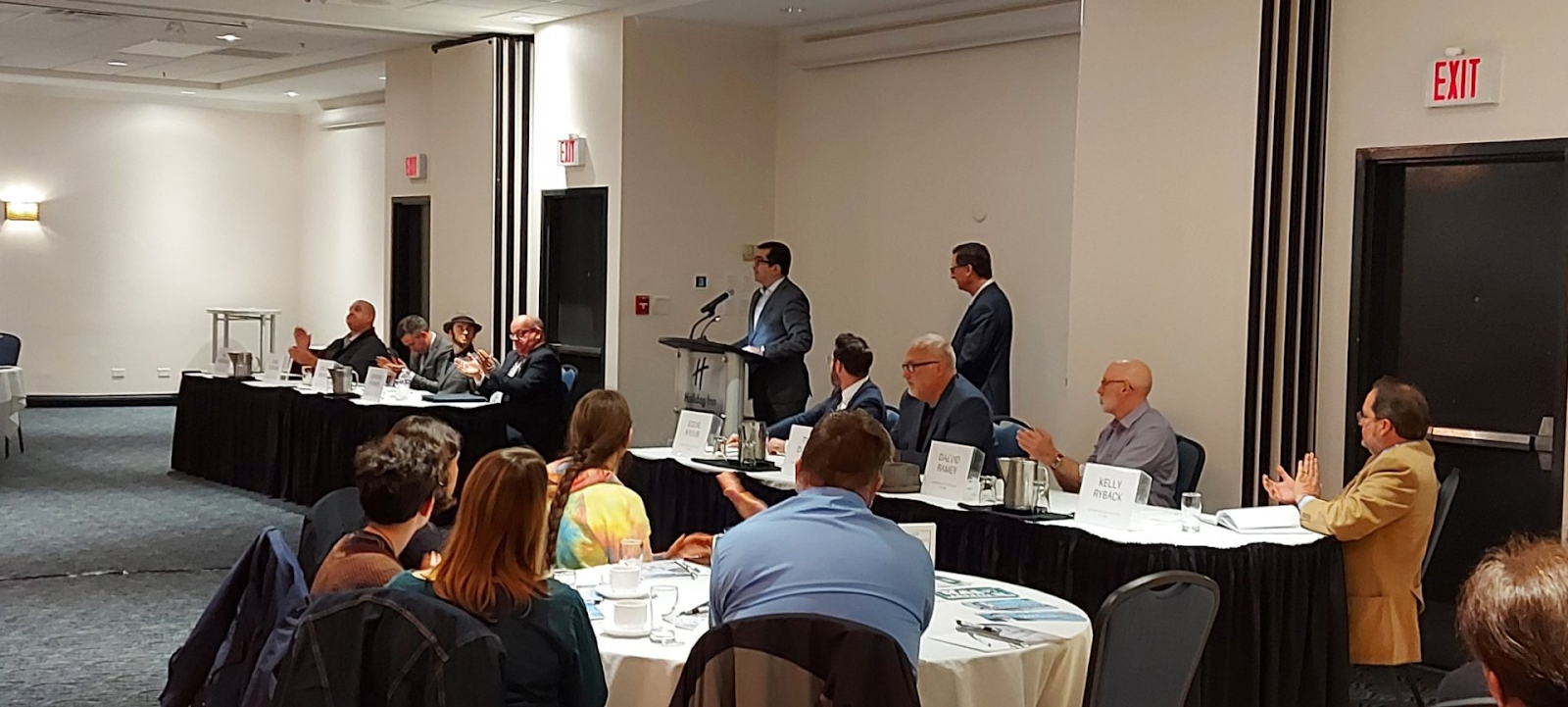
The format let each candidate have a few minutes before and after to make statements about who they were and why they were running. After a moderator, covered a host of topics from crime, to taxes. I will let people judge from their own viewing of the event if they are undecided.

Brad Gross was absent from the Charleswood side. Shawn Dobson was absent from the St. James side. It has not been easy finding details on candidates and I have tried. I have received flyers, I have checked out the community papers and I have searched online. I have not seen a lot on policy and this is what the debate tried to inform the public on.

Candidates who have been slow to release policy, donor info or were late getting to people at the door will find that thousands of people have already voted. And it might not be for them. Those running come from varied backgrounds but there have been several community activists and volunteers, a number of those who followed the Freedom slate of ideas, former candidates, business people. And as far as council, sadly, no women.
Like a lot of people at the debate, I wanted to hear policy. Moreover, there was a hunger to hear workable policies. Beyond the introduction, some candidates did get into policies and stated where they stood on tax. Some had innovative ideas but there were some focused on narrow areas. Experience campaigner were able to get their points across more clearly. Those that stood got more attention than those that sat.

There was a criticism in the St. James side about a candidate who works for IKEA. The association of of the person to the corporation's store location and sprawl was an unexpected spark of criticism. Candidates did interject on policy statements but that was an attack based on where a person works. 

On the point of IKEA, their land development was a brownfield redevelopment, The land was industrial. They paid for the intersection changes at Sterling Lyon and Kenaston. They built sidewalks when the city built none. The Outlet Collections Mall included a bus loop and residential development was included in the overall plan and non-stop housing has been built the last 10 years. IKEA itself has the most advanced geo-thermal plant. More housing has gone up at a former railyard and value added to the tax base inside city limits than almost any place else in the city. They are a $100 million business here and prior to arriving, people from the province ordered from the catalogue and had it shipped. There are 400 full and part-time workers employed.
 
IKEA doesn't owe any apologies to anyone in Winnipeg. And no one working there does either. If only every mall built the last 50 years included that much housing. The mall could easily be in Headingley.

There was some talk on infill which has been an issue in the city. IKEA above could be considered retail and residential infill. Certainly Kapyong will be infill of a military base. One candidate said there should be a three floor limit on Charleswood multi-unit development. Sadly, that likely won't be enough for those aging in the community to remain there. Is it is wonder they are moving to Seasons of Tuxedo?
On the issue of crime, there was a lot of talk of prevention, addiction and poverty. With two candidates from Justice and police, there was some interesting talk on reform and budget in that area.

Audience questions were written in and we were told that an email would come back with candidate responses. In my case, it will be too late. Based on the information I did have, I voted already.
Here is how I came to my decision on my vote:

What was the driving force that led them to running?
What connection did the candidate have to the ward?
What was their grasp of the issues?
Did they seem to be able to articulate a vision?
Did they seem to have the temperament to be in office?
Every election there are candidates for mayor, council and trustee who fall into categories unfit for office. One of those is the candidate that is there to get publicity for their brand. Prime example of that is Donald Trump who even his admirers know was there as much for his business brand and to make money. We had a mayor like that in Winnipeg.
Without guardrails, such a person in office will always run afoul of where their interests lay and where the public's lay.

Another type of candidate is the one that doesn't start in the mail room but believes they are are suited for the CEO's office.  Now, not everyone needs to work their way up from trustee to premier. But there ought to be an indication of life and work experience that might suggest a higher position. For example, Brian Bowman had no Council experience when he ran. But the feeling was that his job as a lawyer and life experience along with his platform was suitable for mayor. Even still, his lack of experience led him into political traps that any Council experience would have informed him on. Case in point: Portage and Main.

Another type of candidate is the one where Council seat is her first step to being Prime Minister. We have seen short term people move right on up including former mayor Glenn Murray.

Lastly, there is the firebrand candidate. We have a few Freedom Convoy types running, we have a few pro-Labour or pro-Commerce types, we have some special interest types running. We seem to have a few people running who would like to get into culture warfare. Invariably, this seems to be a recipe for fighting all the time. 

If one thing was clear, the Charleswood and St. James wards seem to want someone to commit to longer than 4 years, who knows the ward well, who is engaged in policy, can work well with others and is approachable.

I can't really vote for candidates I haven't seen or heard much from. In St. James, former Councillor Shawn Dobson seems to have the lead in signs. But I don't know his policies except he has talked about potholes a lot. For those in Charleswood, Brad Gross probably needed to do more to make people aware of him and what made him the best candidate.

I voted in St. James ward. There were four trustee candidates. One of them was caught on a Ring camera and was going through the mailbox. Not good and not easily explained. The other three were either incumbents or new and seemed intent to do the job of trustee. I voted for them. 

For council, I saw a few people running in St. James who were earnest, educated and community minded. Given that I think that crime is a leading issue, I considered police and changes in policing to be critical. For that reason and because of much experience in the Winnipeg Police, I voted for Tim Diack. He talked police reform and I think his knowledge there is unmatched.

For mayor, I looked at a number issues. Three of the present candidates, I have voted for in a number of elections in the past. However, I look at a host of things that had me evaluate this election if I could vote for them again. With inflation as big an issue this year as it is, with a number of collective bargaining agreements about to be decided and with infrastructure such as water and sewer and roads needing to be fixed, I looked at any tax freeze as possibly a double digit cut in city spending. Even committing to a 2% rise with inflation means an 8% cut.

Some candidates for mayor were not being candid about what cuts they were about to make. Or realistic they could cut wages or benefits and run afoul of the law. Again. And making proposals that depend of the province making your dreams come true is unrealistic. And while there will be federal money every year, it won't pay for all city functions.

I like Shaun Loney quite a bit but feel he is going to run smack right into fights because of other Councillors. Being able to work with Council is not overrated. It is an imperative. I am not completely happy with my pick and not even sure if he will win but I voted for Scott Gillingham. But I did think his proposal on taxes was most realistic even if I think there is no predicting on tri-level government support of his idea of Peguis and Kenaston expansion. Let's just say that is a while lot of negotiation still to happen.

Lastly, I can't vote in Charleswood but lived there many years and after attending the debate, I can say Evan Duncan is exactly the person that you like to see in office. His Justice experience, his long time community involvement and disposition overall should make him a valued member of City Council.

So to review, I voted for:

Mayor: Scott Gillingham
Councillor: Tim Diack
Trustees: Rachelle Wood, Craig Glennie, Michael Cabral

I'm just one voter. If you are more progressive, more conservative or want radical change or no change, you might choose someone different.

Whoever wins, I wish them well. And those not successful this time, remember that many candidates who did not succeed in being elected at some point often were elected some other time.

Friday, October 21, 2022

Assiniboinia Residential School in River Heights 2022

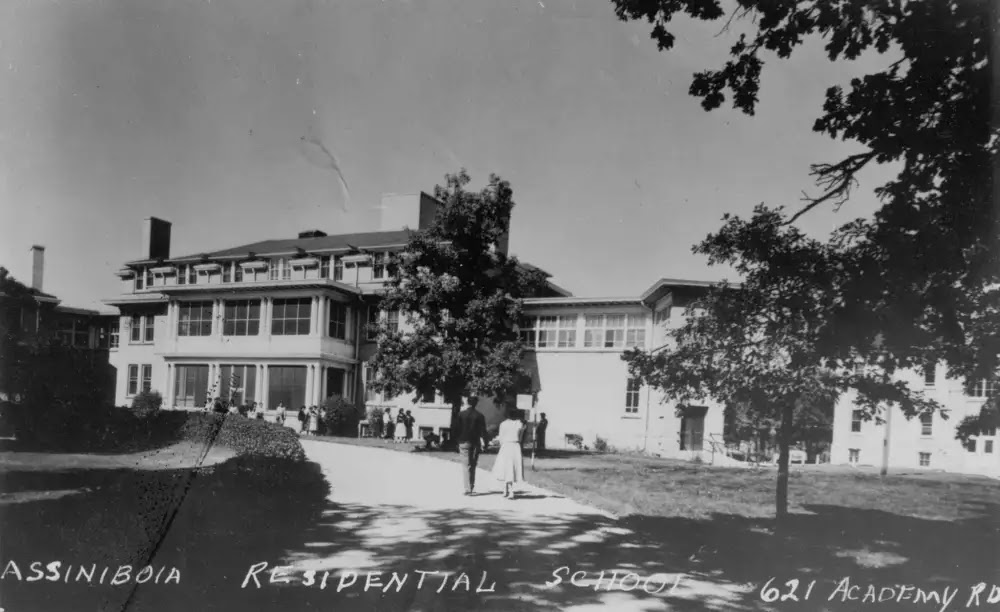
Just before Thanksgiving, I went to visit the Assiniboia Residential School Commemoration and Gathering Place at 621 Academy Road. It was a Catholic High School run by the Grey Nuns that operated from 1958 to 1973. By the fall of that year, I was about to enter Grade 3 and the school was closed. From 1970 to 1973, it was largely a day school as no one stayed overnight anymore. Most in River Heights really didn't know much about the school or the residential system.

Our family moved in in 1968/69 on Renfrew Street, none of the kids yet in Kindergarten. We moved to Kingsway in 1970 and my first year at Sir John Franklin Elementary school. There was not much Canadian in my curriculum materials. Dick and Jane talked about a President, not a prime minister. It was just 25 years after World War II and the one book in the library on the war was written by an RAF pilot on the Battle of Britain.

If this was my experience, imagine my parents. In the 1960s, we had under 10% go on to higher education whereas the U.S. was nearly 30% and rising fast. Vocation, technical and professional training was far behind. It was only in 1970 when it was mandated that teachers have a professional credential. The Canadian flag as we know it now only began to fly five years earlier.

What history education we did receive about Canada was about explorers and discovery of Canada by Europeans including Sir John Franklin, the school namesake. I got more education about Canada listening to As it Happens on CBC Radio from Harry Brown starting in 1968 and later joined by Barbara Frum than any schoolbook material available. As a five year in Kindergarten at Sir John, I didn't have a bike or could leave my block.

And yet, I knew about the Indian School in 1970 on Academy Road. We drove past it often headed to the St. James Y for swimming lessons in the one car the family had, a VW Beetle. It had become a day school by then but I vaguely remember being told it was much older kids and that nuns had lived there. My knowledge of nuns was limited to the Sound of Music from 1965. I heard the music much earlier than seeing it at Rainbow Stage or on TV. But at 1970, I had a certain image of what a nun looked like.

My first home as a newborn was downtown in the Ambassador Block. As my sister and brother came along, we moved to rental houses in places like Elmwood and such till settling in River Heights. By 1973, the Indian School closed. As an 8 year old, it was bewildering. My parents had no insight into it at all either. By the time I was able to ride a bike to places like Assinibone Park down the monkey trails, it was past an empty school building that stayed that way for decades.

It was not until I was well into university that that I heard how widespread and abusive the residential school system was. The first apology came from the United Church in 1986. Government apologies would not come till 20 to 25 years later. And action is still in progress. The public often only experienced the effects of the system and not the cause. It is why the discovery of all the graves this short while was a shock to the much of the Canadian public.
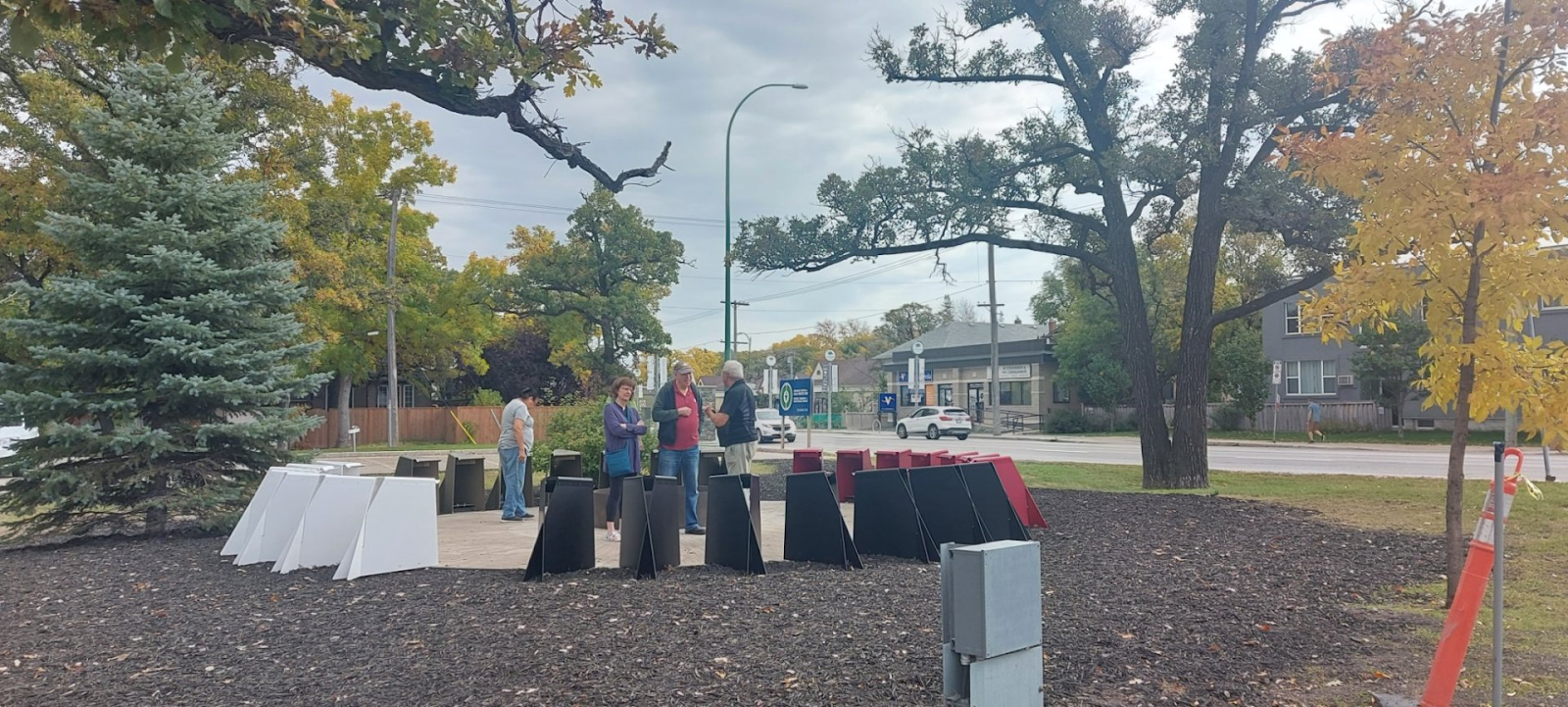
My family lived in River Heights for fifty years and I love the area to this day. On the Friday before Thanksgiving, I went to the memorial on Academy Road. As luck would have it, an Elder from the school was there. You can see him in the picture above. He spent his high school days on Academy and was able to tell me everything about the days before 1973 and I was able to tell him everything that happened after. And in 2022, it all came to together.

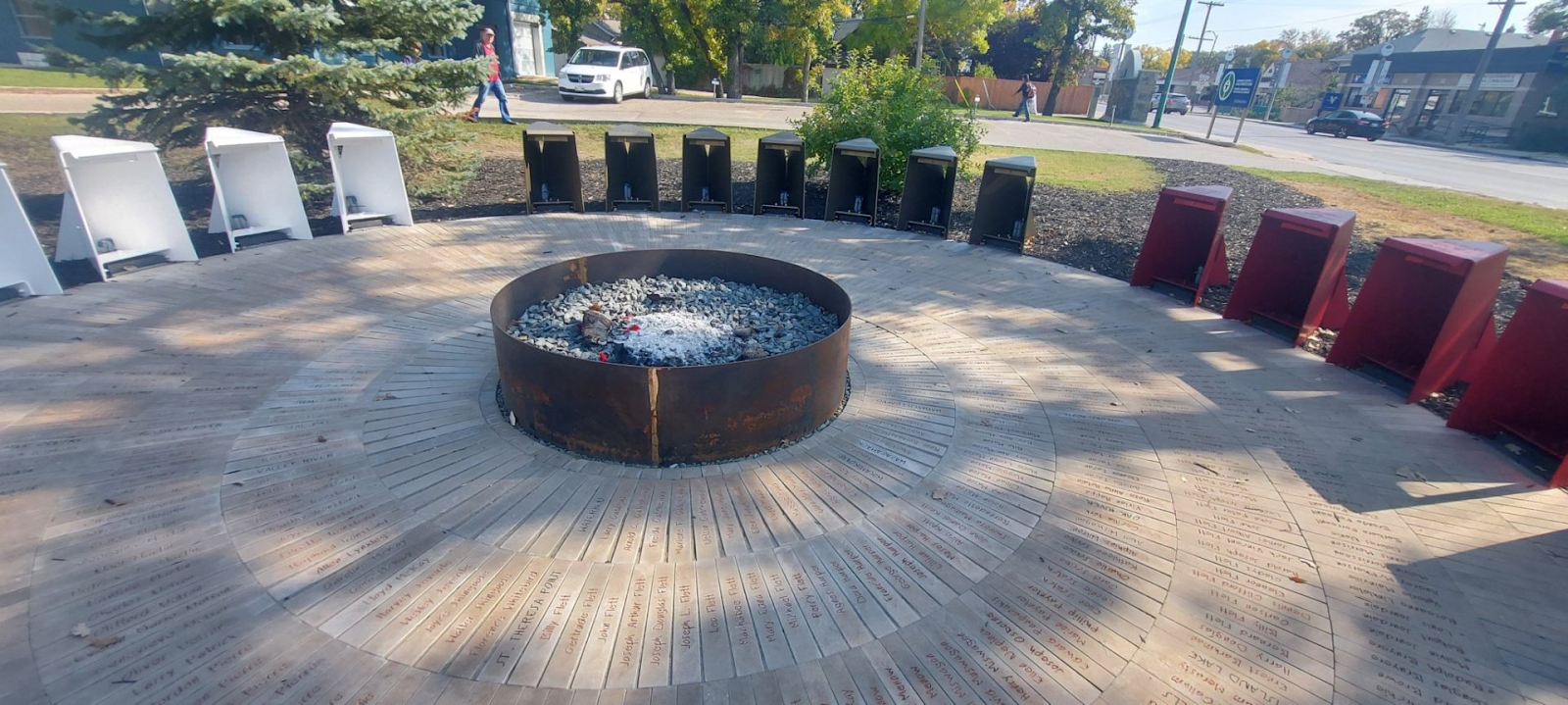
Inside the circle is a list of every community that had students come to the school. And on paving stones, the students names were written. Many names are yet to be added. And more done to the memorial in the new year including lights, landscaping and if lucky, benches for Elders who need somewhere to rest, to contemplate. The Elder and his sister, also an Elder, showed me their names. They showed me people who had passed away, some who struggled and he showed me lots who succeeded. 

As far as anyone knows, and this was from the Elders, no one is buried at Academy. And no one died there. But many struggled and died as a result of the trauma which we learned in detail from the Truth and Reconciliation meetings.
This was not a somber visit. It was a beautiful day, it is an amazing memorial and the Elder was full of information and stories that I was happy to hear. He laughed a lot. I told him how tobogganing and baseball had been long time activities after 1973.
It is worth a visit and with luck maybe an Elder will be there as well. The only way to know history is for the story to be told. And the reason history is taught is because it can tell us a lot about who we were and what we would like to become.
I know I will visit again. I can't wait to see it lit up. 

Monday, October 17, 2022

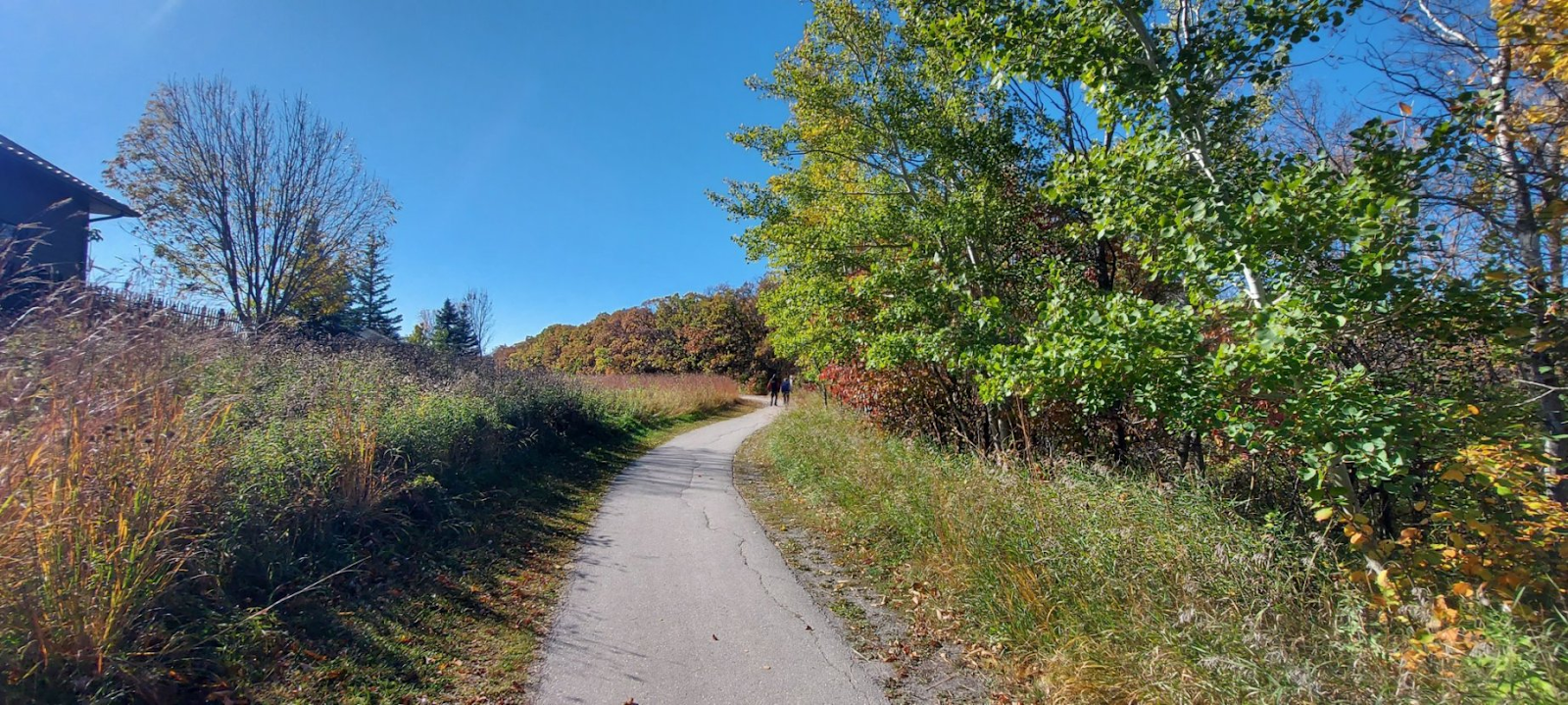
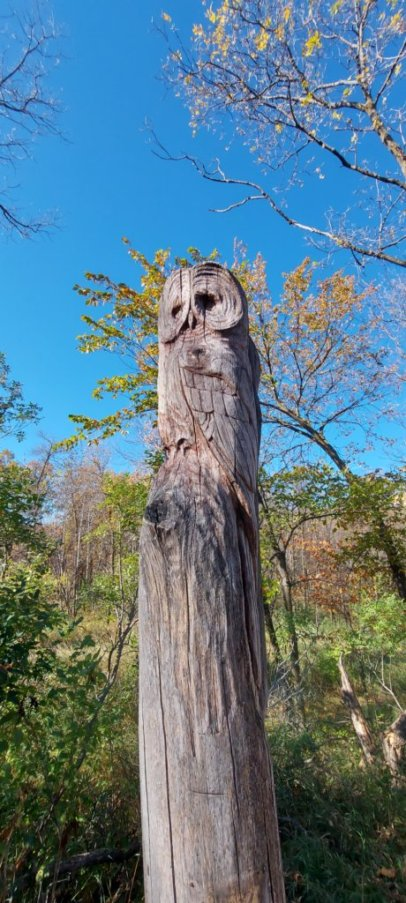
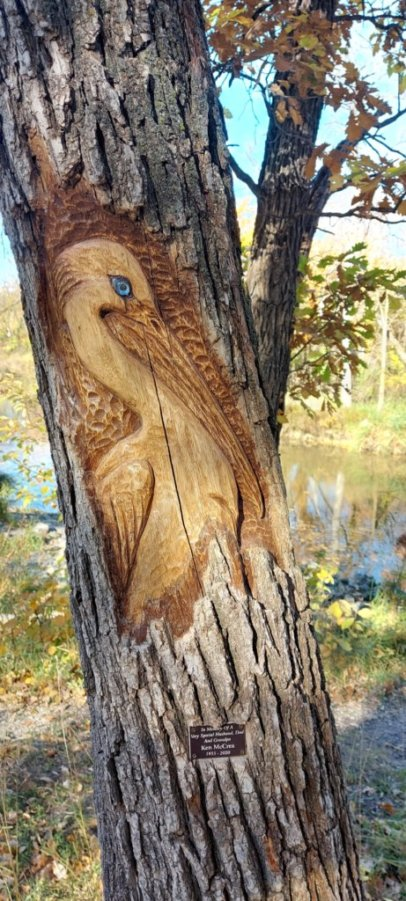
Bois des Esprit Thanksgiving Walk 2022

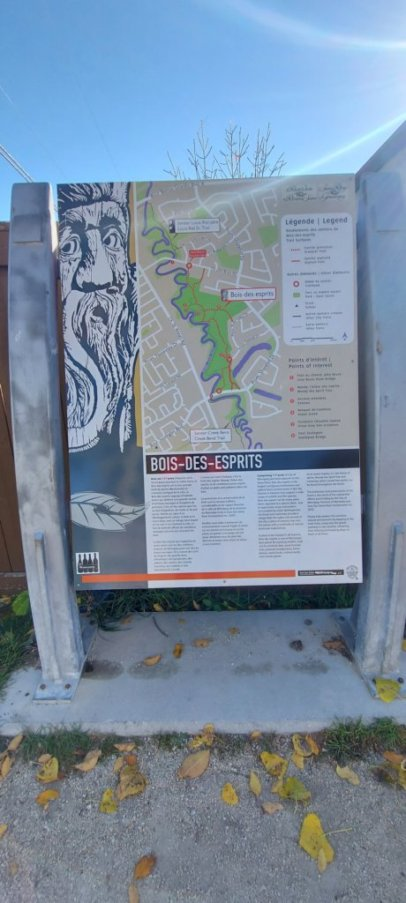
My walk trough Bois des Esprits spirit woods Friday of the Thanksgiving weekend in 2022.


Monday, October 10, 2022

Portage Place Again

As Portage Place enters its 35th year, social agencies have come forward to say that if $70 to $400 million was publicly available that it should be given to them to turn the mall into a 430,000 square foot housing and community centre. It seems simple but no actual plan was presented about how it all comes together. The site has multiple levels of government, the mall owner and an agency responsible for the site. 

No First Nation organization will likely want to pay $70 million to buy out mall owners and the parkade from Forks Partnership without the same commitment that Starlight was asking for which was $400 million. The private owners of the mall have to be bought out. And The Forks is not giving up the parking lot without getting paid or The Forks itself is in trouble. They need the $2 million coming out of there every year.

The Feds balked at what Starlight was asking for. It was a transfer of ownership of the site with all the money paid by the taxpayer. And the new owners would be able to generate money right away because of the parkade and all their housing and other building funded by the Feds. I think they call this a steal.

I was against this $500 million funding of Starlight Investments and I'm against such a concept here. We don't need to engage a for profit developer to take the mall and parkade off our hands while using taxpayer money. Nor do I see how transferring everything to a non-profit, paying for the mall and handing over the parkade and paying hundreds of millions for housing is the most cost effective thing to do either.

It is painful to see Thunderbird House sit empty now and be stripped of copper or whatever can be torn off of it. Neechi Commons has only now been taken over by an indigenous agency. But it isn't just indigenous groups, Lion's Place a 40 year old non-profit is about to be sold because the Lion's Club cannot afford to renovate it. The common denominator is money. The three levels of government can and should do better but so should non-profits and co-ops. In the case of Neechi Commons, a well run and funded non-profit took over the space. The former Co-Op was shocked but should they have been? Most government funders ask agencies what sort of revenue do they expect from government support. If the answer is a continuous stream that grows because that is the only revenue, the government wonders why they fund that particular agency rather than another.

In the case of Thunderbird House, rentals from use and agencies occupying space was to be a revenue source. But the building struggled, had management problems and then aside from vaccine clinics, was largely under utilized. Housing has now gone up with supports but for last few years the entire section as been a homeless living space. Can Thunderbird House be a vital and sustaining force on Main? It remains to be seen. The people have spoken so far and what they have said is that the land around the culture centre is more important as a place to live.

As far as Lion's Place. It was built in 1983. After 40 years, it probably needs upgrades. Was that never part of the plans? For the 300+ people there it is probably a scary time. What do you do when you are abandoned? For the government, they are left with a head ache as affordable housing increasingly becomes an election issue. It probably won't be a good look as people are evicted from Lion's Place for condos or luxury living. Below is 1986 construction of Portage Place.
How this relates to Portage Place is that no plan has been presented aside from a request for $500 million and vague promises of affordable housing and a community centre. We don't even know any details about who would manage it. Revenue considerations are not mentioned and yet infrastructure will have to be maintained lest it all fall apart. Unless half a billion is only the start. And how is it affordable housing if the the group running the facility ends up having to sell it just as Lion's Club now has to sell Lion's Place?

As mentioned many times in this blog, the key to unlocking value and development at Portage Place lies in the 1000 car parkade. It generates a few million every year and is likely what Starlight and even some of the social agencies covet as an asset that is a consistent performer. Presently, all of revenue goes to The Forks which would have gone bankrupt without it. The parkade subsidized The Forks and kept them from pricing their own parking space for years at market rates. The money still continues to come in and had Starlight been successful, $47 million would have been transferred to The Forks. Below is what the mall looks like now and the pads atop are where new value can be found for apartments but without settling the mall and the parkade question.
Ponder this for a moment. Money meant for North Portage has been going for decades to The Forks and a sale to Starlight would have placed $47 million more with The Forks. Now I love The Forks but there is no way anyone could have figured the plan would be to funnel tens of millions out of one area to fund another. Worse, there has been very little public debate. Had Starlight deal gone through, The Forks would score nearly $50 million all at once.

Interestingly, the mall in the deal was valued at under $23 million. That is down from $50 million the last time it was purchased. The present owners are trying to sell. The mall is not a completely failed business as the social agencies keep suggesting. If it was, people wouldn't gather there. It isn't just because it is warm and dry place to be. Prairie Theatre Exchange has called it home from the beginning. Manitoba Chamber Orchestra is right next door on the third floor. Service Canada has a major centre inside. University of Winnipeg Legal Centre has a robust presence. And let's not forget Shoppers Drug Mart and every cell phone company in the county has a presence in the mall. Add to that a mix of retail and other services and a food court. There may be vacancies but is far from a drop in community centre with no future.

The opening of the Expo Live in the former Staples taking up 20,000 square feet and hosting Rolling Stones Unzipped is a good thing for Portage Place and North Portage. It extends the operating hours of the mall into the evening hours. Staples was more a Monday to Friday day operation and while there is a need for an office supplies store, it probably needs to be closer to Portage and Main. Moreover, if there are other areas of the mall or nearby areas that are operating till 10 PM, there is more impetus for retailers to stay open longer as they did till the early 2000s.

Make no mistake. There will be no return of downtown as the primary retailing area of the city. But there have been some consistent new building of residential units downtown after decades of not seeing much of that. The tallest building in the city will be all residential. The former UGG grain company HQ has been converted to residential on the upper floors. The Medical Arts buildings is now residential. Two new towers on Assiniboine have come on stream. A new apartment on Broadway has been built and a number near the University of Winnipeg. Residential additions at True North Square and across the street have been built and more are coming. The former site of the police HQ and parkade by City Hall will also bring new residents downtown.

Portage Place should not feel too much shame about how long it has taken to get to complete the next planned phases of its development. Trizec at Portage and Main was built from 1974 to 1978 and the office tower was near empty for quite some time as Winnipeg was going through a painful and prolonged recession. Driving down Main Street in 1980 it was quite noticeable that the Trizec tower had mostly unlit floors. The mall and parkade though met with better initial success. The restaurants and food court were well accepted by those who did work in the office tower and the parkade was a cash cow for the city. The mall itself though was a 9 to 5 work day kind of place.

To be sure the pandemic has wounded downtown badly. There are many places closed and are still closing because of the slow return of workers. However, it is very likely going to be improved numbers as universities and colleges have returned to classes and young people are seen everywhere. Jets games and concerts have been frequent in September and will be joined by Moose games in October. The resumption of theatre also supplies more people on Portage as well as Main Street. Edmonton has led North America with strong numbers going downtown. Ottawa experienced excellent numbers as well. The social aspect of downtown life has returned even with Covid still doing damage out there. 

The two areas contributing to recovery in downtowns are have been things like sports, theatre and festivals/conventions coming back on stream. Most cities have at least convention centres, theatres and sports facilities centrally located. In Winnipeg, the Jets arena has led to a slowly expanding footprint filling a decades long gap at True North Square which for decades was a surface parking lot and now across the street north of the RBC Convention Centre, the former motel and RWB residence is being transformed into hotel, condos and offices. 

Portage Place has housing behind it, the YM/WCA beside it,  Investors head office attached by Skywalk and University of Winnipeg legal offices already occupying space in the building. It seems the most logical step is to take requests for proposals for housing atop Portage Place. It does not need Starlight nor a nebulous non-profit to be handed all wanting $500 million. It is quite possible that organizations like the University of Winnipeg housing unit can actually put up housing on the existing pads. But don't look for The Forks as the driving force for that. If the goal is to remove $50 million in a sale to go to The Forks, that is a non-starter. If you really want to kickstart development, keep the $2 million in parkade revenue transferred to the Forks every year use it for projects where it was supposed to be used: North Portage.