Friday, August 16, 2024

The War on Taiwan Movie【零日攻擊 ZERO DAY】 官方完整版前導片 Official Full-Length Trailer


Taiwan is roughly 130 kilometers off China's mainland. It is separated by the Strait of Taiwan. Since 1949, it has been governed by the Republic of China (ROC) which was on the losing side of the Chinese civil war that saw the Communist Party take over China as the People's Republic of China (PRC). Till the 1970s Taiwan held fast that they would re-take all of China and most western countries would not recognize the PRC as the legitimate government on the mainland.

Canada would recognize the PRC as the government of China in 1970. It would take till 1979 for the United States to do so. And while it looked like Taiwan was being displaced and was, they received from the U.S. and other countries specifically from the 1950s on because it was anti-Communist. During the Korean War in the 1950s, the U.S. as well as Canada were at war with North Korean as well as China. 

China's attempts to take Taiwan and associated islands was rebuffed and the U.S. helped defend Republic of China with U.S. military assets as well as the equipment. The Taiwan Strait might as well have been a moat. And it wasn't lost on China that the U.S. would use nuclear weapons to defend Taiwan.

The Korean and Vietnam Wars meant enormous U.S. spending in the region and Taiwan benefitted in the 1960s from economic reforms. Huge growth was the result. Meanwhile mainland China was struggling with a planned economy and Communist governance. Taiwan also had a dictatorial government that saw many thousands arrested or executed but the rising economic fortunes continued year after year.

By the 1970s, martial law in Taiwan began to weigh on the population. Many overseas Chinese saw the freedoms in places like the U.S. and yearned for not just economic success but personal freedom. Government crackdowns only stiffened the resolve. In 1987, martial law ended and elections began to be the norm The people of Taiwan began to assert their vision of their country's governance even as the Communist regime pushed back. It seemed they were more wary of a multi-party democracy than they were of a nationalist military force in control of Taiwan.

Taiwan is now a fully formed democracy with regular elections and has moved back and forth between the nationalist KMT and newer parties forming government. From economic miracle to a democratic model, the 23 million people in the densely packed islands have shown remarkable resilience. While the One China policy may still exist, Taiwanese have shown pride of place and no longer harbour ideas of ruling mainland China. The 23 million people of Taiwan have been trying to forge their own path and it is a democratic market economy.

China, on the other hand, has created economic success but any sign of democracy is crushed ruthlessly. Threats to Taiwan are a routine occurrence and calls for invasion come often. China has not ruled out force to bring Taiwan under their control. Understandably, Taiwanese are resistant to that and wish to just engage in a non-hostile relationship. Were it not for the United States and a fairly prickly defence Taiwan has invested in, China would likely take Taiwan if it could.

Taiwan has a fairly significant military force. At times they have painfully had to beg countries to sell to them weapons. And when that hasn't worked, they have built there own. Compared to Canada, Taiwan has substantial navy, air force, army and marine units. If they were brought to full defence, it is likely they could land more than a bloody nose to China but ultimately couldn't defeat it. It is the United States that holds China back. Sink a U.S. carrier and America will respond.

Canada and Taiwan maintain trade offices with each other and Canada has sailed military ships through the Straits of Taiwan in favour of international shipping lines. This has supported Taiwan while irritating mainland China. However, international travel lanes are essential to trade and China laying claim to vast areas in the region and creating artificial islands has been causing fear with many countries.

Taiwan has been facing this since 1949. There has been several military flare ups over the years and even now, China has navy and air assets squeeze in and intimidate. There is still support for one China policy in Taiwan but real fear about loss of autonomy and persecution if the Communist government does ever take over. It is clear there is discussion that seems to lead to a mutually happy joining. Taiwan's mere existence seems to whip up Beijing's ire.

The business climate of Taiwan is well known but the community has many artists, particularly film and television. Netflix has numerous offerings from Taiwan this year and none from China. This is largely in part due to China making it hard for western partnerships. Hong Kong once produced 300 films a year but none for Netflix this year. Taiwan used to invest heavily in film production there but the cold chill of recent relations has meant Taiwan is turning to home investment in the industry and western partners. Meanwhile Hong Kong suffers more stringent rules and caters production to China. This it finds it's home audience in its own city in decline as tricky subjects like police corruption that moviemakers used to love in Hong Kong can't be done as they once were. 

With this in mind Taiwan has repatriated money that they used to invest in freewheeling Hong Kong industry including film. It isn't a surprise then that Taiwanese TV and filmmakers have thought about mainland China and what it might be like if Taiwan was taken by force. The result has been a TV series called Zero Day that has recently released a 17 minute trailer that can also be watched in English. Why English? Because this is just as much for western audiences as they are for Asian.

The actual series won't come out till 2025 but the trailer was released during a air raid siren drill. The trailer obviously got everyone talking. The producers consulted widely and researched how a forced China takeover of Taiwan might overwhelm the island and isolate it from any potential help. Quite rightly they identify how China would have many pieces already in place in Taiwan before they acted. They would need a pretext such as a false flag attack against Chinese aircraft, they would need people on the ground to sabotage transportation, communication and utilities. Everything in the trailer sounds plausible and worse for Taiwan, it seems likely. 

China has already test-drived filling both air and water with military assets. It remains to be seen if the U.S and other allies would attempt to keep those routes open. If there was fear that American and western citizens could be harm's way, they certainly would. Any mixed messages from Taiwan might stall that help. This is why verifiable communications would be essential. In the TV series, it is suggested that China would use deep fakes to confuse the population. It would likely confuse allies as well. It is for this reason that the U.S. is about to build new bases in The Philippines within 150 kilometers of Taiwan to support that area if needed. To the north, the U.S. already has massive bases in Okinawa.

It is likely Zero Day will see interest in other countries as well. The security of Taiwan has always been the back of the people's mind but the level of wariness has increased. The one area that was not really detailed in the trailer is what Taiwan might look like following a takeover. I guess we will have to wait for the sequel to find that out! 

Wednesday, August 14, 2024

More 7-Elevens to Possibly Close in Winnipeg

In a meeting with 7-Elevens CEO and officials from Canada, Winnipeg City Council was warned that 10 more of their convenience stores face closure over crime issues. This is a unique warning for Winnipeg as the company has tremendous success in the city but shoplifting challenges have outpaced all their considerable security measures. The time-lock safes, the LED lights, the security cameras, the removal of lottery tickets and tobacco from easy access at night and the low amount of cash on hand has not been enough to stop wholesale removal of product. Police regularly stop at 7-Elevens for coffee and Slurpees. It still isn't enough.

Some helpful people have suggested liqour store-like IDs and locked doors. This would an expensive add on as a full time person has to be doing security. Heaven help us if every store went this way then it would lead to line-ups the likes we haven't seen since Covid. Perhaps there is a way to streamline this but it puts the onus far too much on the retailer. And to be fair, 7-Eleven already does a considerable amount on security.

The ten stores likely to be closed have not been identified but there are several such as William and on Ellice that have shuttered and remain boarded up. No other business has seemed interested in the properties. And why would they? If heavy security 7-Eleven can't withstand it, who can? Some areas of Winnipeg that are a food and convenience store desert will be even more so. 

The province has stepped up policing with supports and retailers and restaurants are asking for it to be extended and expanded. The feeling is that some crime issues manifest from seeming lack of consequences. Add to that a real increase in toxic drugs that result in addiction and more desperation.

So what stores are in danger of closing? They are: 1895 Wellington (Airport location) 119 Salter Street, 1184 Portage Avenue (Wolsely location), 909 Lorette (Fort Rouge location), 665 McPhillips, 120 Keewatin, 456 Talbot, 891 Arlington, 1485 Inkster Blvd and 815 Ellice. At some of these locations stock was entirely removed from shelves and walked out the store.

One suggestion was for doors to be locked and only a few people let in at a time. In the U.S. sometimes only a take out window is open. Some suggested security guards full time but even grocery stores are finding only police actions and consistent arrests will put a stop to it. 

Others will blame society, police, housing, poverty, drugs and say only a re-make of society will be helpful. That likely won't save the grocery and convenience stores. Certainly police arrests of some people with tens of thousands of goods should give some idea how pervasive the problem is. The loss of so many stores is an emergency requiring provincial and city effort.  Having only two city councillors meet the officials from 7-Eleven might not be enough. The warning should be enough to reach all elected officials on holiday. 

Tuesday, August 13, 2024

Dakota Foods Closed

Dakota Foods closed this August 11 weekend although any stock left Monday and Tuesday could be sold as well. The Clement family still has their location on Portage Avenue. In a day where every grocery store can contribute to a neighbourhood, the store at St. Mary's Road struggled with shoplifting, higher lease prices, inflation and labour costs. Most retailers have said the police strategy for shoplifters is starting to work and have asked for an extension but it is not to save the 60 workers at the store.

The old Safeway design of the building is still visible on Dakota Foods. It isn't clear what will replace the old store. Ideally, it would have been another grocer. Dollar stores generally won't be sellers of dairy or meat. As mentioned in this blog, we could really use discount grocers in Canada and still don't have any.

There were a lot of sad faces in St. Vital over the closure. A lot of memories of the 20 years for Dakota Foods store as well as as groceries past. Just prior to Dakota, it had been an IGA store. It is a very busy commercial area by the grocer. It seems the perfect place for that type of business to succeed.
Schools, apartments and various roads intersect by the store. Gimli Fish Market is nearby and successful. They may be hurt somewhat by the closure depending on what goes in the space left by Dakota. 

Grocery stores drive regular traffic to an area. While department stores have reduced capacity as anchor stores, a grocery store will have people from early in the morning till late at night. A shopping mall relies on this for success. It is also essential for apartments, transit and other services to have commercial hubs or areas become food deserts and people have no choice but to travel far for essentials.
It is the smaller grocers that have really suffered. One example: Academy Road had three grocery stores on it till at least the late 1980s, early 1990s. Now there is one specialty grocer. In general, people in River Heights have to travel outside their neighbourhood for grocery, banking and pharmacy. And now people in this end of St. Vital will have to do the same thing. 
Across from Dakota Foods were apartments, a hotel and many businesses. It truly was a hub.
The cross section of streets by Dakota Foods should still be attractive to some businesses.
Fast foods restaurants across the street.
There is already a Dollarama across the street so some grocery items are still sold nearby. Just no dairy or meat sections.
It is certainly the end of a multi-decade era of a grocery store where Dakota Food was. A sad time really. We can use all the competition in the food industry as we can. And something local versus travelling far is more affordable for everyone.

Wednesday, August 7, 2024

New Office/Apartment Tower at 127 Bannatyne in Exchange

It really does seem to be standard that it takes 10 years to get approvals for any type of buildings in Winnipeg. Now, not all of this is the fault of the city and zoning but a lot of it can and has been. The site at 127 Bannatyne has been a parking lot for decades. The East Exchange has a been slowly transforming along Waterfront Drive. Taking advantage of a new roadway and space to build, housing has gone up pretty consistently over the years. Warehouses along the east/west streets have seen conversions from the 1980s onward. However, there have been very long gaps where nothing has been getting done.

Conversions of older buildings have always been a labour of love. Many have required some incentive lest the decision was to demolish them. Some might say that is a good business decision to tear down old buildings but it doesn't make for good cities. And in Winnipeg it has often led to decades of parking lots because it is always easier to keep spreading out than to try and get land for building anywhere else. Most of the costs of sprawl are not borne immediately but later on where services are provided and infrastructure such as schools, police and fire houses, parks and recreation and transit. The low density then begins to affect budgets for the city overall. For example, there is nothing in the budget to presently replace the Arlington Bridge. This soon will likely be the issue for the Louise Bridge as well. No money in the budget.

Infill is the only way to use existing infrastructure while raising density and the tax base. Parking lots pay less in taxes than other forms of development. Parking lots in Toronto converted to patios in the pandemic took in 49 times what they took in parking fees. That is an indication that parking is heavily subsidized by business and government. It is hard to pay for transit when overnight parking costs only $60 a year in Winnipeg. The city provides parking below cost for cars and subsequently there is no incentive to use space wisely.
From the above picture it is clear that the development by Alston Properties and built by Concord Projects comes right out to the curb side and out to the back lane and side to side touches the historic buildings next to it. It is uses up the entire surface parking lot. I've not seen the entire number of parking spaces allotted but they will be underground.

The configuration of the building is a four storey pedestal with an eight floor residential tower setback and canted to one side. No longer a windy gap of a surface lot but a building with retail on the first floor and offices on the second floor. More of a true mixed development rather than just an office or just a residential building. Success in the past and in the future would appear to be mixed developments.

Retail at ground level will help create vitality on the street that the Exchange is very much in need of. Concord Projects which has had its headquarters on Henderson for a very long time is moving their 65 employees to the second floor offices when they are complete. If this isn't standing by your work, nothing is.

The 80 apartments in the upper floors will join give other apartment projects that Alston has brought to the downtown. They have already indicated the margin for return is low but that their belief in the project is high. As commented on many times here, Canada needs far more housing built and with a variety of configurations with more bedrooms. However,  it takes so long to get projects done that it is hard keep up momentum.

The completion of this $30 million project should help bring some vitality to this stretch of Bannatyne and continue the work of more housing in and around Waterfront Drive. What also will be interesting will be the type of retail and restaurants that will go in on the ground floor. The last few years have been tough on foot traffic in the Exchange and having 80 apartments and a few hundred office workers in the building or very near by gives new businesses hope that they have customers nearby.

Security comes from having a lot of people around. It is much harder for crime to take root when a lot of people are vigilant in looking out for issues. We have overcome tough crime situations before in the 1990s. It is likely we can do again. The strategies are some times the same such as identifying who are the repeat offenders and getting them off the street. The next is changing security measures to keep step with the times. It involves fewer entry doors, more security cameras, more fire prevention measures and security and police foot patrols rather than just a patrol car.

The Exchange has a few of these surface lots that would make excellent new homes while moving the parking underground. In some cases, people who live and work in the area may require fewer or even no vehicles as we see in places like New York. But it only happens by filling the gaps and mixing development so that it gives an opening for grocery stores to service the population.

Thursday, August 1, 2024

Boardwalk Burgers Fries Shakes Now Open in Charleswood

Charleswood has long stretches where there is not much in the way of commercial development. As such, it is a bit of a drive for grocery, pharmacy and restaurants. The Safeway in the Charleswood Mall and the No Frills in the Westdale area along with some Shopper's Drug Marts are it. Residents have to go further afield for other stores. And so it is for restaurants.

There are just not a lot of spots for any commercial development in all of Charleswood. It is largely a sleeper suburb of Winnipeg. Opportunity arose when No Frills Charleswood had a renovation. It created three spaces for other businesses either side of the entrance to the grocery store. In one of those spaces between the Liquor Mart and No Frills, a 1,690 square foot restaurant went up. That restaurant called Boardwalk Burgers Fries Shakes is totally new to the Winnipeg market.

Boardwalk, started in 1981 in Maryland and had grown to 750 locations worldwide with 22 of them being in Canada.  There are six more locations coming in Canada. Known for their lightly salted fries and a variety of shakes, Boardwalk is consider a mid-priced alternative to the higher priced burgers elsewhere and a step up from the big chains. The Cheema family and around six employees have the franchise in Winnipeg and quietly opened May 25 with an official opening in July.

The 6650 Roblin retail area has slowly transformed into a mix of housing, retail and offices. It hasn't always been easy. Resistance to any change around the area has been fierce. Any multi-unit housing has been painfully slow to come on stream. The Charleswood Condos went up only after a decade of being an empty field. The renovations to No Frills was mostly painless and the result is an insurance outlet and a new restaurant. The third space remains ready to lease.
Long time landlords are realizing they have to spruce up their properties and right size them for the market. Charleswood is no different. Space is needed but hard to come up. And the space offered sometimes is far too big. It was one of the reasons why some spaces in places like Osborne Village were so hard to lease. Landlord refused to subdivide and subsequently, the space went unused until this year where Basil's used to be. Today, two restaurants are being built where one once was.

Charleswood residents now have a place to go that is local to them and will likely see a few people come from farther away just to try out Boardwalk.

Wednesday, July 24, 2024

More Student Housing Outside University of Manitoba

Of the 15 major universities across the country with medical schools, the University of Manitoba has the fewest student housing option of any of those listed. The Fort Garry campus even up to the 1980s was a far into the suburbs as possible and even then it was light on residential units. In the 1980s, the University of Winnipeg closed down all their student housing. Brandon University and Canadian Mennonite University have been better for housing than the two biggest campuses in Manitoba.

Pembina Hall was added to the University of Manitoba to make way for major work to expand academic teaching space into Tache Hall. It was imperative for the university to build housing to unlock donation money that came in. That will has died off waiting for the next capital campaign. It has only been private investors who have filled the void and it has taken a while for these projects to get done.

The Toronto-based Campus Suites began the process eight years ago and acquired land and began to build the first of two 16 storey mixed use towers across from the University of Manitoba. At the southwest corner of Pembina and Bison Drive, the first tower began to take shape around 2017. A spectacular fire just as it reached the top floor delayed the project but eventually the ARC was completed. It made for a fairly bold skyline just at the curve on Pembina Highway was in front of the university.

The purpose-built student residence is the tallest apartment in front of the U of M but was not the only one built over the the previous years. Surrounding and bordering the Real Canadian Superstore are a series of apartments from 4 to 7 storeys. Students have moved into these apartments although they are not designed for them in the way the ARC has been. Part of the student housing is amenities such as furnished apartments as well as price point are a strong draw for U of M students, especially international students.
Over the last several years, the Chinese population along Pembina has grown substantially. The university has been one of the main reasons. With 368 units and 570 beds, the ARC represents a good chunk of new student housing within walking distance of the campus. The 2023 enrollment at U of M was over 30,000 with around 7,000 international students, a 2.9% increase. Were it not for the private apartments, the university would be in no less a jam than some others across the country.

The curved building of the ARC has a Little Pizza Heaven and a dentist office in it. And just open now is Meltwich. The mixed development is being seen in more and more apartments. The first floors of many places are often the least desirable for renters/owners, especially women. It would appear that some shops and restaurants are giving the first floors a chance.

The Arc now has about 70% student residents living there. It was so successful that Align, the second phase 16 storey tower 397 units and 554 beds will be ready just as school starts. A Dairy Queen and a Subaru dealership occupied the spot the two towers are on. A rail track runs behinds the buildings. The two towers share a similar colour scheme and are only slightly set back from the sidewalk. 

The 16 floors of total space are not the only apartments that have gone up in the last little while near the University of Manitoba. As mentioned, there are three building sites called Bison Pointe already completed by the Superstore. A number of condos and apartments have gone up on Chancellor Drive and further down Pembina Highway. The apartments further down are also 15 and 16 storeys.

It is the University of Manitoba that sits on the largest chunk of land. Their present footprint plus the former Southwood golf course represent one of the biggest opportunities of providing housing to the 30,000 students and growing Fort Garry area. It has been a painfully slow process and pretty much all concerned hope the first of a number of projects are announced. The biggest university can score a big advantage over others in Canada if nearby and affordable housing is available for students, faculty and others in the area. 

Sunday, July 21, 2024

The Low Cost of Parking Permits in Winnipeg

The Globe and Mail in their editorial has commented on the below market prices set for street parking by cities across Canada. The permits for overnight parking are so low that even car supporters ought to be embarrassed. Think that most people would agree that curbside parking near where you live is valuable. How valuable? Well, so valuable that people will get very upset about cars that park in front of their house regularly even if there are no parking restrictions at all.

Think about your own streets and how many cars are parked out front each night every night. Even when someone has two parking spaces, they sometimes end filling their garage with stuff to store and end up parking on the street instead. Along many residential streets in Winnipeg, it is an unbroken chain of cars parked overnight every night, most without permits. Even where permits are required, the cost is so low annually that it likely costs more to issue documents than what comes in. 

Winnipeg charges $50 a year for an annual parking permit. Calgary is $30 a year. In Toronto, it is $300 a year. Any of those rates seems like a deep subsidy given the value of the roads. The cost of building nearly free parking is staggering and yet every city does it. Safe to say that if all overnight parking had a fee and that it rose every year then more people might actually park in their garages or seek other parking options. 

How is that short term parking pay high prices and end up being towed when in Winnipeg you can pay $50 a park all year. What's the point of parking in your garage? It is so cheap to pay for parking on your street. It is easier to save money not using a storage locker and fill a double garage than pay market rates privately.  And don't think that doesn't happen. There are so many garages filled with stuff and cars out in the street because the cost and consequences of it are so low.

The city is so cash strapped that giving this space away for free and having it occupied all the time so that it can't be used for deliveries or customers is costly in so many ways. The last time the city looked at this was many years ago. We clearly have a cars up and down every street even when people have space to park them. This should help make people realize there is a cost for this and the city will be able to bill people for the actual cost.

Saturday, July 20, 2024

Manitoba Metis Federation Buys Two More Towers in Winnipeg

The Manitoba Metis Federation continues to put together quite the portfolio of real estate holdings in Winnipeg. The investments are very much a consolidation of space already being used by the MMF for their staff. The two towers with BellMTS logos on them will see MMF staff starting to move in right away. The towers beside the former Bank of Montreal building at Portage and Main which is being turned in a heritage centre are at 333 Main Street and 191 Pioneer Avenue. Bell is no longer supporting a large head office staff. Occupancy at 333 Main in recent year has dropped to about 68% vacancy. The towers were listed in recent years for sale by Artis in Winnipeg for about $33.5 million but the price of the sale this year has not been disclosed. As office workers start to move in, occupancy will rise so that the vacancy rate will be 32%. The MMF indicates that 160 workers will be moving in the taller of the two towers. A parking lot was part of the purchase.

Just down the street the MMF has offices in the the former Wawanesa tower at Broadway and Main as well as other offices in the former sport federation building. Wawanesa consolidated their five offices in a tower at True North Square. MMF has around 300 employees working out of the building at 200 Main Street. That office building also comes with both an underground as well as surface parking lot.

The MMF has other offices they have been using but as their leader David Chatrand explained, they have upgrades needed that need to be done. It is likely the move to to new BellMTS towers will be an upgrade on quality compared to some of the older buildings out there. As if to demonstrated the disrepair of downtown buildings, it was reported that the Canada Building is closed after flooding affecting Manitoba government offices.

The MMF is its own level of government as a Red River Metis, the leadership has chosen downtown Winnipeg as where their cultural, political and economic centre is. It is hard to peg how many employees they have altogether but at least 500 now will work along Main in the 24 floor 333 Main Street, the 13 floor 191 Pioneer Avenue and the 7 floor 400 Main Street location. The MMF have a total of 11 buildings downtown including 280 Fort Street, the former Carlton Club and Yoga Public location.

The 280 Fort Street is planned as a 36 room boutique hotel. There will be many watching that with interest to see how well it goes. The $154 million in land claim money awarded in 2018 has helped spur these investments and some such as RV park near St. Laurent are starting to turn a profit. A tree nursery is also a business owed by the Metis.  The total value of buildings and parking lots bought total around $122 million.

The MMF has signed a $500 million agreement for housing and has recently built 20 units of transitional housing at old Bell Hotel location for $4.3 million. Elsewhere in the province they are building houses and retirement residences. It is likely we will see more housing as there is a limit to how much commercial buildings the Metis want to be exposed to. 

The next 20 years the critical area for development in housing and the Metis will likely be critical in building that housing. Of course much of this will be for the Metis community but like their commercial buildings, it will likely have tenants across the spectrum. The business success for Metis will continue to come from from the diversity of their businesses that serve all Canadians. Listening to David Chartrand, he seems to take Winnipeg's overall health as critical to the success of Metis health. He isn't wrong. Partnership is the way to go for prosperity and long term healthy success.

The hotel that is proposed for 280 Fort Street could be a new business area for the Metis. First Nations across Manitoba are having success in hotels and tourism. We could see more of these hotels in Winnipeg and other provincial towns and cities. Real estate has always been one area where enormous wealth can be derived but there is risk in the business. It will be interested to see how the Metis handle their portfolio.

Wednesday, July 17, 2024

Canada and NATO

Canada attends the NATO meeting in Washington DC this week and a lot is riding on many of the participants as the organization reaches 75 years old. For the U.S. all eyes inside and outside America are watching Joe Biden to see if comes back from the presidential debate low. Real fear in NATO is that if Biden is defeated that Ukraine and possibly NATO are cut loose.

The 32 member alliance has seen two new members join in Finland and Sweden. These two long time neutral countries have joined because of the growing threat from Russia and aggression in Ukraine and in other areas. The key metric for NATO countries to hit in military spending is 2% including 20% on new military equipment. In another post I point out how Canada has tripled military spending under Trudeau but we are only at 1.3% of GDP. The plan is to get to 1.7% by 2030.

This is simply not good enough for our allies, especially since 10 years from now the expectation is we still don't get to 2%. Liberal cabinet ministers still talk about soft power and sanctions but they clearly are not working. Bill Blair, the defence minister, is desperately saying more announcements will push it over 2%. He specifically is talking about Navy subs that are either diesel or nuclear. The Australians are buying nuclear ones at a cost of up to $368 billion through to 2050. This would buy between three and five Virginia-class nuclear subs as well as sub manufacturing capabilities. This is part of the Labor party Australia goal of 2% of GDP although the subs would be .15% of that total over the years.

Trudeau met with U.S. senators from both parties and a non-partisan group is pushing Canada to commit to 2%. Canada is being singled out as the riches country with the lowest spending. However, as one of the richer NATO members, it means in dollar amounts it is higher than a lot of European countries. Moreover, Canada commands a brigade in Latvia as well as fully supports Ukraine.

Both the Liberals and Conservatives have not said how they will get to 2%. Pierre Poilievre is pretty quiet on this because he does not want to detail how Conservatives will do that because it is not a vote winner. Certain groups have indicated that they believe we can't hit 2% without significant debt. 

The focus on Canada is making the Trudeau government squirm in ways that they likely hoped would not come. However, Trudeau should not be be surprised as his dad had the same thing happen and had to bring Canada's military spending up to avoid economic sanctions from our allies. Although the Pacific is not part of NATO, Canada has been left out of talks and alliances because soft power is not wanted.

Canada was a founding member of NATO and huge contributor to NATO. Few people were untouched by WWII. Many understood the implications of the Soviet threat and the fear Germany would rebuild and be involved in some way after the war. Soviet aggression through 1950s to the 1980s reinforced the view that NATO was needed. Canada kept forces in Germany thereafter until the 1990s when the Cold War ended with the Soviet Union break-up. Still, over the last 75 years Canadian financing of the military has ebbed and flowed. Sometimes it has been 2% and other times it has been below.

Canada's military is not the only one to be struggling. Britain has nearly 2.5% GDP spending and yet says it could not field a fighting unit for more than 30 days. Canada currently spends $27 billion a year on the military. Australia spends roughly $10-12 billion more than us and 2.2% GDP. It is no wonder Britain and the U.S. have nothing bad to say about Australia. As for Australia, they are terrified of China right in their back yard.

Canada ranks as 7th largest spender in dollars in NATO and 14the largest spender in the world. During the Harper years Canada spent .97 of GDP on defence despite big talks about how they were law and order party.  It could explain why they have not been all over the media criticizing Liberal spending which literally outpaces the Tories. Next year's election will probably not bring clarity on this. It usually warrants a single line in the policy platform with no elaboration from any parties.

The problem is that Canada's allies are cutting the country out. And some of this is going to hurt economically. Trudeau and his cabinet have seemed paralyzed by this. They think our good standing won't be affected by the slow walking of getting to 2%. The announcement that Canada will purchase up to 12 submarines with requests for proposals in the fall is going to be posted. Canada in the 1980s/90s said it would order 12 submarines but it always seems that four is what the end number is. We should expect no less this time.

With the announcement of the submarines, we can expect the Norwegian/German consortium, the Swedes, the Koreans and the Spanish will all be bidding. We can expect a certain amount of competition between these parties. The last submarines purchased from the British were the Victoria-class which at the time seemed like a bargain since they were built but retired because the British had switched to all nuclear fleet. In the end they cost $750 million and that much again in refurbishments and then a $3 billion sustainability program. They have been marked by human error, tragedy and technical issues from the beginning. And now they have a hard time fielding a crew for even one.

The issue of the submarines keeps coming up because all around the world countries are building or buying them because of the threat to waterways from powers asserting themselves to access resources. Canada's Arctic is such a place. It can't be lost on Canada that even small places like Singapore have four subs. So true of Brazil, Malaysia and soon The Philippines. 

Politico and Wall Street Journal have both blasted Canada and the BBC has done a story on it as well. The Sun newspaper chain blames Trudeau while never mentioning how poor the Harper government did while in majority. In Canada the blame game is usually one sided. There were cuts through Chretien, Martin, Harper and Trudeau's time. Procurement has been flawed for decades. Pierre Poilievre will have no less pressure from allies to state how he gets to 2% in next year's election.

The Trump assassination attempt is going to result in a very skittish United States over the next little while. Maybe a long while. There is not telling how the electorate will react. And it is uncertain if Biden can hold onto his candidacy after his poor performance in the debate. There could be severe consequences. Trump has already said there are few things limiting what he will do if president. And now the Supreme Court agrees.

 If Trump becomes the president in November, Ukraine will likely be cut loose and the U.S. might pull out of NATO. The implications for this are immense. If Ukraine falls, it will start a refugee crisis in the millions. Canada may see a huge surge of refugees. It will certainly put all of Europe in crisis. The movement among the conservatives in the Republican party is that they should withdraw from the world save for many two places: Israel and China.

Trump thinks NATO members should be paying the U.S. actual cash for protection. The 2% is spending each country does for defence at home and for the NATO alliance. It isn't a transfer payment to the U.S. for protection. The U.S. receives the lion share of military spending contracts so they do very well in that regard. However, if Trump becomes President, he could bring about penalties immediately. Canada can't afford to have a plan that takes several years to realize. It could be a miserable four Trump years that Canada could take economic hits.

The Defence minister Bill Blair and those that previously served in the role need to make it clear to cabinet and the PM that they believe we don't have much time the avoid punishing responses economically and possibly terrible outcomes militarily. 


The U.S. receives value from NATO because they have been drawn into two world wars originating in Europe and they don't want to be drawn into a third. They have managed to stay out of one in part due to NATO.  

As for Canada, they will still face heat if they don't articulate in more detail what they are doing in defence. This past week it was revealed they bought a large hangar in Iqaluit that Russian and Chinese interests were looking at. The Department of National Defence had leased it in the past but foreign interest and the ability to land and shelter our new F-35 jets played a strong role in buying the hangar and lengthening the runway. 

One significant agreement between Canada, Finland and the United States will see the three cooperate on icebreakers. The details are slim but all three countries need icebreakers to counter the Chinese and especially the Russians who have nearly 40 icebreakers including four nuclear ones. The talk has been that possibly 90 icebreakers might be built. That would be a remarkable number if it holds up. The U.S. is in desperate need with only two top class icebreakers.

One of the other things talked about at NATO conference that Canada looks to bring itself up to 2% spending is NORAD and air defence spending. The threat from Russia in the north is not lost on the government. The purchase of the hangar in Iqaluit is an indication they really don't want Russian or Chinese to set up operation in the north and dominate the area nor travel through it without so much as a by your leave. The problem with the $38.6 billion in spending is that a lot of it comes in the 2030s. It does nothing for 2025 when we may see huge blowback.

To mitigate the economic effects of increased spending on defence the government is likely to look at industrial policy. A military cyber warfare operations center is tied to out economic wellbeing. It isn't just international crime rings but government intervention that tries to disrupt our economic function to take our innovations without compensation.  Runway expansions for military aircraft can double for northern access for civilian use as well. CFB Winnipeg and the Richardson Airport share the campus opposite one another. It is a policy that benefits both.  Only Yellowknife also have a shared airport.

NORAD needs a deepwater port infrastructure and tugs and icebreakers in the north. Three are under construction in Iqaluit, Pond Inlet and Qikiqtujuarq all in Nunavut. Only Churchill, Manitoba is a deepwater port with a railway and airport attached. But the port is largely abandoned. First by the military and then by government of Canada. In recent years the military has rebuffed any mention of Churchill or the north. And yet, the NORAD commitment would imply ships, planes and yes, troops up there and not just on summer break. Canada is upgrading Iqaluit, Inuvik, Yellow Knife and Goose Bay for the military. It is worth noting that we see next to nothing in American media about NORAD. It is probably why Canada has felt no real pressure until recently.

Canada's election in 2025 could have military spending as an election issue. Wab Kinew, Manitoba's premier, has said Canada should speed up NATO spending to not run afoul of a new government in the U.S. This remark came at the premier's conference when the group agreed that the PM should stay out of provincial business save for federal transfers with no strings attached. In recent days Pierre Poilievre says he won't commit to 2% because Canada is broke. He may not get that option if the U.S. government promises punishment. There is some indication that Conservatives might pull out of assistance for Ukraine if the the U.S. does.

It is all very complicated and the election next year in Canada and this year in the U.S. will make it even more complicated. And all the while this is going on, you have Russia and China wanting to buy assets in Canada's north.

Tuesday, July 9, 2024

The Seniors Residences of Oakdale

In 2021 many residents of Charleswood protested this 55+ housing development. While all agreed housing was needed for the area, the residents just didn't want it near them. The housing now approved against many of those wishes can be seeing al the William R. Clement Parkway, the road running from river to Grant and ending at the dogpark.

As seen in the above illustration, there are three apartment building being built. The tallest at 7 storeys is closest to the road. with two more apartments in a U shape beside it. One of them closer to the road and the other less so. The parking lot is in the middle. There will be 270 units altogether.

At the corner of Oakdale and Grant there are already four multi-unit apartments, one facing right out to Grant. There were objections to those as well. However, Oakdale Drive remains largely a quiet Charleswood street with very large houses and sprawling properties. 

The William R. Clement Parkway connects Grant to Roblin and extends to the Charleswood Bridge. The roadway runs through the old city owned Charleswood Golf Course which has extensive forested areas, especially on the west side. Despite how many cars are taking the parkway, it is has mature as well as newly planted trees, pedestrian crossings and walk and bike paths everywhere. The streets running parallel to the parkway are decidedly low density.

Charleswood has very low rise apartments along some of its busier roads. Across from the Charleswood Mall are several apartments that are actually taller than three floors. Most of the places built are more than 30 and even 40 years old. Newer places for seniors with mobility issues or wanting other amenities are nowhere to be found. A three floor walk up is just not what a senior with bad knees needs to wants.

A property held by a religious group with a large parking lot became available. There are some who wanted it divided into four or five large house lots with enormous back yards. This would have been wholly a poor use for the size of the property. Even a very active church would have had detractors on the street. It seemed inevitable that the land would be looked at for multi-unit housing.

Generally, there is resistance to any change in a neighbourhood. Even changing colour of a house can be disruptive. If it wasn't in the neighbourhood initially, a lot of people don't want it. It is why places like Bridgwater have multi-unit housing right from the start. No one complains because they were there when the detached houses were built.

The Charlewood Active Living Centre which was in need of a new home will be locating within the facility. They will occupy 4000 square feet in Building B which will serve between 500-600 members. The residents of Oakdale will have access to the facility. Presumably, there will be parking for those going to the Centre. The 55+ residents of Oakdale will also have common rooms and a gym.

There will be quite a buffer of trees between Oakdale and the apartments s well as north and south of the property. Understandably, the 7 storey building is higher the tree-line perimeter but the building is it set far enough toward the road. It is clearly visible from the parkway. This does have to be a problem. There are some lovely neighbourhoods where the second or third floors can see into surrounding yards. River Heights comes to mind. Most of the city is like that. Even Charleswood with deep lots doesn't necessarily have wide lots except maybe on Oakdale.
If you were to have a choice on types of housing that would nearby a 55+ apartment would be top of the list. Having retired or near retirement people living nearby means they don't keep the same work hours as the 9 to 5 crowd. No school bus coming to pick up kids at the apartment. The McDonald's at the mall is likely to have seniors there drinking coffee early morning. The traffic on Oakdale is probably going to less geared to rush hour.

As for Charleswood residents, a 55+ apartment gives them a choice when a they reach an age where the detached house is just too big and too much. Presently, people in the area don't have a lot of choices or none at all. They often have to move way out of the the neighbourhood to places like Tuxedo. It is only then that some realize just how hard it is to stay in the area you might have lived for 30 or more years.
It is likely not going to take very long for the importance of this housing will be in the neighbourhood. Oakdale itself will remain a very desirable street to live on and it not likely the majority will notice any real traffic problems. The fears that the street would be ruined by loss of the golf course were assuaged by the handiness of using the parkway and having traffic stop using the other side streets. Likewise, getting the Charleswood Bridge made the neighbourhood more convenient rather than less convenient.

The city desperately needs more apartment and especially in areas like Charleswood where the population is nearing or is at retirement. The developer paved the road from the entrance of the apartment out to Grant and did other improvements totalling $2.5 million to persuade council to approve. They added a new sidewalk and made sewer improvements. In all, council got the developer to do what was needed to not have the city on the hook later. 

It takes far too long for developments to get built. Some have delays as long as ten years that seem confounding. It is not difficult to see that this new 55+ apartment will have a line-up of new residents wanting to move in. It was also open up detached housing for those unwilling to move until they had this option available. They get to remain in their beloved, safe and green neighbourhood.

Monday, July 8, 2024

How is it Britain Can Transition Government in One Day?

Victoria Jones PA, 10 Downing Street London

It always amazes me how fast a British prime minister is moved in and out of the official resident 10 Downing Street. In the recent general election in Britain July 4, 2024, it took one day for Rishi Sunak of the Conservatives to move out and for Sir Keir Starmer of Labour to move in.

Britain is a small country in size compared to Canada and one assumes we don't have that fast transition because in the old days, an MP would be back in their home riding and even if they were the leader with the most seats and their to form a government, they might take days of travel to get to Ottawa. Now, it seems doubtful it would take more than 24 hours for an party leader and future cabinet to not not make it back to Ottawa to be sworn and take up their duties.

Only four times in the last 45 years has there been a change from one party to another in Britain and a one day conversion of 10 Downing Street. In Canada it took 16 days for Trudeau to transition to PM after the Harper government was defeated. Of course, compared to Americans we are unbelievably fast. Even provincial transitions of the same party remains in power take a minimal of a few weeks!

A long transition can lead to problems as the new Wab Kinew government has found. The last PC government tried to slip some major initiatives through that did not have the authority of the new government. This is unacceptable. Still, as we have seen in the U.S., a government in transition must respond to emergencies and threats to security and have the freedom to do it. The legal authority exists in place but as we saw from end of the Trump presidency, many cabinet members decamped and there did not seem to be anyone to ensure a smooth transition.

British prime ministers have been sworn in since 1721. In Canada, it has only been formalized in the last 40 years. The transition time has been said to be good for prime ministers to assess who among their newly elected caucus should be in cabinet. In Britain, the law only allows for 21 paid cabinet members. The finance Lord Chancellor and Attorney-General are paid separately. Canada has 35 ministers who are all paid. Since Trudeau, it has been evenly split between men and women.

In Canada, there has been a tradition of regional top cabinet ministers from each province. The party in power has a chief lieutenant represent the province that doles out the money. Nowadays, this can be a man or a woman in the party. A change of political party for a new government continues the process. The point is that the prime minister appoints people to cabinet who not only can run their portfolio but who also keep the juniors MPs in check and contribute to the power politics of getting things done.

Is it possible to get a PM and cabinet sworn in less than 24 hours in Canada? The answer is yes but a lot of planning has to take place. In Britain, moving vans are hired for whatever outcome. The permanent staff work with the political staff to determine who will be moving into 10 Downing Street in the event of a win and where furnishings of the departing PM will go. The past PM had kids and the incoming PM has kids. Even the kid's bedrooms have to be packed up, cleaned and painted all in short order. The PMs with kids usually choose 12 Downing Street next door which has four bedrooms for their home. Packing up requires an army of staff and a great deal of sensitivity. 

There also needs to a measure of realism. The present and past prime ministers have to rely on staff but have to prepare themselves and family for the whirlwind transition is like following election night. Even while votes are still being counted, both leaders have to prepare for the outcomes. A change of government means that there is no time to sit and think about things. Or help pack and unpack. A visit to the king is in order and then a news conference outside 10 Downing and then throughout the day the new cabinet is sworn in and a cabinet meeting.

The old cabinet is out of their offices just as fast. The reliance on the permanent staff is complete at this time. The party political staff will have been working with the permanent staff for some time about every eventuality.  If Canada was to replicate this, it would require a level of planning requiring of the civil service and political parties not seen before. It is worth keeping in mind that 10 Downing Street is not only a residence but a working office as well. In that, it has more in common with the Whitehouse than the former 24 Sussex Road or Rideau College. The only time news conferences that were held outside Rideau was during Covid. However, at 10 Downing Street, it common practice for the PM to address the people from a podium outside the doors to the house.

In Canada, the Office of the Prime Minister is across the street from the House of Commons in what was known as the Langevin Block. Because of the association of Langevin to residential schools, the name has been dropped. However, the building today is home to the PMO and the Privy Council. The prime minster has two offices inside as well as all his staff.

What most people don't know is that behind 10 Downing Street is 70 Whitehall which is there the Cabinet Office is and that there is a back door to that office where officials can go back and forth. The Cabinet Office has more than 10,000 staff members and are mostly civil servants.

In terms of moving a prime minister into an official residence in Canada, it seems entirely possible to do quickly. But much more advance work would have to be done to know before winning office who the cabinet members would be. Presently, it isn't always obvious that the shadow cabinet or critic portfolios will actually take a ministers job after an election. For the Trudeau cabinet, some ministers have changed jobs at least four or five times. Some were dropped from cabinet with no explanation. Some were elevated to cabinet shortly after election.

Given the problems of a long transition that we have seen even in Manitoba, it would be worthwhile for a committee in federal and provincial legislatures look at a more speedy process of a handover. The old arguments about travel logistics, selecting a staff and a cabinet no longer have nearly the same weight. Even an MP in the far reaches of the country, should be able to get to Ottawa in 24 hours if made a minister. In the meantime, we can only watch Britain in wonder.

Friday, July 5, 2024

1100 Corydon

Over a long period of decades Corydon from Confusion Corner to Wilton has become more commercial and has seen higher density residential units built along it. It has been fairly organic and neighbourhood pushback on things has only had a few flashpoints such as the drive-thru at Stafford or the long ago Days of Wine and Roses street festival.

The Italian restaurants and others that made the street walkable remains in place but the area but more businesses such as beauty shops, medical and dental clinics and law offices. More housing would also be welcome but that doesn't seem to be in the plans which is a shame.

What does seem to be happening is small sections of the street being transformed from single floor shops and restaurants to a mix of retail/restaurants and commercial tenants of up to three floors. This is happening a little bit at a time but changes in zoning means less setbacks from the sidewalk and more opportunity for balcony and rooftop stuff.

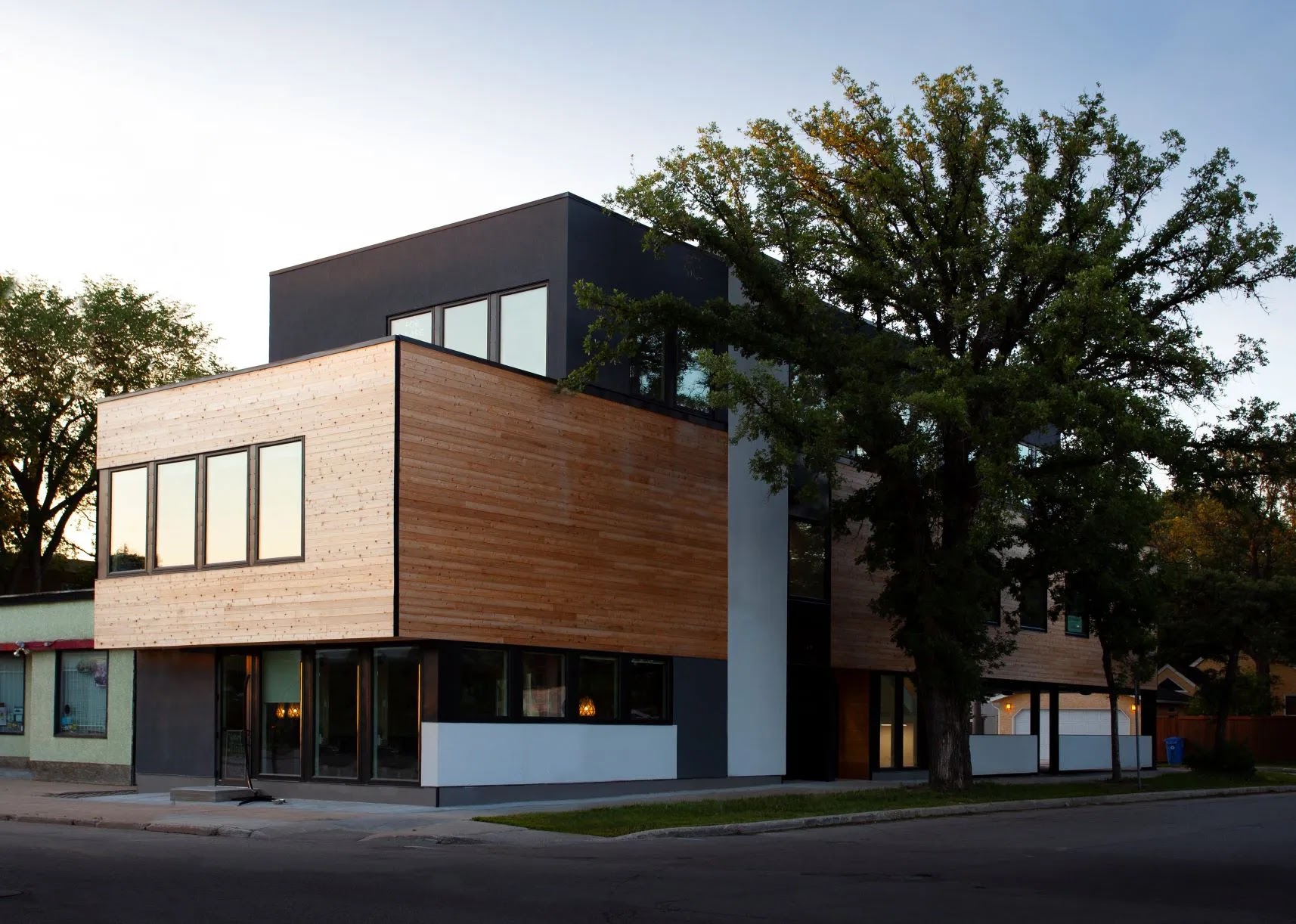
Corydon and Wentworth, just before Crescentwood Community Club, is the last stretch on commercial before angling into River Heights where commercial stretches are spotty at best. One such building at the corner aforementioned was Ralph Cantafio's Custom Tailors was a single floor shop that existed in River Heights since the 1950s. It has been rebuilt as a three floor, four commercial unit building that has no setbacks. It comes right to the curbside and extends to the end of its lot. It is an attractive building.

It is the two buildings next door that are now being redeveloped in much the same way as Cantafio's. The former comic book store and hair salon and a house next door that looks like it was used for offices are going to be demolished. In its place will go up a three storey building with three commercial units facing out to the street and two floors of offices including a rooftop terrace.

Put together with the Cantafio building next door, it is a continuous commercial curb side development. It has a street front profile. Anyone walking down the street has reason to window shop. The difference between Corydon and Osborne Street until recently was that almost no apartments existed directly on Osborne as it went through the Village. Corydon has always had apartments and houses on it and this should remain so.
If Covid has shown us anything it is that neighbourhoods that are all offices or all retail will suffer without people living close by. Neighbourhoods such as Bridgwater which are more mixed use and have transit within them tend to do much better. Corydon is mixed use for blocks but these occasional tweaks will make more a fuller neighbourhood experience.
The economy and growth rate in Manitoba is improving although it is still hard to see it. Population growth is up and GDP growth as well. Productivity is still in need of improvement. However, one of the ways to improve productivity is logistics. Try to ensure the every neighbourhood has what it needs to be sustainable makes it a more productive place to live. Not to mention move livable. No grocery stores or pharmacies means you have to leave to find those things.
The new building seen above features two floors of window facing the street on the second and third floors. The first floor will be the three shops which may include a restaurant. As seen in the pic, the building blends into the corner building. The highlight if the rooftop terrace.
There are still gaps in Corydon which could could use a re-fresh but organic growth means, it is a small piece at a time. Likewise, we are not likely to see a Day of Wine and Roses festival in full throated street party as in the past. Even Osborne has found that it can interfere with business as much as support it. What does work is a consistent organic upgrading. 

The city planner can help by not mandating setbacks from the sidewalk. It is uninviting to shopkeepers and a waste of space in general. There are a few other places along the street getting touchups but nothing so quick as to alarm. However, it is interesting to note that when people who have been away from the city from a year or two come back, they notice the changes. This is markedly different than when the city went through long periods with few changes to areas. In some cases, showing a bit of wear and tear. This is no longer the case for some streets such as Corydon.

Edit: A reader reminded me that the corner in question is Wilton, not Wentworth. She mentioned the shop next to Cantafio's was Sandy's, a candy store. The house in the picture was mentioned as Dr. Schwart's dentist office in the past.

Across the street was the Belgian Bakery and the opposite corner Sal's, Mclean's Tomboy Waugh's Annex General Store. Before it was Sal's it was the Purple Parrot. She recalls a soda shop and a small shop with hardware next door. Today massage therapy clinic and yoga places are on the corner.

Corydon Hardware further down Corydon which is closing is part of a bygone era. The only grocery further down is Foodfare.

Monday, July 1, 2024

25 Station Street - Jubilee Station Apartment

The shovels in the ground are finally happening and the politician invitees were there to do the honours. The southwest transit corridor took some time to build and opened during the pandemic in 2020. It has seen a number of apartment units go up along especially where the former Fort Rouge Yards CN rail site was. This was the goal all along to create density along a former industrial area from the core to the University of Manitoba. It all started back with phase 1 for the blue line. Like all projects in the city, it took 12 years to complete. This is simply too long and if the Transcona phase takes this long, it will be some time in the 2030s when it gets done. Other routes will likely not get done or even started for decades.

A revolution in travel is not likely to have much patience with Winnipeg's timetable. Regardless of what the city plans, they will have to contend with aging infrastructure and construction inflation. Building six lanes of freeways all over the city in not practical or affordable. We have seen many neighbourhoods reject them. Meanwhile bridges like the Arlington Bridge are closed with no solution in place for its replacement or demolition.

In recent days, media has been focusing on the desperate need for housing across Canada and what has led to the shortages and meteoric rise in prices. Extremely low interest rates did nothing for curbing prices. If anything, it led to people buying larger houses, farther away and commuting everywhere. Neighbourhoods were set up to have only detached housing with no retail, commercial offices, duplexes, apartments or anything other than a house with garage facing out to the street. For some this is idyllic until they look to downsize and then they have no choice but to move out of the area they may have lived in for decades. It is possible some people dreamed of moving to a warm retreat and some do. For many though, it might be that they haven't planned for anything other than the house they are in. And that can be a problem as people age.
The reconstruction of the underpass at Jubilee and road work on Pembina and along Jubilee has been painfully long. More than two years of slow work. Even as that was going on the southwest transit corridor was being phased in. By 2020, it was all starting to shape up but the pandemic meant a lot of the housing plans slowed down due to shut downs, supply chin issues, rising interest rates and and slow zoning approval added years to getting anything built.

The Jubilee Station has had open land ready to go for some time so this week, all the politicians came to shovels ceremony for a project by Carrington Real Estate. It is a 16 storey apartment with a 3 storey townhouse right across from the bus terminal. The apartment will have 156 units and the townhouse will have 10.  The federal accelerator program is assisting housing along corridors the city and the Feds wish to see have more housing. The three year program has $122 million to be used for this type of housing. Portage Avenue is also considered for this funding.
Winnipeg really didn't see a boom on Graham when they made it into Winnipeg Transit corridor. There was some nice commercial areas along it but no  support for housing by any level of government and zero interest from the private sector. It took the True North people a multi-year effort to have housing built both north and south of Portage. Only then came some assistance but there are still huge empty gaps of surface parking.

The new apartment building will be the tallest and most significant project in that area along the Fort Rouge CN rail line. It hasn't been without it's critics. Many of those living in the area complain there is too much traffic. They have a point but there have also people who complained that it is obstructed their clear view looking west. That isn't a legitimate complaint about what was industrial land.

It was the right move to build a transit corridor along the rail line. It took far too long and the dogleg through the Parker lands has taken ten years to sort out. The apartments that were planned for it were obstructed and it took a court to tell the city they were wrong. It appears things are back on track and if construction can happen this year, it will go a significant way to reducing the chronic shortage of housing in Winnipeg.

Tomorrow's affordable housing is what goes up now and every year from now. It is about 20 years that brings stable pricing. The country can't take huge breaks in building sustainability. Zoning issues that take ten years are a scourge all over the city. Bylaws on size of house, setbacks, how many parking spaces, how many stairwell often have nothing to do with safety or aesthetics except in the most not in my yard type of view. It can be tough seeing houses being torn down for tall, for or three floor houses. However, we are seeing more and more houses reach 100 years of age. Not all in great shape. Nor are they likely to be built exactly like what was there before.
The new apartments will cost about $1300+ which isn't exactly cheap but does include utilities and WiFi. Geo-Thermal heat and cooling is part of the design. This isn't an insignificant add on. And if the residents don't have a car or only make do with a car co-op, they could see substantial savings. A lot of renters could save a lot of money if they did not have to drive everywhere. But that would mean more work and places to live along safe and active transit routes.

The Station Street development by Carrington is one of a few projects they anticipate doing around stations over the next five years. We surely could use it. They have talked about speed in getting things done as did some of the politicians present. Think there is acknowledgement that development companies specializing in multi-unit places can't be sidelined for year after year. Many companies that built the apartments of Osborne or along Henderson Highway or Portage were cooling their heels for decades because the city seemed only interested in detached housing suburbs. Many of them had not a single multi-unit place even next to them. Contrast that with Seasons of Tuxedo or Bridgwater which have that type of housing built right along with the development.

In 2025 quite a lot of housing will come on stream and more in 2026. It can be difficult because a lot of people believe in housing until it is a suburb going up near them, or an apartment or someone's granny house out back. The city has to be sympathetic to design, traffic and infrastructure needs but when it can't even get anything built on empty land, it is simply a total failure of governance. Let's hope the Station Street apartments are the first of many built to help create capacity, make rent stop its meteoric rise and to create corridors of transportation that have the population to make them convenient and safe.