Sunday, August 18, 2019

Viscount Gort, Polo Park and St. James Bridge History

It seems like the Viscount Gort has been under renovations for years. There is scaffolding surrounding it as the last phase of the most recent work continues.The original hotel was built in 1960 just one year after Polo Park was built as an open air mall and two years before a new span was built alongside the St. James Bridge in 1962.

The picture below is the original St. James Bridge heading north just past the Assiniboine River in 1935. The road is Madison Street. The bridge would be a critical link to the north of the city and the communities of St. James and Assiniboia. Much of the area north would have been rural and rustic. The route north would also lead to the Polo Park Racetrack as well as Stevenson Field, Winnipeg's airport.
The picture below is 1935. The St. James Bridge is visible as is Stevenson Field. World War II is only four years away. By 1941 massive construction would take place in support of the war effort including training and manufacturing. The bridge is visible in the top right corner. The Polo Park Racetrack is seen in the center.

The above picture from 1937 shows the St. James bridge two years after its original construction. In
the background is the residential school that would remain open till early 1970s.

The Polo Park Racetrack in 1949 also included a golf course. However, by the early 1950s developers saw all that land in between Winnipeg and St. James an an opportunity to build one of the earliest malls in Canada. No doubt this was to cash in on all the returning service people from World War II starting work and families.
The sale of the golf courses to the city brought immediate construction of very much needed sports facilities. The Winnipeg Stadium was built in 1953 and the Winnipeg Arena was built in 1955.

Below is a picture of the Winnipeg Stadium's baseball diamond in 1959, home to the original Goldeyes but later teams such as the Winnipeg Whips as well.

It was in 1955 that the Winnipeg Arena was built in Polo Park. Although St. James and Assiniboia were just down Portage Avenue, the feeling was that this was truly out in the sticks.

The Winnipeg Stadium was built in 1953 and expanded in 1966 with north side grandstands. The picture below is 1971 before the east side grand stands got an upper deck in 1972. The younger crowds on the west side would have to wait to get their companion upper deck in 1978 with upgraded press boxes.
The picture above was taken in 1959. one year before the Viscount Gort was built. Note the two way traffic headed to the St. James Bridge at the bottom of picture. Ahead is Hydro building in right corner on St. James across from newly built Polo Park.

St. James Bridge 1935
Polo Park Mall 1959
Viscount Gort 1960
St. James Bridge Second Span 1962

The Viscount Gort was named for Standish Robert Gage Prendergast Vereker, 7th Viscount of Gort (Robert Vereker). Verecker would between 1911 and 1917 acquire land that would later become the hotel and Kiltarton Towers.The building would be designed by Roy M Lev, a Winnipeg architect, who was known for designing the Dakota Hotel. The modern cube design with onsite parking was in keeping with the new car culture sweeping North America,

The land was leased by Robert Vereker (Lord Gort) to the Kives family of Winnipeg. Phil Kives built and owned the hotel itself. If the hotel owner name sounds familiar it is because Kives owned K-Tel which went onto fame as an international television merchandiser. Kives continues to own the hotel and now owns the land as well.

The 1959 picture below is the approach to the old St. James Bridge from Portage Avenue. The Viscount Court is not yet built. The Co-Op Building which later became Government Services and now the Herzing School is on the right.
The picture below is 1959. Polo Park is built, the present Blue Cross building is built but the MTS building has not even begun construction. The Viscount Gort in the background is under construction. The second span of St. James bridge has not begun yet.
The picture below is from 1960. Polo Park is complete as is the Viscount Gort. Winnipeg Supply is directly across the street and took over that location in 1959. It is my impression there was another supply business located there prior. Billboard signs were in an abundance directly across from Polo Park. The Paddock restaurant is visible in the lower part of the picture.
The picture below is from 1962 and you imagine the owners of the Viscount Gort must have been thinking: How is this bridge going to affect us?
The picture below is from the Academy in 1962 just before the St. James Bridge second span's was construction.
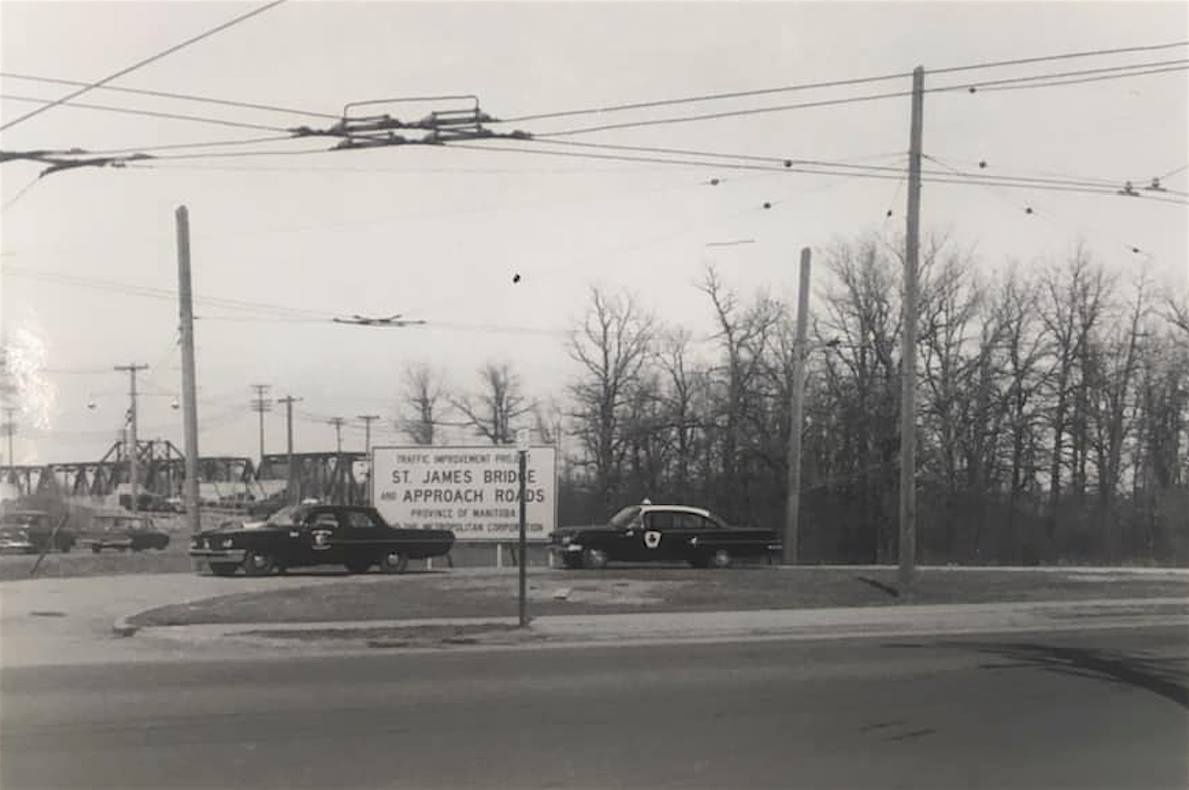
The picture below is Academy Road in 1962 and shows the approach to the old St. James Bridge. Parked by the signing announcing the bridge work is a Winnipeg Police car and a Town of Tuxedo Police car. The trolley bus lines are seen over the road.
The picture below shows the southbound lane from the St. James Bridge in 1962 as it heads toward Academy Road. Note the Viscount Gort in the background on the far left side in the middle.
The picture below from Portage Avenue shows literally how sleepy the original St. James Bridge was in 1962 before the second span was constructed. The Viscount Gort on the left and Co-Op Building is on the right. It would later become Government Service Building for decades and now is the Herzing School
The picture below in 1962 really shows construction on the second span across over the Assiniboine River. It ran between the rail crossing and the 1935 St. James Bridge span.
The picture below in spring of 1962 shows the completed St. James Bridge second span. The Viscount Gort is seen in the middle on the right side. The river is partially iced over in the picture.

The above picture from 1965 shows how the Viscount Gort would literally be encircled by elements of the St. James Bridge. I'm sure there have been times the city has just wanted that land for its own use but they were a year short in making that happen. Polo Park, the Winnipeg Arena and Winnipeg Stadium were attracting development everywhere in the area and the Viscount was pretty much closest to it.

The picture below of construction of Simpsons-Sears in 1958 at Polo Park.
The pictures below shows Polo Park completed in 1959. Still open air at the time in the middle. So it was more like two strip malls with a roof and anchor stores at the end. The Viscount Gort would not come till the following year in 1960. The second span of the St. James Bridge would not come till 1962.
The Dominion grocer was initially on the north side of Polo Park and Eaton's would only come years later. Doiminion and Loblaw's would eventually go head to head and side by side on the east of the mall when the Eaton's expansion happened.
Polo Park complete in 1959 but the MTS building and the Manitoba Heath Commission building were not built yet. They would be more or less complete same year,
The Polo Park sign was a distinctive feature. The mall could have been called anything but to actually adopt the racetrack name was a stroke of genius. From day one till this very day it remains unique in a country that calls everything centre, plaza and place.
In 1959, Polo Park really changed what the future of Winnipeg would look like. At the time it was a suburban mall but now it is more central. The above pictures show how new and expansive it was on the grounds of the old Polo Park Racetrack.
The picture below is inside the open air Polo Park in 1959. Rain kept people under partial roofs.
A picture of Simpsons-Sears below from 1960. Take a look at the VW bug,
This 1960 picture below Empress looks out toward Portage Avenue. 
A picture below of Polo Park in 1962. The Viscount Gort can be seen on lower left. The MTS phone building, built in 1959 can be seen in upper right. The two spans of St. James Bridge are built at this time. The present Blue Cross building, built in 1959, is partially seen in right corner on Empress.
The picture is Polo Park in 1962 with the Winnipeg Arena and Winnipeg Stadium in the background. Note that there is no through street to Polo Park yet on Ness Avenue yet. 
By 1964, as witnessed by the cars in the parking lot above at Polo Park, the trend towards bigger, longer cars that could travel to the suburbs was well established.
The above pictures in 1964, two years after the bridge was built by a partnership of the province and the feds shows how massive the project was. And there in the middle of it is the Viscount Gort.
The picture above from the River Heights and Tuxedo side of the Assiniboine in 1964. Viscount Gort peaking from top left corner. Kenaston seen heading south from Academy Road. The residential school in the middle of the right of the picture was still very much in operation.

For those on Portage Avenue itself, the Viscount Gort was there right at the turn-offs Route 90. A pictures below from 1964 shortly after the overpass was built.
Below picture looking north on Route 90 taken in 1964. Car is headed southbound towards the St. James Bridge. The Viscount Gort sitting in the middle alongside the road on Portage Avenue where the overpass is seen.
The picture below from 1965 is looking south on Route 90 towards the St. James Bridge. The Viscount Gort is on the left.
The Paddock Restaurant with the horseshoe on top was a reminder that Polo Park had indeed been a racetrack. The unique design of the building and the fabulous interior made the Paddock beloved. This picture in 1965 shows the restaurant and the Viscount Gort behind it along Portage Avenue.
Here are a few more gratuitous pictures of cars at Polo Park in 1964.
Looking down Portage Avenue in 1966. MTS building on the right with new Canadian flag and British flag, possibly from a royal visit that year. Polo Park on the right. Esso sign visible from St. James Street. City buses were a orangey red.
The picture below from 1966 shows the Viscount Gort was the place to go for food and entertainment.
By 1967 to 1969 Polo Park was already expanding with Loblaw's and Dominion going up on the east side of the mall and enclosing Polo Park. The two grocers below under construction in 1967.
The picture above in 1967 shows where the Pancake House originally was.

The picture below from 1967 shows the Portage Avenue overpass. The Co-Op building is still around at this time. It will later be taken over by Government Services.
The picture below in 1969 looks north from the Viscount Gort. The overpass fountain, flowers and grass were lovingly taken care of by the city for years. It has been one area of consistent cuts as witnessed by our poor trees all over the city being cut down.
The picture taken from the Kiltartan Towers in 1969 shows the beautifully maintained grounds of the overpass and the long stretch of Route 90 leading to the airport and Red River Community College.
The stairs leading down from the Viscount Gort to the sidewalk in 1969. For many years there were flowers in all the flowerbeds.
The picture below in 1969 shows very much how the area surrounding the St. James Bridge filled up in addition to the Viscount Gort.
The pictures below also from 1969 shows the landscaping that was on the Academy Road side of the St. James Bridge second span. The city really did care for the site for years.
The picture below in 1970 shows the St. James side where the firehall now stands. The Viscount Gort is top left corner. A pond was on this side.
The picture below from 1972 shows the sundial that graced the front of Polo Park.
The picture below taken from MTS building shows what Polo Park looked like in 1974 when Loblaw's and Dominion were going strong in their new location on the east side of the mall. A corridor separated the two stores and price checkers from each retailer would walk the aisles of the other's store on a daily basis.
The picture below from 1974 is Polo Park with the St. James Tower behind it. The apartment with retail on the first floor was built in 1969. It is unlikely any future tower would be allowed the build as high due to restrictions today on building height.
In 1974 Simpsons-Sears had over 600 employees at Polo Park and was packed most days of the week. Their car center and one time marine sales section on the west side was extremely busy. At just under 300,000 square feet, it was a very competitive with the big department stores and had a very good catalogue.
The picture below from 1977 shows the Viscount Gort with the K-Tel logo on it. For a time the Osborne Village in was known as the K-Tel Hotel as it was owned by the Kives family.
The picture below from 1978 when both east and west sides of Winnipeg Stadium have upper decks. The Polo Park area was the top shopping and recreation spot in Manitoba. The Winnipeg Velodrome built for the 1967 Pan Am Games is seen on the right.
By 1978, the infrastructure of what became Route 90 became the major route the airport and later Red River Community College. The picture below is looking north and taken from Portage Avenue overpass.

Another picture above from 1977. I don't think it can be understated how much landscaping and grounds management the city did around the St. James Bridge expansion. There was stairways, ponds, flower gardens on both sides of the bridge that were lovingly maintained. Most of that has been plowed over today.

As the closest hotel to Winnipeg, the Viscount Gort became the hotel that visiting hockey teams would use when playing at the Winnipeg Arena. It would also be the the place where out of town shoppers might stay when shopping at Polo Park across the street.

The late 1970s saw an explosion of malls built right through to late 1980s. Polo Park expanded to two floors in 1986.
The picture below shows what it all looked like in 1987.
In 2012, the Winnipeg Stadium was demolished after the Winnipeg Blue Bombers moved to Investors Group Field at the University of Manitoba. Six years earlier the Winnipeg Arena was torn down as Winnipeg Jets moved downtown to MTS Centre. Sears is visible in this 2012 picture. Little did they know that five years later in 2017, they too would be slated for closure.
The picture above in 2006 shows the last days of the Winnipeg Arena. By 2013 Polo Park the Canad Inns Stadium would join it too was demolished. The stadium and arena were bulldozed. A Target went up on the stadium site in 2015 and lasted less than a year there. It has new life now has a call center and a Marshals but the area still has not reached its full potential after the carnage in the retail industry.
The St. James Bridge is slated for replacement. The timetable is uncertain. Sears remains unoccupied at Polo Park but the shopping center remains the top location in Manitoba. Meanwhile,
the Viscount Gort is going through its third phase of renovations determined to carry on no matter what.
Many of the pictures came from Manitoba Archives, Winnipeg Archives or collections of pictures over the years by universities and newspapers in the city. Many thanks to the archivists and photographers. Any notations, corrections or credits, please let me know.

Tuesday, August 6, 2019

Perkins Madison Polo Park Location Closes

Can anyone be surprised? Another Perkins has closed suddenly on Madison. Last year it was Kenaston and Fermor locations closing. This year it is Henderson and now Madison locations. Three more Perkins remain on Portage, Regent and McPhillips. Can they be the next to go?

Is one IHOP location and a few Pancake Houses crushing Perkins? Is it Skip the Dishes? By the way, Perkins works with Skip but are people just ordering everywhere and not going out?

The parent company Perkins and Marie Callender is in bankruptcy again. They are closing stores. However, keep in mind the last time they had problems, the last Winnipeg owner of Perkins kept things going. She seemed to have the pulse of the city despite whatever woes happened in the U.S.

The new owner is Calgary-based and used to be president of Smitty's. I'm assuming the former Winnipeg owner of all the Perkins in the city much be gobsmacked that the locations here are in such trouble considering that Smitty's continues to be doing okay.

The restaurant business is as tough as they come. For every place that goes on for decades, there are a many who don't make the year. My defunct restaurants of Winnipeg post is the top post this blog has seen with hundreds a week looking it up.

Guess everyone will be keeping an eye out on the remaining locations. Never want to write a place off because we have seen some comebacks in both retail and restaurants. However, losing a prominent location like Polo Park is huge.

Monday, August 5, 2019

Main Street 1920s and 1930s and Goodbye to Bank of Montreal

There wasn't much colour in cars. They were pretty much all black in 1920s. The wide roads made Winnipeg tailor-made for cars. Although that same argument cold be made for mass transit. As clearly shown, streetcars ride up and down very wide Main Street just fine.

This picture taken at the corner of Portage and Main shows angle parking along the street. One street in the downtown has brought back reverse angle back in parking.

Despite the wide roads, it is hard to find parking along Main Street now. Rush hours means clearing all the streets for diamond lanes

Banker's Row doesn't exist anymore. Some buildings have been re-purposed. Other's denied other uses like the Canadian Bank of Commerce when Cowboys from Calgary wanted to turn it into a nightclub. Saviours came to stop it and the building mostly stays locked save for the sometime event.

We have a lot of good people trying to save the past and sometimes it is worth it, especially when we see decades long surface parking lots where the owner cry when they are told they can't use them or have to pave them and put trees in. However, we also deny a true re-purposing that can bring a vitality to the street instead of demolition.

Show an old picture of Winnipeg and have people coo about the good old days. It can easy forget the bad old days of blood on the street from the Strike. Or the Depression which had the city taking over property after property for unpaid taxes. Two world wars took some of our best people. The Spanish Flu and Polio kicked our asses. The Red River Flood reminded us we live in a flood plain.

Still, Winnipeg has survived and grown. Sometimes our growth has been very slow but in recent years it has been steady. We don't lack for head offices but they are spread out like much of everything in the city. Population is spread out as well which increasingly stretches infrastructure and and services.

The Bank of Montreal has indicated they are abandoning their old building at Portage and Main. They have faithfully kept it running and beautiful all this time. However, all of the rest of the banks have moved to the towers on the corner or even further afield.

I don't think we have reply on Cowboys to come to rescue. Nor do we need saviours who will turn it into a locked museum with fewer events than a Bomber season. The building has been in place since 1913 and truly is the last of Banker's Row. But it is orphaned. It is surrounded by a wall, connected to a failing Concourse and damned hard to get to.

The hotel on Portage Avenue East is still planned for 2020 but that doesn't really help Bank of Montreal re-purpose itself. Meeting be called soon to do hear proposals.

I do have one proposal. Move Explore Manitoba and Manitoba Tourism's 8000 square feet of space into the bank building. The Forks space is valuable enough that it could be re-purposed to a restaurant or retail.

Still...orphaned building isolated on an island. Tourism probably doesn't want to move from high profile Forks either. The city has stepped in in the past. The Bank of Hamilton building down the street is an example. But it has more true office space. The Bank of Montreal building is more of a cathedral.

The sad thing is that while people will say it is a beautiful building they are likely to veto any private or public use for it.

Sunday, August 4, 2019

The Forks in Winnipeg

Some people recently asked: John, why are you so angry at The Forks? This is likely in regards to my comments about Portage Place.

The truth is that I love The Forks. I go there often enough for dinners, entertainment, festivals and the like. But that is true for North Portage for me as well. Many a Jazz Fest performance just off Central Park.
Above picture from 1956 when CNR was very much a working railway with operations in the East yards downtown. Note the amount of cars parked on site. Today a good portion of the old yards is still surface parking as noted by the picture below from 2014. The parking lot has actually gotten bigger.
The CN East Yards at the The Forks had its start in 1888 when Winnipeggers began to tire of the powerful Canadian Pacific Railway controlling everything. Eventually, the province went into businesses with Northern Pacific & Manitoba Railway that had a line down to Emerson at the border and a cross line from Morris to Brandon. Railway building were built on empty Hudson's Bay Company lands near Water Street and stretched into what comprises what became the East Yards,

The new railway built the Manitoba Hotel along Main Street that was one of the grandest in the land in 1890.
The above picture is 1897 and the site if where the present Federal Building stands. Alas, the railway was losing money and the posh hotel burned down in 1899. However, the land, buildings and rolling stock were of such value that everything was sold to the Northern Railway which took control and built an extension of the line to Port Arthur (Thunder Bay) with provincial assistance.

By 1918, shorter non-national lines were hard pressed to keep up. The Panama Canal was also to change how things got to the west coast. And World War I took its toll on everyone. Canadian National Railway integrated everything into their nation-wide system and the East Yards became the first of a their expansion into Winnipeg. Fort Rouge Yards, Symington Yards and Tuxedo Yards all followed.

Symington was built in 1962 and this was the beginning of the end for East Yards as it was used after for freight storage and passengers. This was still a considerable amount of business but most investment went into Transcona.

The picture above in 1970s shows an active railyard and it was. However, railways began to reduce how many people were working. Intermodal was just starting to make inroads allowing railways to move cargo and do quick seaport and truck loading which required far few people loading boxcars.

The 1970s was still huge in terms of shipping grain so a lot of traffic headed out in all directions. But when you looked at the downtown as a whole, it looked like a one horse town with the Richardsons sitting at the top at Portage and Main as the picture from 1970 shows below.

Winnipeg's growth was slower than some of our western provincial counterparts but it wasn't completely dead. It was slow and steady and the one horse town became more diversified if not more spread out. That spreading out meant that the Symington Yards in Transcona became more important.

I have written a number of times that 1980 was Winnipeg's worst year economically. The Winnipeg General Strike was a body blow politically and economically in 1919 but the beginning of the 1980s was crushing for Winnipeg has the recession hit very hard and structural changes in the economy had businesses shutting down or moving.

By 1982 The East Yards were shut down and the discussion of what was to come next began. In truth there were fires all over the city, especially in the downtown. Things were deteriorating fast. Thankfully, an activist federal government was amenable to a tri-partite agreement called the Core Area Initiative. From that sprang North Portage Development Corporation and Forks Development Corporation. Picture below is 1984 and then rails are being pulled out of the site.


Since 1994 the Forks has used parkade money to fund its operations and expansion, The sale itself will put an additional $47 million into The Forks. The nearly $75 million already has helped fund massive building in The Forks while keeping free parking till very recently. The additional money will probably go a long way to getting the last surface parking lots developed although my concern is they will hold off as they use money earned from the lot to build up a reserve.

Meanwhile the talk in Portage Place will get a $300 million investment following its purchase. That may be but it only part of the North Portage mandate.

The Forks is likely going to continue to be a success but it seems the future of where it goes once the final surface parking lots are developed will have to be analyzed. Certainly some money could be used for debt payment and maintenance as well as programming. However, one look at the picture above from 2014 shows a lot of surface parking lots. Will they remain so for additional decades?

And what of North Portage? Beyond Portage Place there is Central Park and quite a lot of housing and public housing. What supports there? Is the mandate to support it over? Has it been over for a while?

I love The Forks and the years of it being an industrial yard are gone. We have been very protective its growth since 1989 and most have been pleased with the result. Think there is agreement that they last few areas should be carefully assessed for their fit with that area.

At the same time legitimate questions have to be asked about how the rest of the downtown is faring. The drug crisis make us assess our response to security as well as prosperity. The Forks is not an oasis surrounded by desert. The long term success of it requires the rest of the downtown does not fail.

One of the reasons The Forks has been successful is that we have been slow and methodical about getting it right. I'd hate to see continued hasty moves with deadlines we haven't seen before.

Thursday, August 1, 2019

Boeing Aircraft in Winnipeg

We often get questions from elsewhere such as: What do you do in Winnipeg? It isn't innocent question. It is a loaded one that generally suggests that the person can't figure out how anyone lives in Winnipeg. In other words, what jobs exist there?

Well, the answer is that Winnipeg has a diversified economy. We have needed it to protect us from the vagaries of commodity prices, booms and busts in different business enterprises, a more difficult climate and geographic isolation.

In other words, we sell insurance to the point that a number of our companies are the nation's biggest. Over the decades we have come to dominate bus manufacturing. We have strong positions in ag manufacturing, services, trading. The e-commerce side has taken off. We punch above our weight in TV, film and production. Medical research is quite prominent.

We also build and repair aircraft. We have done it a long time. We're good at it. So much so that one of the biggest and most successful aircraft manufacturers Boeing has one of the biggest plants in North America here in Winnipeg. Not Montreal, not Toronto, not Calgary or Vancouver. Winnipeg.

Boeing is going through a patch right now but rest assured, Winnipeg will be part of its recovery. And they will always have the company of several other big players in the air business here.

So when someone asks what we do in Winnipeg, tell them we do everything here. And that's just the business side. You should ask about our weekends.

Tuesday, July 30, 2019

Hudson's Bay Company Store 1960 Winnipeg

In this picture the Bay Parkade is only 3 storeys. It was built in 1954 to 1955 as two floors only. It proved so popular they added a third floor later in 1955.

In 1959 the Winnipeg Clinic added 6 floors to their medical building next door. It is the taller building in the foreground.

This photo is 1960. It would another four years before the Bay Parkade would have an additional fourth floor added for a 800 car capacity in 1964.

The Bay sold the Parkade in 1987. Estimates are that it takes in between $2 and $3 million a year profit. It is very likely that if HBC continued to own the parking lot that the building and lot would have been sold together for development.

Monday, July 29, 2019

Portage and Main 1967

In 1967 Portage and Main was preparing for the development of Canada's famous corner, For decades its stood as a gas station and parking lot when the Great Depression stalled plans for a building for Manitoba's richest family: The Richardsons.

Following World War II there was growth in all aspects of the economy as soldiers returned from overseas, went to school or entered the workforce and then had families. Downtown Winnipeg remained the center of activity even as the suburbs grew through the 1950s and 60s.

Still, it took a long time for gas station/parking lot to become what we now know as the Richardson Building. The announcement came in 1967 and by 1969 the 34 storey building was complete. It became the first of a number a towers at Portage and Main but retained the tallest title until 1987.

Prior to being built though, it was possible to see billboards from a long distance away. Coca Cola took advantage of that and built a clock billboard that that can be seen in the picture, Another clock/billboard is in the foreground and can be seen by anyone coming down north Main Street.

Billboards of this kind were banned in later decades by City Hall for the downtown area.

Sunday, July 28, 2019

The Fate of Pantages

There are not a lot of Pantages theatres left in North America. They once numbered 75. Ours is in remarkable shape and still being used. The city did own it and with some justification they sold it so that deeper pockets could maintain and possibly expand it. Or so they sold it. This was to have happened in March with a 120 day due diligence taking place.

The city says it hasn't been sold yet and the 120 day period has not yet begun. This is while the building remains empty and unused.

This seems typical for the city. The deal is not really a deal.

Meanwhile, arts groups who would book are now left scrambling.

City Council is in the dark. The asking price was something over $500,000. Have we got developers only interested in demolishing it and putting up a parking lot? Where is the city's due diligence? How about a non-refundable deposit for serious bidders.

It is hard not to be cynical when a working building is shut down with no plan, no comment and no answers.

Monday, July 22, 2019

McIvor Mall Henderson Highway

Is there life for an old mall? The answer is yes. We have seen rejuvenation for Northgate, Grant Park, Charleswood and biggest turnaround Unicity over a number of years. McIvor Mall, built in 1980, had been a less glamorous mall than River East to the south on Henderson.

The mall had a Marketplace Co-op grocer, a restaurant, Blaine's Books and served its local community. Over the years though this has not been enough and a number of businesses have closed and the mall, like the fore mentioned, needed a re-fresh.

Sadly, Blaine's won't be part of it as he will retire after outlasting every other music retailer out there except Sunshine Records.

The most important part of of the rejuvenation of McIvor Mall is that a No Frills store will be an anchor. The Loblaw's franchise are independently owned grocers with supply agreement from the company. In some ways this might be better than what was there before because a local owner might have his finger on the pulse of the neighbourhood a lot better.

A Rexall pharmacy anchors the other side which is good since every community needs a drug store. Inside the mall so far are services, dry cleaner, Pizza Hotline, Subway, a fitness center and some restaurants. It will be the other shops that set up that will that distinguish it as a success or not but a good grocer goes a long way. There will also be a roadside restaurant which could be a keep to the mall's future success.

So many stores have closed lately but some places that have a combination of staples and local attractions will still bring people in.

Prime Review: Jack Ryan

Amazon Prime is going up head to head with Netflix. To do this requires more exclusive material. To that end they acquired TV rights to one of feature films most popular characters over the last few decades who wasn't a superhero. Jack Ryan, the CIA agent from novelist Tom Clancy book series, has been played by some of Hollywood's leading actors including Alec Baldwin, Harrison Ford, Ben Affleck and Chris Prine. Joining that list is John Krasinski who not only had the lead role but server as one of the producers of the show.

Season 1 aired in 2018 and was so successful that a second season and then a third was ordered by Amazon. The first season ran as an origin story for Jack Ryan which we have seen a little bit of in the feature films but with an eight episode arc, the audience gets to see a little more of a how a CIA agent begins dating the woman who will becomes his future wife.

The series differs from the books and movies in that Ryan in the book/movie past had a Soviet profiling job in the CIA whereas in a contemporary setting he is a financial analyst tracking money. His girlfriend Cathy works in infectious diseases rather than as an eye surgeon. Other back stories of some of the characters have changed according to present day threats.

The first season runs eight episodes and show how Jack goes from low level financial analyst to full CIA operative out in the field in pursuit of a terrorist. John Krasinski as Jack Ryan and Abbie Cornish as Cathy Mueller make for compelling characters as they begin to intersect both romantically and professionally.

The action cross crosses the world and the threat remains elusive as to whether it is chemical, biological or something else. All the while, the politics in CIA and elsewhere threaten to put Jack on the shelf.

Second season on Prime is coming soon as 8 episodes went all too fast. Look forward to where they take this version of Jack Ryan in coming seasons.